
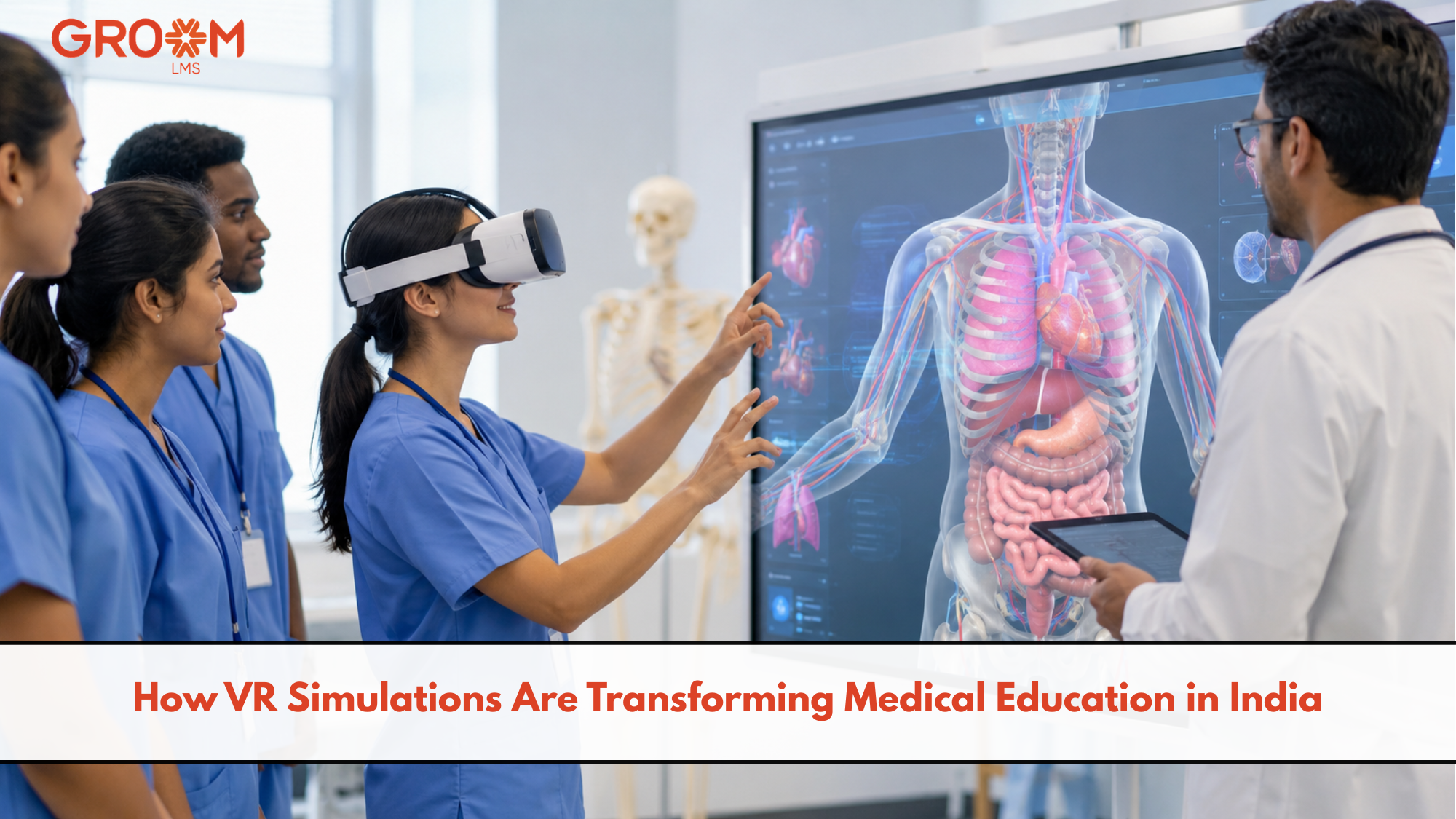
Medical education in India is evolving rapidly. While traditional classroom learning and hospital rotations remain essential, they often struggle to provide enough practical exposure for every learner. Limited access to patients, increasing student numbers, and the need for risk-free clinical practice have created new challenges for healthcare educators.
As a result, VR simulations in medical education are becoming an effective way to bridge the gap between theory and practice. Learners can safely perform procedures, experience emergency situations, and improve decision-making skills without putting patients at risk.
However, implementing immersive learning is only one part of the journey. Healthcare training providers and corporate L&D teams also need a platform that makes course delivery, learner management, assessments, and reporting simple. This is where GroomLMS supports organizations by helping them create, manage, automate, and scale digital learning programs with minimal IT dependency.
Let’s explore how virtual reality is reshaping medical education across India.
Why Traditional Medical Training Needs Innovation
Medical education has always relied on classroom instruction, textbooks, and supervised clinical practice. Although these methods remain valuable, they also present several challenges.
Some common limitations include:
- Limited availability of real clinical cases
- Patient safety concerns during early-stage learning
- High demand for experienced instructors
- Inconsistent practical exposure across institutions
- Difficulty repeating complex procedures multiple times
Consequently, learners may graduate with varying levels of practical confidence.
Healthcare organizations are therefore investing in technology that improves skill development while maintaining safety and consistency.
What Are VR Simulations in Medical Education?
VR simulations in medical education use virtual reality technology to recreate realistic healthcare environments.
Using VR headsets and interactive software, learners can practice medical procedures as if they were working in actual hospitals.
These simulations can include:
- Emergency room scenarios
- Surgical procedures
- Patient diagnosis
- Anatomy exploration
- Critical care management
- Communication with virtual patients
Most importantly, students can repeat scenarios as many times as needed until they gain confidence.
How VR Is Transforming Medical Education in India
Better Clinical Skills Without Patient Risk
One of the biggest advantages of virtual reality is patient safety.
Instead of practicing for the first time on real patients, students can perform procedures in a controlled virtual environment. They can make mistakes, learn from them, and improve without causing harm.
As a result, learners become more confident before entering clinical settings.
Consistent Learning Experiences
Not every medical student gets exposure to the same types of cases during hospital training.
VR simulations solve this problem by providing standardized learning experiences.
Every learner can:
- Handle identical patient cases
- Practice the same procedures
- Receive equal learning opportunities
- Build skills using structured scenarios
This consistency improves overall learning quality.
Improved Decision-Making Skills
Healthcare professionals often work under pressure.
VR simulations recreate realistic situations where learners must:
- Analyze symptoms
- Make quick decisions
- Prioritize treatment
- Manage emergencies
- Communicate with patients and teams
Therefore, learners develop both technical and critical thinking skills.
Why Healthcare Training Providers Are Adopting VR
Healthcare training providers are responsible for preparing professionals who can perform confidently in real clinical environments.
VR offers several advantages for training organizations.
Faster Skill Development
Interactive learning keeps learners actively engaged.
Instead of only reading textbooks, they experience realistic situations that improve retention and practical understanding.
Better Learner Engagement
Immersive learning captures attention more effectively than traditional lectures.
As a result, learners stay focused for longer periods and remember information more easily.
Scalable Training Programs
Healthcare organizations can deliver identical simulations across multiple locations.
Consequently, institutions maintain consistent training quality while expanding their programs.
Challenges of Managing VR-Based Learning
While VR technology offers exciting possibilities, managing training programs can quickly become complicated.
Healthcare organizations often struggle with:
- Manual learner enrollment
- Course scheduling
- Assessment tracking
- Certification management
- Progress reporting
- Multi-location administration
- Continuous IT dependency
Without the right learning management system, scaling immersive learning becomes difficult.
How GroomLMS Simplifies VR-Based Medical Training
Technology becomes truly valuable when it is easy to manage.
GroomLMS helps healthcare training providers and corporate L&D teams deliver VR-enabled learning programs through one centralized platform.
Easy Course Management
Training administrators can:
- Create courses within minutes
- Organize learning paths
- Assign learners automatically
- Update training content independently
This reduces reliance on technical teams.
Automated Assessments and Certifications
Healthcare organizations can automate:
- Online assessments
- Practical evaluations
- Certification issuance
- Learner progress tracking
Therefore, administrative work becomes much more efficient.
Centralized Learning Dashboard
Managers gain complete visibility into training performance through:
- Completion reports
- Assessment analytics
- Learner engagement metrics
- Compliance tracking
- Certification status
This enables faster and more informed decision-making.
Scalable Learning Infrastructure
Whether an organization trains 100 learners or 10,000, GroomLMS supports growth without adding unnecessary complexity.
This makes it suitable for:
- Healthcare training providers
- Corporate healthcare L&D teams
- Medical institutions
- Nursing colleges
- Allied healthcare academies
A Practical Example
Imagine a healthcare training provider launching a new emergency medicine program.
Instead of relying only on classroom sessions, learners complete:
- Interactive theory modules on GroomLMS
- VR-based emergency response simulations
- Online assessments
- Instructor evaluations
- Automated certification
Meanwhile, administrators monitor learner performance through real-time dashboards.
As a result, the entire learning journey becomes structured, measurable, and scalable.
The Future of Medical Education in India
Medical education is moving toward immersive, technology-enabled learning.
Virtual reality will continue to play a larger role because it helps learners gain practical experience before entering clinical environments.
At the same time, institutions will require reliable learning management systems to organize, deliver, and measure these advanced learning experiences efficiently.
Organizations that combine immersive technology with a scalable LMS will be better prepared to develop skilled healthcare professionals while improving operational efficiency.
Conclusion
VR simulations in medical education are redefining how healthcare professionals are trained in India. By creating realistic, hands-on learning experiences in a safe environment, virtual reality helps learners build clinical confidence, improve decision-making, and master complex procedures before treating real patients. As the demand for skilled healthcare professionals continues to grow, immersive learning will play an increasingly important role in delivering high-quality, consistent training.
However, successful VR-based training requires more than advanced technology. Organizations also need a learning management system that simplifies course delivery, learner management, assessments, certifications, and performance tracking. GroomLMS helps healthcare training providers and corporate L&D teams manage these processes efficiently, enabling them to launch, automate, and scale learning programs with ease. By combining immersive learning with a flexible and user-friendly LMS, organizations can prepare a future-ready healthcare workforce while delivering better learning outcomes at scale.
Transform Your Corporate Learning with GroomLMS
Discover how GroomLMS empowers your organization to streamline training, enhance learner engagement, and deliver impactful learning experiences with an AI-powered LMS built for growth.
Request a Demo | Schedule a Consultation | Chat with Our Team
Frequently Asked Questions (FAQs)
What are VR simulations in medical education?
VR simulations in medical education are immersive virtual learning experiences that allow medical students and healthcare professionals to practice clinical procedures safely before working with real patients.
How do VR simulations improve healthcare training?
They improve practical skills, decision-making, learner engagement, and knowledge retention by providing realistic, repeatable clinical scenarios without patient risk.
Can GroomLMS support VR-based medical training programs?
Yes. GroomLMS enables healthcare organizations to manage VR-enabled courses, automate assessments, issue certifications, track learner progress, and scale training programs efficiently.
Why do healthcare training providers need an LMS for VR learning?
An LMS centralizes course management, learner enrollment, reporting, assessments, and certifications, making immersive learning programs easier to administer and scale.
Is VR the future of medical education in India?
VR is becoming an important part of modern medical education because it offers safe, engaging, and standardized practical training. Combined with platforms like GroomLMS, it helps institutions deliver scalable and measurable learning experiences.