
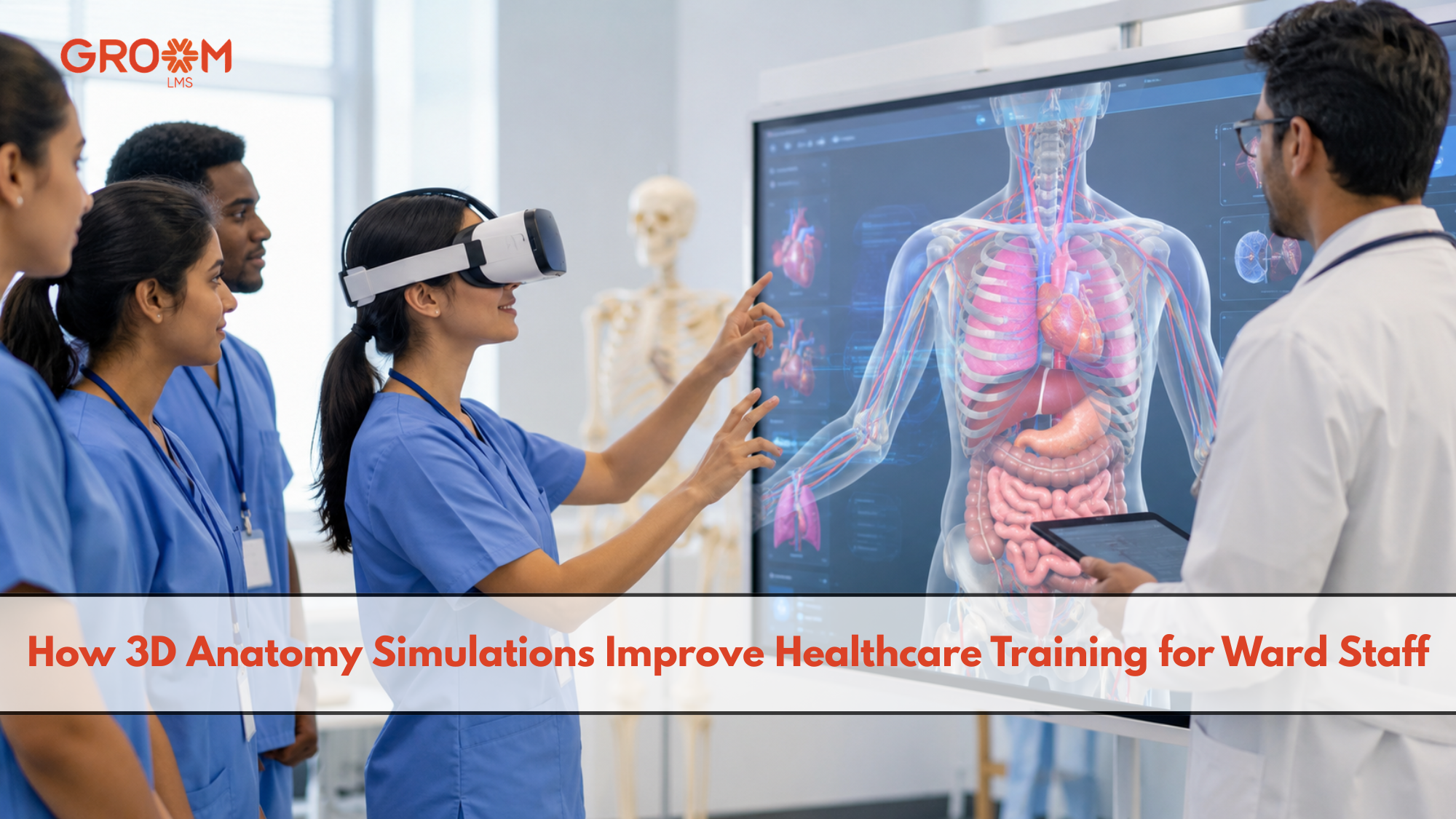
Healthcare organizations face constant pressure to deliver high-quality patient care while ensuring every staff member is trained to the same standard. However, training ward staff can be challenging because hospitals operate around the clock, staff work different shifts, and patient safety cannot be compromised during learning.
Traditional classroom sessions and printed manuals often fail to prepare employees for real-life situations. Moreover, practical demonstrations require time, experienced trainers, and access to equipment that may not always be available. As healthcare facilities expand, these challenges become even greater.
This is where 3D anatomy simulations for healthcare training are changing the way hospitals educate their workforce. Interactive simulations allow ward staff to explore the human body, understand procedures, and practice clinical concepts in a safe digital environment. When combined with GroomLMS, healthcare organizations can launch, manage, and scale these training programmes independently without relying on continuous IT support. As a result, learning becomes more engaging, consistent, and accessible for every employee.
Why Traditional Ward Staff Training Has Its Limitations
Ward staff play an essential role in patient care. They assist nurses, support doctors, handle equipment, monitor patients, and follow strict clinical protocols. Therefore, they need practical knowledge that goes beyond reading documents.
Unfortunately, traditional training methods often create several obstacles.
Common challenges include:
- Limited availability of trainers
- Difficulty scheduling staff across multiple shifts
- Inconsistent training experiences
- Low knowledge retention
- High costs for repeated practical sessions
Furthermore, new employees may struggle to visualise internal anatomy using textbooks alone. Consequently, they may require additional supervision before becoming fully confident in their roles.
Healthcare organizations need a training approach that is scalable, engaging, and easy to manage.
What Are 3D Anatomy Simulations?
3D anatomy simulations are interactive digital learning experiences that allow learners to explore organs, muscles, bones, body systems, and medical procedures from every angle.
Instead of looking at static illustrations, learners can rotate organs, zoom into body structures, observe physiological functions, and interact with realistic clinical scenarios.
These simulations often include:
- Interactive anatomical models
- Procedure walkthroughs
- Clinical case scenarios
- Visual explanations
- Knowledge assessments
Because learners actively participate, they retain information more effectively than through passive learning methods.
A Healthcare Organization’s Training Journey
Imagine a growing healthcare organization onboarding more than 300 ward staff members across multiple hospitals.
Previously, every induction programme required classroom sessions, printed manuals, senior nurses, and repeated demonstrations. Training quality varied between locations, and scheduling sessions delayed employee onboarding.
The organization decided to introduce 3D anatomy simulations through GroomLMS.
The new digital learning programme included:
- Interactive anatomy lessons
- Infection control procedures
- Patient handling demonstrations
- Emergency response scenarios
- Equipment familiarisation
- Digital assessments
- Completion certificates
Since the entire programme was hosted online, staff completed modules whenever their shifts allowed. Managers could also monitor learner progress from one dashboard, making administration significantly easier.
How 3D Simulations Improve Learning Outcomes
Better Visual Understanding
Healthcare professionals often learn complex concepts more quickly when they can see them in action.
For example, instead of memorising the respiratory system from diagrams, learners can observe how the lungs expand, how oxygen travels through the body, and how diseases affect normal function.
This visual approach simplifies difficult topics and improves comprehension.
Safe Learning Environment
Mistakes during patient care can have serious consequences.
Fortunately, simulations allow learners to practise repeatedly without placing patients at risk.
Ward staff can confidently explore procedures before performing them in real clinical settings.
Higher Engagement
Many healthcare workers find long presentations difficult to follow after demanding shifts.
Interactive simulations encourage active participation through exploration, quizzes, and scenario-based learning. Consequently, learners remain focused for longer periods.
Improved Knowledge Retention
People generally remember information better when they interact with it.
Because simulations combine visuals, movement, practical application, and assessments, employees retain knowledge for longer and require fewer refresher sessions.
How GroomLMS Makes Healthcare Training Easier
Even the best learning content needs an efficient platform to manage delivery.
GroomLMS helps healthcare organizations simplify every stage of employee training while giving Learning and Development teams complete control.
With GroomLMS, organizations can:
- Create learning programmes within minutes
- Upload simulation-based learning content
- Assign courses to different departments
- Automate learner enrolment
- Schedule assessments
- Issue certificates automatically
- Monitor learner progress through dashboards
- Generate reports for compliance and audits
Most importantly, administrators can manage the entire platform independently without needing continuous technical assistance.
Supporting Continuous Learning Across Multiple Locations
Modern healthcare providers often operate across several hospitals, clinics, or healthcare centres.
Without a central learning system, maintaining consistent training standards becomes extremely difficult.
GroomLMS enables organizations to standardise training across every location.
Whether a learner joins from a city hospital or a rural healthcare centre, everyone receives the same high-quality learning experience.
Additionally, updates to medical protocols can be published instantly, ensuring every employee accesses the latest information.
Training Beyond Anatomy
Although anatomy simulations provide an excellent foundation, healthcare organizations can build complete learning journeys using GroomLMS.
Training programmes may include:
Clinical Skills
Employees learn patient handling, infection prevention, wound care, and equipment operation through interactive modules.
Compliance Training
Hospitals can deliver mandatory courses covering patient privacy, workplace safety, emergency procedures, and regulatory requirements.
Soft Skills
Ward staff also benefit from communication training, teamwork exercises, empathy development, and patient interaction scenarios.
Continuous Professional Development
Healthcare professionals can regularly complete refresher courses, earn certifications, and stay updated with changing medical practices.
This creates a culture of continuous learning instead of one-time onboarding.
Why Learning Automation Matters
Healthcare administrators already manage numerous operational responsibilities.
Manual training administration only adds to their workload.
Automation reduces repetitive tasks while improving accuracy.
With GroomLMS, organizations can automatically:
- Enrol new employees
- Send learning reminders
- Schedule recurring compliance training
- Generate certificates
- Track course completion
- Produce training reports
As a result, Learning and Development teams spend less time managing spreadsheets and more time improving learning experiences.
Measuring Training Success
Healthcare organizations need evidence that training programmes deliver measurable value.
GroomLMS provides detailed analytics that help administrators understand learner performance.
Important metrics include:
- Course completion rates
- Assessment scores
- Time spent learning
- Certification status
- Department-wise progress
- Compliance reports
These insights allow organizations to identify knowledge gaps quickly and improve future training programmes.
Best Practices for Implementing 3D Anatomy Simulations
Organizations planning to introduce simulation-based healthcare learning should follow a structured approach.
First, identify the learning needs of different employee groups. Ward staff, nurses, technicians, and administrators all require different content.
Next, combine simulations with assessments to reinforce learning.
After that, automate enrolment and certification using GroomLMS to minimise manual administration.
Finally, review learner analytics regularly and update content whenever clinical guidelines change.
Following these steps helps organizations build a sustainable and scalable digital learning strategy.
The Future of Healthcare Learning
Healthcare education continues to evolve as digital technologies become more advanced.
Interactive simulations, virtual learning environments, AI-powered recommendations, and mobile learning are making training more flexible than ever before.
Healthcare organizations that adopt modern learning technologies today will be better prepared to onboard new employees, maintain compliance, and improve patient care tomorrow.
By combining immersive 3D anatomy simulations with an easy-to-manage learning platform like GroomLMS, organizations can deliver engaging training experiences while reducing administrative complexity.
Conclusion
Training ward staff requires more than classroom presentations and printed manuals. Healthcare organizations need learning experiences that are engaging, consistent, and easy to scale across departments and locations. 3D anatomy simulations for healthcare training provide an effective way to help employees understand complex medical concepts, practise safely, and build confidence before working with patients.
When paired with GroomLMS, these simulations become even more powerful. Organizations can create learning programmes quickly, automate training workflows, monitor learner progress, and manage everything independently without ongoing technical support. This allows Learning and Development teams to focus on improving employee skills rather than managing complicated systems. As healthcare continues to embrace digital transformation, combining immersive learning with GroomLMS can help organizations deliver better training, support staff development, and ultimately contribute to improved patient care.
CTA – Request a Demo
Explore GroomLMS Today
Whether you’re training employees, partners, or customers, GroomLMS helps you deliver learning that drives results.
Request a demo, sign up to experience the platform, or contact us to find the right solution for your organization.
Frequently Asked Questions (FAQs)
What is a healthcare Learning Management System?
A healthcare Learning Management System is a platform that helps hospitals and healthcare organizations deliver, manage, track, and automate employee training, compliance programmes, certifications, and continuous professional development.
How do 3D anatomy simulations improve healthcare training?
3D anatomy simulations improve understanding by allowing learners to explore realistic human anatomy, practise procedures safely, and engage with interactive clinical scenarios that increase knowledge retention.
Can GroomLMS support healthcare compliance training?
Yes. GroomLMS enables organizations to deliver mandatory compliance courses, automate assessments, issue certificates, track completion, and generate reports for audits and regulatory requirements.
Why is training automation important for healthcare organizations?
Training automation saves time by automatically enrolling learners, sending reminders, managing certifications, tracking progress, and reducing administrative work for Learning and Development teams.
Is GroomLMS suitable for multi-location healthcare organizations?
Yes. GroomLMS allows healthcare providers to deliver consistent training across multiple hospitals, clinics, and healthcare facilities while providing centralized management, learner analytics, and scalable digital learning solutions.