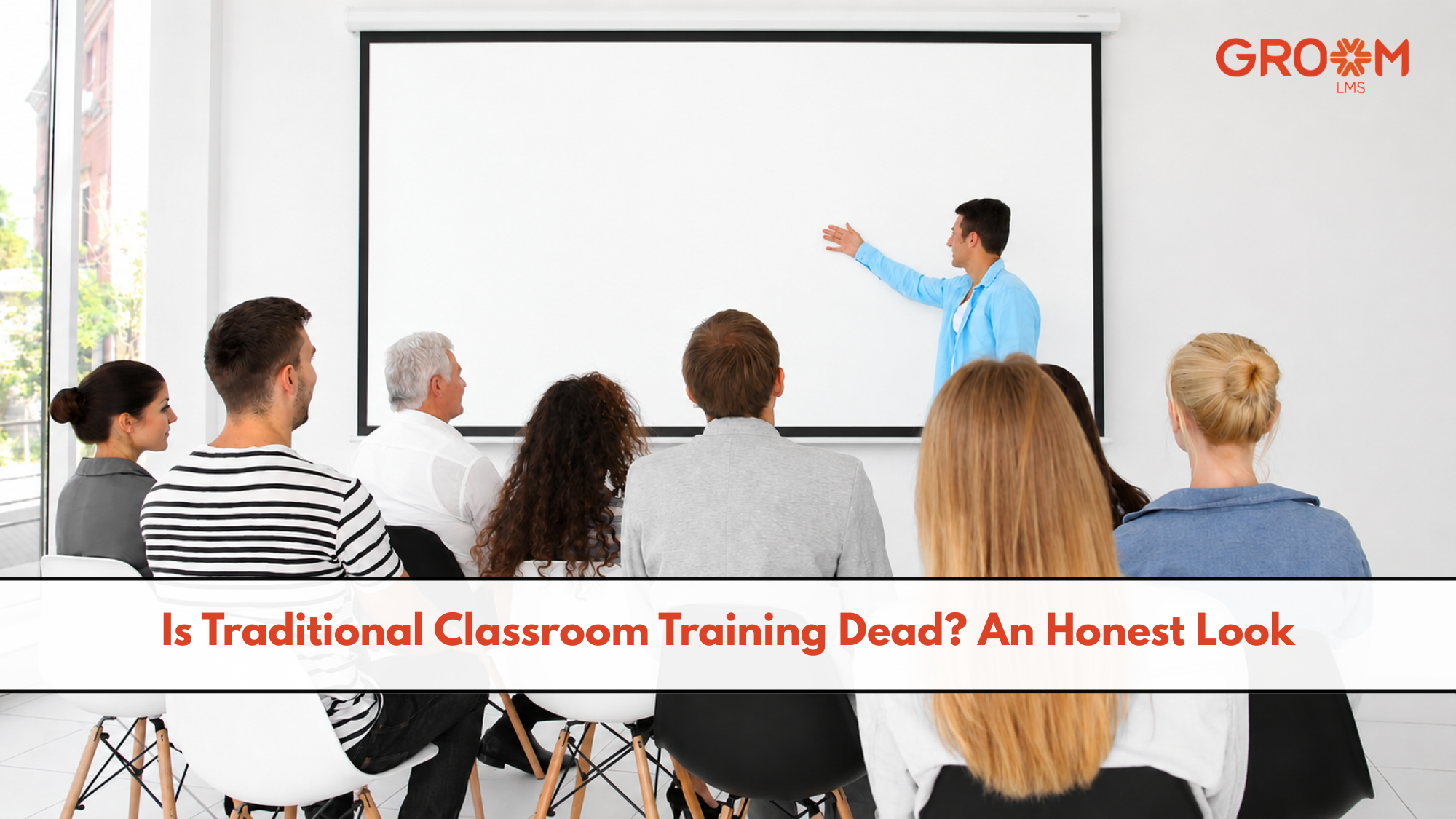
For decades, traditional classroom training was the standard approach to employee learning. Teams gathered in meeting rooms, trainers delivered presentations, and employees completed scheduled sessions together. While this model worked well in the past, today’s business environment demands greater flexibility, speed, and scalability.
Corporate organisations now operate across multiple locations, hybrid workplaces, and different time zones. As a result, L&D and HR teams face increasing pressure to deliver consistent learning experiences without relying on complicated systems or continuous IT support.
Does this mean traditional classroom training is completely dead? Not quite.
Instead, organisations are discovering that classroom learning alone is no longer enough. They need digital solutions that complement or replace traditional methods where appropriate. GroomLMS helps organisations build, manage, automate, and scale training programmes independently within minutes, making workplace learning more accessible, measurable, and efficient.
Let’s take an honest look at where classroom training still works and where modern learning platforms have changed the game.
Why traditional classroom training became the standard
Traditional learning offered several advantages for organisations.
Face-to-face interaction
Employees could ask questions immediately and receive instant clarification from instructors.
Collaborative learning
Group discussions, workshops, and role-playing exercises encouraged teamwork and knowledge sharing.
Structured schedules
Everyone completed the same training at the same time, ensuring consistent delivery.
For many years, these strengths made classroom learning the preferred choice for employee development.
However, today’s business needs have evolved significantly.
The biggest challenges organisations face today
Corporate learning has become far more complex than simply organising a training room.
Limited scalability
As organisations grow, arranging classroom sessions for hundreds or thousands of employees becomes increasingly difficult.
Challenges include:
- Booking venues
- Coordinating trainer availability
- Managing employee schedules
- Handling travel expenses
- Repeating the same sessions multiple times
Consequently, costs increase while efficiency decreases.
Hybrid and remote workforces
Many employees now work remotely or across different office locations.
Traditional classroom sessions often exclude:
- Remote employees
- International teams
- Shift workers
- Field staff
Therefore, organisations struggle to provide equal learning opportunities.
Inconsistent learning experiences
Different trainers may explain the same topic differently.
As a result:
- Learning quality varies
- Important information may be missed
- Compliance becomes harder to maintain
Consistency matters, especially for corporate policies, compliance training, and onboarding.
Difficult progress tracking
After a classroom session, HR teams often rely on attendance sheets and feedback forms.
Unfortunately, these methods rarely answer important questions.
For example:
- Did employees understand the material?
- Who completed the assessment?
- Which topics need reinforcement?
- How effective was the training?
Without reliable data, improving learning becomes difficult.
Is classroom training really dead?
The short answer is no.
Traditional classroom training still has value, especially for:
- Leadership workshops
- Team-building activities
- Hands-on practical demonstrations
- Interactive brainstorming sessions
However, relying only on classroom learning is becoming less practical.
Modern organisations need learning that is:
- Available anytime
- Accessible from anywhere
- Easy to update
- Simple to measure
- Cost-effective to scale
Instead of replacing classroom learning entirely, many organisations now combine both approaches through blended learning.
Why digital learning continues to grow
Digital learning addresses many limitations of traditional training while creating better experiences for both employees and administrators.
Greater flexibility
Employees can learn:
- At their own pace
- During convenient hours
- From any location
- On multiple devices
This flexibility improves both participation and knowledge retention.
Faster training deployment
Instead of organising multiple classroom sessions, L&D teams can launch courses across the organisation within minutes.
New policies, compliance updates, or product training become available instantly.
Consistent learning delivery
Every employee receives the same content, assessments, and learning materials.
This consistency improves quality while reducing training gaps.
Better reporting
Learning analytics provide valuable insights, including:
- Course completion rates
- Assessment scores
- Learner engagement
- Progress tracking
- Certification status
These reports help HR and L&D teams make informed decisions.
How GroomLMS supports modern corporate learning
As learning expectations evolve, organisations need solutions that simplify every stage of training management.
GroomLMS is designed to help corporate organisations, HR professionals, and L&D teams create engaging learning experiences without depending on complex technical support.
Simple course management
Training administrators can:
- Create learning programmes
- Upload digital content
- Assign learners
- Schedule courses
- Manage certifications
The platform makes everyday learning administration straightforward.
Scalable learning
Whether training 50 employees or 5,000, organisations can expand learning programmes without significantly increasing administrative effort.
This scalability supports long-term business growth.
Learning automation
Routine tasks can be automated, including:
- Course enrolment
- Notifications
- Assessments
- Certificates
- Progress reminders
Automation reduces manual work while improving learner engagement.
Data-driven decision making
Comprehensive dashboards help organisations understand learning performance through real-time reports and analytics.
Instead of guessing training effectiveness, decision-makers gain measurable insights.
Independent platform management
Unlike many traditional systems, GroomLMS enables organisations to create and manage learning programmes independently, reducing reliance on continuous IT support.
This gives HR and L&D teams greater control over employee development.
A practical example
Imagine a growing organisation with offices in Delhi, Bengaluru, Mumbai, and Hyderabad.
Previously, every compliance update required:
- Booking trainers
- Reserving meeting rooms
- Coordinating employee schedules
- Printing materials
- Collecting attendance records
The process often took several weeks.
With GroomLMS, the same organisation uploads the updated course once.
Employees receive notifications automatically.
They complete the training online, take assessments, and earn certificates.
Meanwhile, HR managers monitor progress from a single dashboard.
The entire process becomes faster, more consistent, and easier to manage.
Choosing the right training approach
Every organisation has unique learning needs.
Instead of asking whether classroom training is dead, consider which approach best supports your workforce.
Many successful organisations combine multiple learning methods.
A balanced strategy may include:
- Classroom workshops for collaboration
- Online compliance training
- Self-paced learning modules
- Virtual instructor-led sessions
- Continuous learning through an LMS
This blended approach provides flexibility while maintaining meaningful employee engagement.
Conclusion
Traditional classroom training is not disappearing, but it is no longer sufficient on its own. Today’s organisations require learning systems that adapt to changing work environments, growing teams, and evolving business priorities.
Digital learning offers greater flexibility, improved consistency, better reporting, and significantly easier management. Moreover, it enables HR and L&D teams to deliver learning experiences that support employee growth without unnecessary administrative complexity.
Rather than replacing human interaction, modern LMS platforms enhance it by handling routine processes, improving accessibility, and providing valuable insights into learning outcomes.
GroomLMS helps organisations create, manage, automate, and scale employee training with confidence. Whether you are modernising onboarding, delivering compliance programmes, or building continuous learning initiatives, the platform makes training simpler, faster, and more effective for today’s workforce.
CTA – Request a Demo
Transform Your Corporate Learning with GroomLMS
Discover how GroomLMS empowers your organization to streamline training, enhance learner engagement, and deliver impactful learning experiences with an AI-powered LMS built for growth.
Request a Personalized Demo | Schedule a Consultation | Chat with Our Team on WhatsApp
Frequently Asked Questions (FAQs)
What is traditional classroom training?
Traditional classroom training is an instructor-led learning method where employees attend scheduled sessions in a physical location to receive training together.
Can an LMS completely replace classroom training?
Not always. Many organisations achieve better results by combining classroom sessions with online learning through a blended learning approach.
How does GroomLMS simplify employee training?
GroomLMS allows organisations to create, manage, automate, and monitor training programmes independently while reducing reliance on continuous IT support.
Why are organisations moving towards online learning platforms?
Online learning platforms provide greater flexibility, consistent content delivery, automated administration, detailed analytics, and easier scalability for growing organisations.
Which businesses benefit most from GroomLMS?
GroomLMS is well suited for corporate organisations, HR departments, L&D teams, growing enterprises, and businesses that want to simplify and scale employee learning efficiently.