
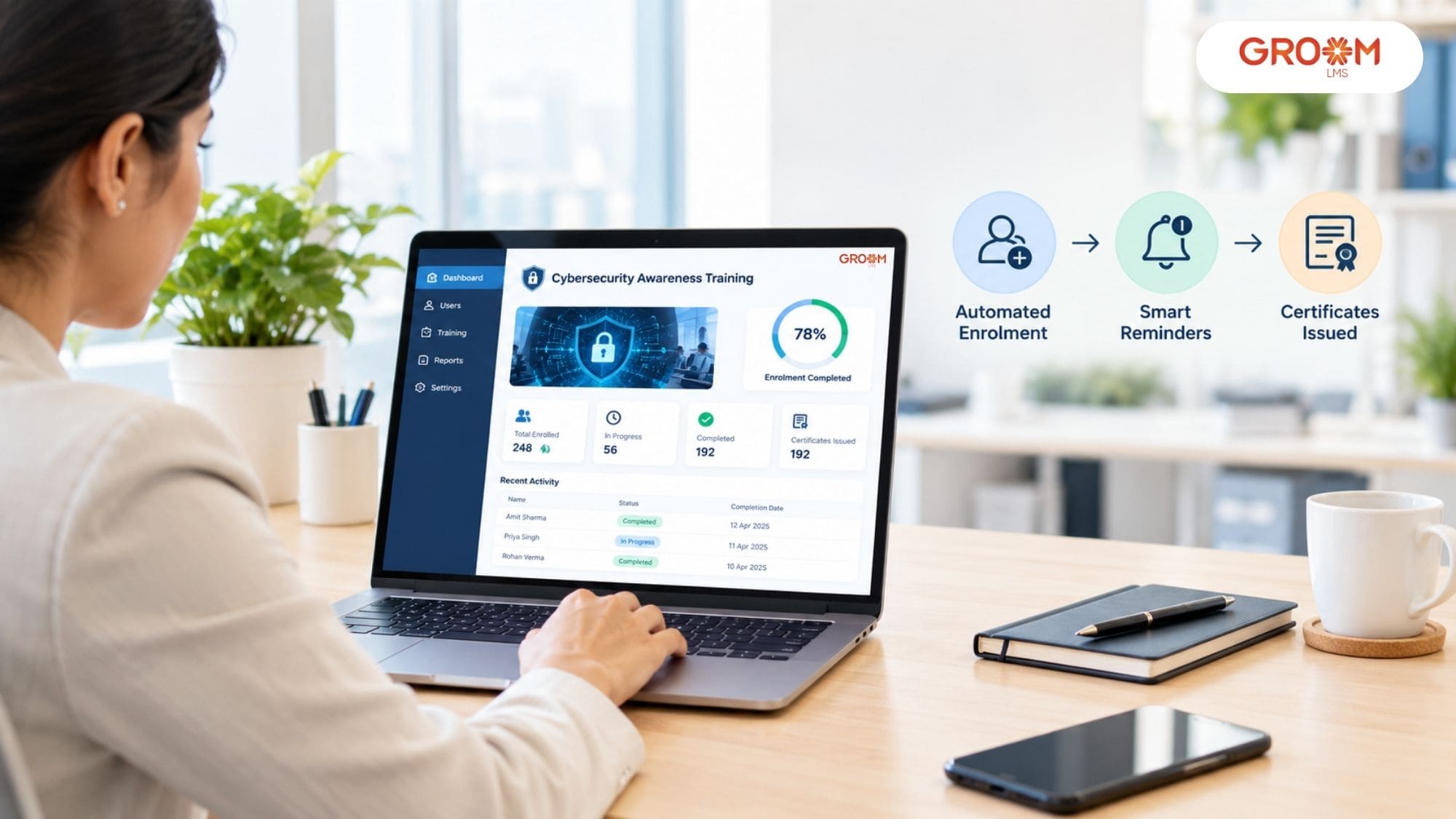
Cyber awareness training often starts with a simple plan: assign the course, ask employees to complete it, and record the results. Yet HR and IT teams can quickly find themselves sending repeated reminders, checking spreadsheets, following up with managers, and collecting certificates manually.
The problem becomes more difficult when employees work across departments, offices, or shifts. Some may not start their assigned modules, while others complete the training without updating the records the organisation needs. As a result, teams spend valuable time managing administration instead of improving security awareness.
Cyber Jagrookta Awareness Training is more effective when organisations have a clear process for assigning learning, monitoring completion, and following up with employees. A learning management system (LMS) can help bring these activities into one structured workflow.
GroomLMS offers learning management capabilities that organisations can evaluate for organising courses, managing assessments, tracking learner progress, and supporting training administration. With the right setup, teams can reduce repetitive work while keeping employees informed about their responsibilities.
The goal is not simply to automate reminders. It is to make cyber awareness training easier to administer, easier to complete, and easier to monitor.
Why Cyber Jagrookta Awareness Training Becomes Difficult to Manage
Cyber awareness programmes require coordination between the people delivering training and the employees expected to complete it. When each step relies on manual follow-ups, even a straightforward programme can become time-consuming.
Common challenges include:
- Manual enrolment: Training coordinators add employees to courses individually or maintain separate assignment lists.
- Repeated reminders: HR or IT teams spend time contacting employees who have not started or completed training.
- Scattered completion records: Course results, attendance details, and certificates may sit in different files or systems.
- Limited visibility: Managers cannot quickly identify which teams have outstanding training.
- Inconsistent follow-up: Some employees receive several reminders, while others may be missed.
- Difficult reporting: Preparing a summary for management requires collecting and checking information from multiple sources.
These problems can affect the consistency of Cyber Jagrookta Awareness Training. They also make it harder to identify where employees need support.
For example, imagine a company assigning cyber awareness training to employees across five departments. If the coordinator tracks progress in a spreadsheet, every new enrolment, completion, and reminder may require a manual update.
A structured LMS workflow can reduce this administrative burden by centralising course assignments and making available progress information easier to review.
How Automation Improves Cyber Jagrookta Awareness Training
Automation helps organisations reduce repetitive tasks by using predefined workflows. Instead of manually coordinating every activity, training teams configure a process that supports enrolment, communication, completion tracking, and reporting.
The exact automation options depend on the selected LMS and its configuration. Organisations should confirm which capabilities are available before designing their workflow.
1. Simplify Employee Enrolment
The first step is ensuring that the right employees receive the right training. A consistent enrolment process reduces the risk of missed assignments and duplicate entries.
Training administrators can organise employees by relevant groups, such as departments, locations, or job responsibilities, where the platform supports these options. They can then assign the appropriate cyber awareness course to each group.
For instance, new employees could receive introductory security awareness training during onboarding, while existing staff could be assigned a refresher module according to the organisation’s training schedule.
A central enrolment process makes assignments easier to manage and gives administrators a clearer starting point for tracking completion.
2. Automate Training Reminders
Repeatedly contacting employees is one of the most frustrating parts of training administration. Automated reminders can help reduce this work when the LMS supports scheduled notifications or rule-based communication.
A practical reminder workflow might include:
- An initial notification explaining the course and deadline.
- A reminder before the deadline for employees with incomplete training.
- A follow-up after the deadline, according to internal policy.
- Escalation to the appropriate manager when additional action is required.
The wording should remain clear and professional. Employees need to know what training is assigned, why it matters, and when they must complete it.
Avoid sending unnecessary messages to employees who have already finished. Where supported, configure reminders to reflect current completion status and test the workflow before launching it organisation-wide.
3. Track Progress Without Rebuilding Spreadsheets
A central dashboard or report can help administrators review available training data without repeatedly combining information from different files.
Depending on the platform, progress reports may show assigned courses, started modules, completed training, assessment results, and outstanding activities.
This visibility helps teams decide where to focus their follow-up. If one department has a higher number of incomplete assignments, the coordinator can investigate whether employees need additional time, clearer instructions, or technical assistance.
Progress tracking should support constructive follow-up, not simply measure participation. Teams should interpret the data in context and distinguish between incomplete training and genuine technical barriers.
Make Cyber Jagrookta Awareness Training Easier with Digital Certificates
Certificates can provide a useful record that an employee completed an assigned course. However, manually preparing and distributing them creates another task for training administrators.
An LMS may support certificate generation after learners meet defined completion requirements. Where available, this can reduce repetitive administrative work and make completion records easier to retrieve.
Before enabling certificates, define what qualifies as completion. For example, an organisation may require employees to finish all lessons and achieve a specified assessment result. The criteria should be communicated clearly before training begins.
Certificates should also be treated as evidence of the defined learning activity, not proof that an employee can avoid every cyber threat. Awareness needs reinforcement through practical guidance, regular communication, and workplace security procedures.
For Cyber Jagrookta Awareness Training, a well-designed certificate process can help teams document participation while keeping the learner experience straightforward.
What Should an Automated Cyber Awareness Workflow Include?
A useful workflow connects enrolment, communication, learning, completion, and reporting. Automating isolated tasks may help, but a coordinated process is easier to maintain.
Consider this example for a company introducing a cyber awareness refresher programme.
- Identify the learner group. Confirm which employees need training and who is responsible for maintaining the employee list.
- Assign the course. Enrol the relevant employees and communicate the learning objectives, deadline, and completion requirements.
- Send reminders. Configure available notifications to prompt employees who have not completed their assigned training.
- Record completion. Use the platform’s available tracking features to monitor progress and assessment results.
- Issue certificates where appropriate. Generate completion certificates for learners who meet the defined requirements, if the platform supports this function.
- Review the results. Check completion reports, identify outstanding assignments, and plan any necessary follow-up.
This workflow gives each stage a clear purpose. It also helps administrators identify where a process needs adjustment.
For example, if employees regularly miss the deadline, the issue may not be the reminder schedule alone. The course might be too difficult to access, the deadline may be unclear, or employees may need protected time to complete training.
Automation works best when the underlying process is well designed. Review the workflow periodically and update it as the organisation’s training needs change.
How to Choose an LMS for Cyber Jagrookta Awareness Training
Not every learning management system provides the same automation or reporting options. HR, IT, and training teams should evaluate platforms against their operational needs before committing to a workflow.
Look for these capabilities:
- Course assignment: Can administrators enrol the intended employees efficiently?
- Reminder options: Does the platform support the notifications and schedules your process requires?
- Completion tracking: Can authorised staff identify completed and pending training?
- Assessment management: Can employees demonstrate their understanding through relevant knowledge checks?
- Certificate management: Can the system issue and retrieve certificates according to your requirements?
- Reporting: Can teams review and export the information they need?
- Access controls: Can employee training records be accessed only by authorised users?
- Ease of administration: Can training coordinators manage routine tasks without constant technical support?
Ask for a demonstration using a realistic scenario. Assign a sample course, complete it as a learner, trigger a reminder if available, and review the resulting records.
Also consider how the platform will support future requirements. Your organisation may add employees, introduce new courses, or expand training across multiple locations. A system should remain manageable as those needs grow.
Cyber awareness training should also reflect credible security guidance. The Indian Computer Emergency Response Team (CERT-In) provides cybersecurity advisories and resources that organisations can consult when reviewing relevant awareness topics. Use appropriate, verified guidance when developing training content, and ensure that internal security policies remain consistent with the lessons employees receive.
How GroomLMS Can Support Cyber Awareness Training Administration
GroomLMS provides learning management capabilities that organisations can assess when building a more organised employee training process. Its features can help teams structure learning programmes and manage activities according to their requirements.
For Cyber Jagrookta Awareness Training, organisations should evaluate how the platform’s course management, assessments, progress tracking, reporting, and certificate capabilities fit their existing workflow. Confirm the specific automation options available for enrolment and reminders before implementation.
A central learning environment can help training coordinators manage course materials and review learner progress. It can also make it easier to identify incomplete assignments and plan follow-up activities using available reports.
GroomLMS allows organisations to create an instance online and adjust subscriptions as their needs change. This flexibility may be useful for teams that want to organise training without depending on continuous technical assistance.
Explore the GroomLMS features to evaluate its capabilities against your training requirements.
Before launching the programme, test the complete process with a small employee group. Verify enrolment, notifications, course completion, certificate handling, and reporting. This practical check helps identify gaps before the workflow is introduced more widely.
Conclusion
Cyber Jagrookta Awareness Training should help employees recognise cyber risks and practise safer online behaviour. Yet manual enrolment, repeated reminders, scattered records, and certificate administration can place unnecessary pressure on HR, IT, and corporate training teams.
A structured LMS workflow can help reduce this burden. By connecting course assignments, reminders, progress tracking, assessments, and completion records, organisations can manage training more consistently.
However, automation alone is not enough. Teams should establish clear completion requirements, provide relevant learning content, protect employee information, and review training results regularly. They should also verify that their chosen platform supports the automation and reporting functions they actually need.
GroomLMS offers learning management capabilities that organisations can evaluate when planning and managing employee awareness programmes. A carefully configured system can help teams organise training activities, monitor progress, and reduce repetitive administrative work.
Start by reviewing your current process. Identify which tasks consume the most time, test a practical workflow, and improve it using feedback from learners and administrators. With clear procedures and suitable technology, your organisation can make cyber awareness training easier to manage and more consistent to deliver.
Simplify Cyber Training Administration with GroomLMS
Discover how GroomLMS empowers your organization to streamline training, enhance learner engagement, and deliver impactful learning experiences with an AI-powered LMS built for growth.
Contact Us | Join GroomLMS | Chat on WhatsApp
Frequently Asked Questions (FAQs)
What is Cyber Jagrookta Awareness Training?
Cyber Jagrookta Awareness Training educates employees about cyber threats, safe online practices, phishing prevention, password security, and responsible handling of organisational data.
How can an LMS improve employee cyber awareness training?
An LMS automates course delivery, learner enrolment, assessments, certifications, reminders, and reporting, making cyber awareness programmes easier to manage and scale.
Why should organisations provide regular cyber awareness training?
Regular training keeps employees informed about evolving cyber threats, reduces security risks, supports compliance, and strengthens the organisation’s overall cyber security posture.
Can GroomLMS automate cyber awareness training?
Yes. GroomLMS allows organisations to automate course enrolment, assessments, reminders, certifications, progress tracking, and reporting, helping teams manage training efficiently.
Which industries benefit from Cyber Jagrookta Awareness Training?
Cyber awareness training benefits organisations across industries, including IT, banking, healthcare, education, manufacturing, retail, government, and professional services, where protecting sensitive information is essential.