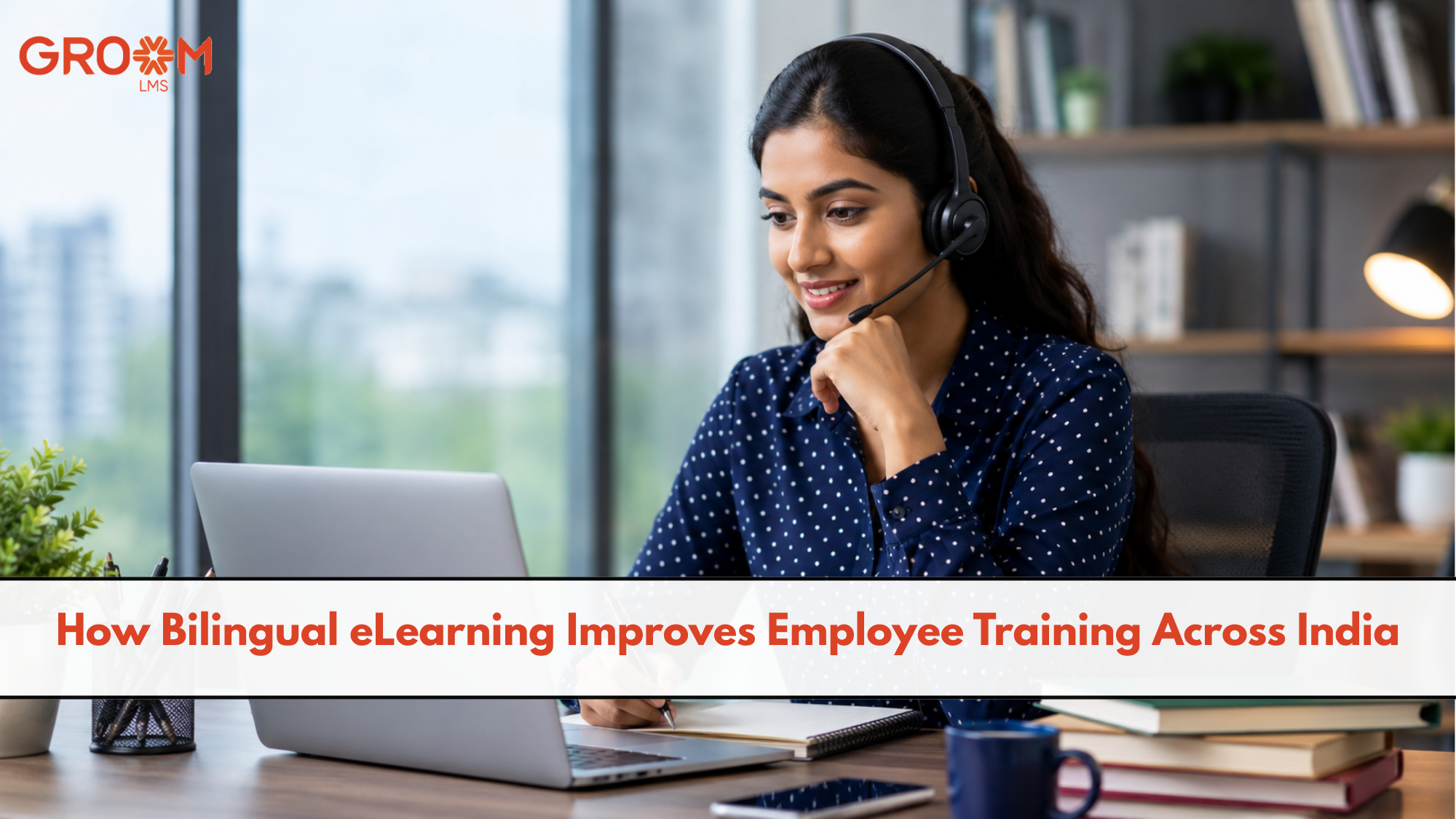
As businesses expand across multiple states in India, employee training has become more challenging than ever. Organisations often have teams that speak different regional languages, making it difficult to deliver consistent learning experiences. While English remains the language of business for many organisations, not every employee feels equally comfortable learning in it.
This language gap can reduce learner engagement, slow knowledge retention, and affect assessment performance. Consequently, organisations may struggle to achieve the desired outcomes from their Learning and Development (L&D) initiatives.
Bilingual eLearning addresses this challenge by combining English with regional languages, allowing employees to learn in a language they understand while becoming familiar with business terminology. As a result, organisations can create inclusive learning experiences that improve participation, confidence, and overall learning effectiveness.
GroomLMS helps organisations deliver scalable bilingual eLearning programmes that simplify training management, support diverse workforces, and make learning more accessible across India.
Why Language Matters in Employee Training
India’s workforce is incredibly diverse. Employees often come from different educational backgrounds, cultures, and language preferences. Therefore, using a single language for every training programme may not meet the needs of all learners.
Common challenges include:
- Employees struggle to understand complex concepts.
- Learners hesitate to participate during assessments.
- Important compliance information may be misunderstood.
- Training completion rates remain low.
- Managers find it difficult to measure actual learning outcomes.
Although employees possess the necessary skills, language barriers can prevent them from demonstrating their knowledge effectively.
What Is Bilingual eLearning?
Bilingual eLearning is a training approach that delivers learning content in two languages, typically English and a regional language. Instead of replacing one language with another, it provides learners with the flexibility to understand concepts in the language they are most comfortable with.
A bilingual learning programme may include:
- Course content in two languages
- Localised videos and animations
- Voice-over narration
- Interactive assessments
- Downloadable learning resources
- Regional examples and workplace scenarios
This approach creates a more personalised learning experience while maintaining consistent training standards across the organisation.
Benefits of Bilingual eLearning for Organisations
Improves Learner Engagement
Employees engage more actively when they clearly understand the training material. Familiar language encourages participation, reduces hesitation, and creates a more comfortable learning environment.
Increases Knowledge Retention
Learning becomes more meaningful when employees understand concepts rather than memorising information. Consequently, they retain knowledge for longer and apply it more effectively in their daily work.
Supports Better Assessment Performance
When assessment questions are presented in an easy-to-understand language, learners can focus on demonstrating their knowledge instead of interpreting complex wording. This often leads to more accurate evaluations of employee skills and understanding.
Creates Inclusive Learning Experiences
Bilingual learning ensures every employee receives equal opportunities to learn, regardless of their preferred language. This supports diversity, inclusion, and employee development across the organisation.
Simplifies Pan-India Training Rollouts
Organisations operating across multiple locations can deliver consistent training while accommodating regional language preferences. As a result, employees receive the same quality of learning experience across all branches.
Where Bilingual eLearning Delivers the Greatest Impact
Bilingual eLearning can support various corporate learning initiatives, including:
Employee Onboarding
New hires understand company policies, workplace culture, and job responsibilities more quickly when learning materials are available in multiple languages.
Compliance Training
Safety procedures, legal requirements, and regulatory guidelines become easier to understand, helping organisations improve compliance readiness.
Product and Process Training
Sales teams, customer service representatives, and operational staff can confidently learn new products and business processes regardless of their primary language.
Technical Skills Development
Complex technical concepts become easier to grasp through localised explanations and examples, improving learner confidence and performance.
Leadership Development
Emerging leaders can participate more actively in management programmes when learning materials are available in both English and regional languages.
Best Practices for Implementing Bilingual eLearning
Organisations can maximise the effectiveness of bilingual learning by following these best practices:
Understand Your Workforce
Identify the languages spoken across locations and departments before designing training programmes.
Localise Instead of Simply Translating
Effective localisation considers cultural context, workplace scenarios, and regional terminology rather than translating content word for word.
Keep Content Interactive
Use videos, quizzes, simulations, and scenario-based activities to improve learner engagement and knowledge retention.
Monitor Learning Performance
Track learner progress, assessment scores, course completion, and engagement metrics to identify opportunities for continuous improvement.
Choose a Scalable LMS
Select a learning platform that supports multilingual content, learner tracking, automation, and reporting for large-scale training programmes.
How GroomLMS Supports Bilingual Employee Training
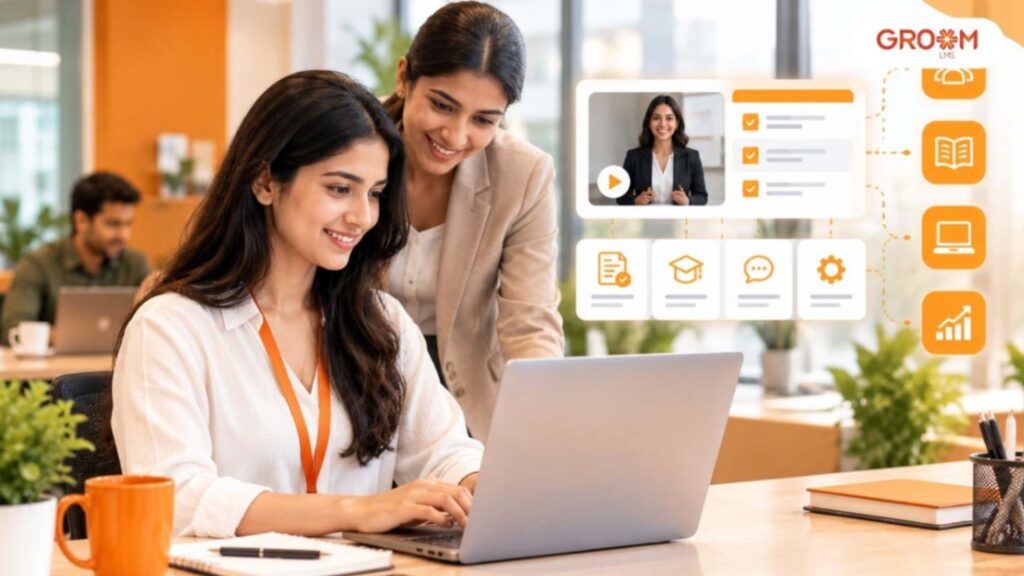
Managing multilingual learning across a distributed workforce can be complex without the right technology. GroomLMS simplifies this process by enabling organisations to create, manage, and scale bilingual training programmes through a single, easy-to-use platform.
With GroomLMS, organisations can:
- Deliver multilingual eLearning courses
- Create structured onboarding programmes
- Automate learning assignments and certifications
- Track learner progress through real-time dashboards
- Manage assessments and learning paths
- Scale training across multiple locations
- Reduce dependency on continuous IT support
Its flexible and scalable learning environment helps HR and Learning & Development teams deliver consistent employee training while improving operational efficiency.
Why Choose GroomLMS?
Choosing the right Learning Management System is essential for delivering successful bilingual training programmes. GroomLMS combines powerful learning technology with user-friendly features that simplify employee training across organisations of every size.
Key advantages include:
- Quick and easy LMS deployment
- Support for multilingual and localised learning content
- Automated assessments, certifications, and learning paths
- Interactive digital learning experiences
- Real-time analytics and learner progress tracking
- Secure, scalable, cloud-based platform
- Flexible solutions for startups, SMEs, enterprises, educational institutions, and government organisations
- End-to-end implementation and ongoing support
- Trusted by 100+ corporate customers globally
Whether your organisation is onboarding new employees, delivering compliance programmes, or upskilling teams across India, GroomLMS provides the tools needed to create engaging, accessible, and measurable learning experiences.
Conclusion
As organisations continue to expand across India’s diverse workforce, delivering inclusive and effective employee training has become increasingly important. Bilingual eLearning helps bridge language gaps by making learning more accessible, engaging, and relevant for employees across different regions. Consequently, organisations can improve learner participation, strengthen knowledge retention, and create more consistent training experiences.
When combined with a scalable Learning Management System, bilingual training becomes even more effective. GroomLMS enables organisations to create, manage, automate, and monitor multilingual learning programmes from a single platform. From onboarding and compliance training to continuous skill development, GroomLMS empowers Learning & Development teams to deliver impactful training with greater efficiency and confidence.
CTA – Request a Demo
Transform Your Corporate Learning with GroomLMS
Discover how GroomLMS empowers your organisation to streamline training, enhance learner engagement, and deliver impactful learning experiences with an AI-powered LMS built for growth.
Request a Personalised Demo | Schedule a Consultation | Chat with Our Team on WhatsApp
Frequently Asked Questions (FAQs)
What is bilingual eLearning?
Bilingual eLearning delivers training content in two languages, helping employees learn in the language they understand best while maintaining consistent learning outcomes across the organisation.
Why is bilingual eLearning important for employee training in India?
India has a diverse workforce with multiple regional languages. Bilingual eLearning improves accessibility, learner engagement, and knowledge retention while ensuring consistent training across locations.
Why is bilingual eLearning important for employee training in India?
India has a diverse workforce with multiple regional languages. Bilingual eLearning improves accessibility, learner engagement, and knowledge retention while ensuring consistent training across locations.
How does GroomLMS support multilingual learning?
GroomLMS allows organisations to create and manage multilingual courses, automate training workflows, track learner progress, and deliver scalable employee training through a single platform.
Can bilingual eLearning improve assessment performance?
Yes. When learners clearly understand training content and assessment questions, they can better demonstrate their knowledge, leading to more accurate evaluation of learning outcomes.