
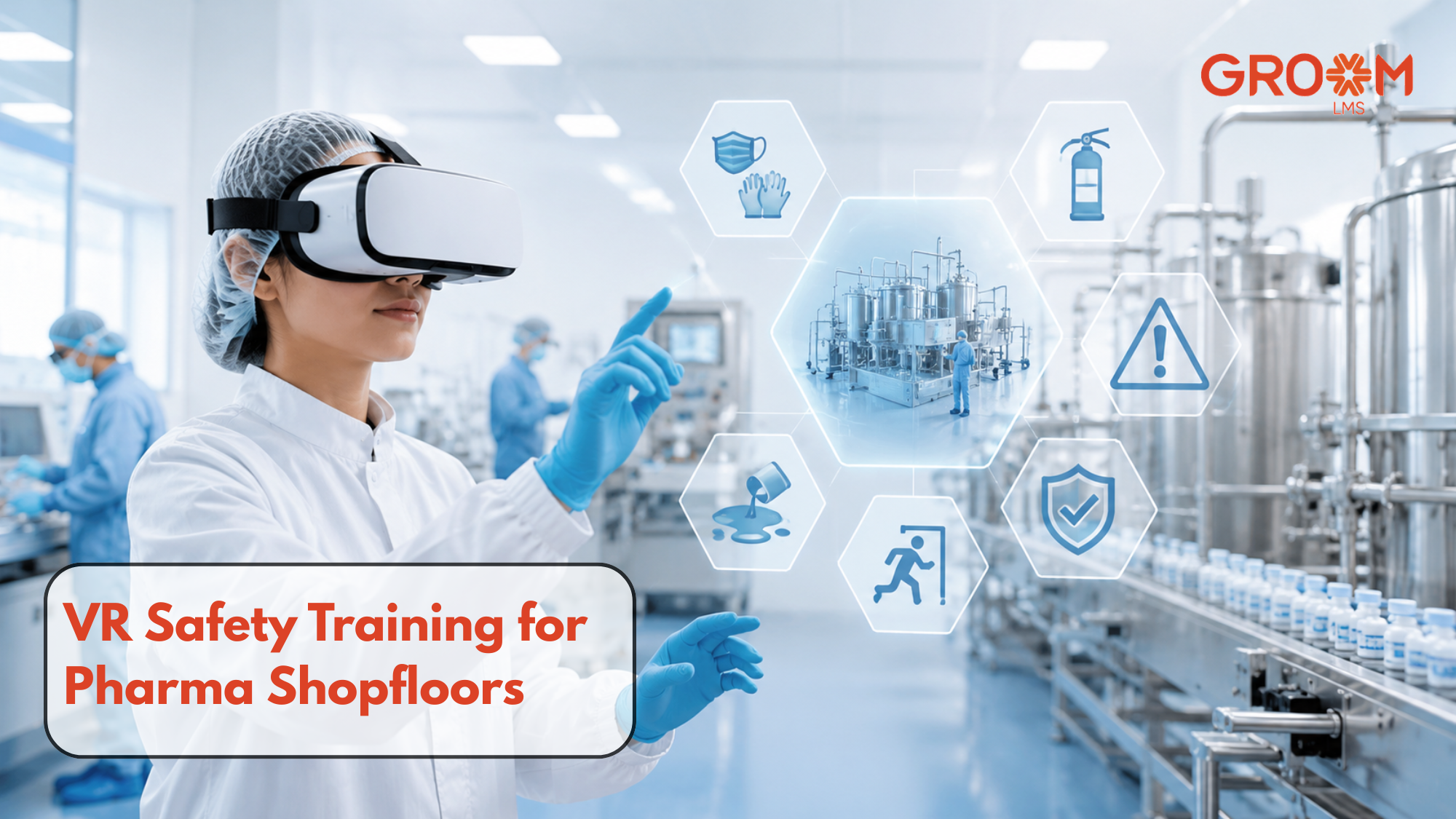
Pharmaceutical manufacturing demands precision, compliance, and safety at every step. Even a small mistake on the shopfloor can lead to product contamination, equipment damage, regulatory violations, or employee injuries. As production environments become more complex, traditional classroom-based safety training often struggles to prepare employees for real-world situations.
This is where VR safety training for pharma shopfloors is changing the way organizations train their workforce. Instead of reading manuals or watching videos, employees can safely experience realistic workplace scenarios, practice emergency procedures, and learn through hands-on simulations without any actual risk.
However, implementing immersive training should not create another operational challenge. Many Learning & Development teams worry about complicated software, technical dependencies, and lengthy deployment timelines. GroomLMS simplifies the entire process by enabling organizations to create, manage, automate, and scale training programs independently. As a result, pharma companies can deliver engaging safety learning while maintaining compliance and operational efficiency.
Why Safety Training Matters on Pharma Shopfloors
Pharmaceutical manufacturing environments involve strict quality standards and regulatory compliance. Employees interact with sensitive equipment, hazardous chemicals, sterile production areas, and validated processes every day.
Proper safety training helps organizations:
- Reduce workplace accidents
- Improve GMP compliance
- Minimize production downtime
- Strengthen employee confidence
- Ensure consistent operational procedures
- Support regulatory audits
Moreover, continuous training creates a culture where safety becomes part of daily operations rather than a periodic requirement.
Challenges of Traditional Pharma Safety Training
Many organizations still rely on presentations, printed manuals, and classroom sessions. While these methods share information, they often fail to prepare employees for real workplace situations.
Common challenges include:
- Limited practical experience
- Low learner engagement
- Difficulty retaining safety procedures
- High costs for repeated physical demonstrations
- Production interruptions during live training
- Inconsistent learning across multiple locations
Consequently, employees may understand procedures theoretically but hesitate during actual emergencies.
What Is VR Safety Training?
Virtual Reality (VR) safety training allows employees to enter immersive digital environments where they interact with realistic workplace scenarios using VR headsets.
Instead of imagining situations, learners actively perform tasks such as:
- Handling hazardous materials
- Operating production equipment
- Following cleanroom entry procedures
- Responding to chemical spills
- Managing fire emergencies
- Practicing evacuation drills
Because learners experience these situations firsthand, they develop stronger confidence and better decision-making skills.
Benefits of VR Safety Training for Pharma Shopfloors
Improves Learning Retention
People remember experiences better than lectures. VR allows employees to practice procedures multiple times until they become familiar with every step.
As a result, knowledge retention improves significantly.
Creates a Safe Learning Environment
Employees can make mistakes without causing injuries, contamination, or production losses.
Therefore, they gain confidence before performing tasks in actual manufacturing environments.
Standardizes Training
Every employee receives the same high-quality learning experience regardless of location or trainer.
This consistency becomes especially valuable for pharmaceutical companies operating multiple manufacturing plants.
Supports Regulatory Compliance
VR training documents learner progress, assessments, and completion records.
Consequently, organizations can demonstrate training effectiveness during regulatory inspections and internal audits.
Reduces Operational Disruptions
Instead of shutting down equipment for demonstrations, employees practice virtually.
This approach saves production time while maintaining effective learning.
Practical Applications of VR Safety Training
Pharma organizations can use VR across multiple safety scenarios.
Cleanroom Behaviour
Employees learn:
- Correct gowning procedures
- Sterile movement techniques
- Contamination prevention
- Entry and exit protocols
Chemical Handling
Learners practice:
- Chemical storage
- Safe transportation
- Spill management
- PPE selection
Equipment Operations
Training includes:
- Machine startup
- Safe shutdown procedures
- Lockout/tagout practices
- Equipment inspections
Emergency Response
Teams experience realistic situations such as:
- Fire emergencies
- Gas leaks
- Chemical exposure
- Medical incidents
- Evacuation procedures
Because these scenarios feel realistic, employees respond more confidently during actual emergencies.
How an LMS Makes VR Safety Training More Effective
While VR delivers immersive learning, organizations still need a central platform to manage training efficiently.
An LMS helps by:
- Assigning courses automatically
- Tracking learner progress
- Managing certifications
- Scheduling refresher training
- Monitoring compliance reports
- Generating audit-ready records
Without a centralized learning platform, managing large-scale VR programs becomes time-consuming.
How GroomLMS Simplifies VR Safety Training
Many organizations hesitate to adopt new learning technologies because they expect complex implementation and ongoing IT involvement.
GroomLMS removes those barriers by offering an easy-to-manage learning platform designed for scalable workforce training.
With GroomLMS, organizations can:
- Launch training programs within minutes
- Manage learners independently
- Deliver blended learning experiences
- Track VR course completion
- Automate assessments and certifications
- Generate detailed learning analytics
- Scale training across multiple manufacturing facilities
Additionally, GroomLMS supports end-to-end e-learning content services, allowing organizations to combine VR modules with instructional content, assessments, multimedia learning, and certification programs.
As training requirements grow, the platform scales without increasing administrative complexity.
Example Workflow: VR Safety Training in Action
Imagine a pharmaceutical manufacturer onboarding 300 new production employees.
Instead of relying solely on classroom sessions, the company follows this workflow:
- Employees complete introductory compliance modules on GroomLMS.
- Learners access VR safety simulations for shopfloor operations.
- They practice emergency procedures in immersive environments.
- GroomLMS records completion and assessment scores.
- Managers review dashboards to identify knowledge gaps.
- Employees automatically receive refresher training before certifications expire.
As a result, the organization reduces manual administration while improving training consistency.
Best Practices for Successful VR Safety Training
To maximize results, organizations should follow these practices:
- Start with high-risk operational scenarios.
- Combine VR with online learning modules.
- Measure learner performance regularly.
- Schedule periodic refresher training.
- Monitor compliance using LMS dashboards.
- Update simulations as regulations evolve.
- Gather employee feedback for continuous improvement.
Furthermore, integrating immersive learning with automated learning management creates a more sustainable training ecosystem.
The Future of Pharma Safety Training
The pharmaceutical industry continues to embrace digital transformation. Alongside automation and smart manufacturing, immersive learning is becoming an essential component of workforce development.
As VR technology becomes more accessible, organizations will increasingly adopt simulation-based training to improve safety, compliance, and operational efficiency.
At the same time, cloud-based learning platforms will simplify deployment, learner management, reporting, and certification. Together, VR and modern LMS solutions will create more engaging, measurable, and scalable training experiences for pharmaceutical teams.
Conclusion
Workplace safety remains one of the highest priorities in pharmaceutical manufacturing. Traditional training methods provide valuable knowledge, yet they often lack the practical experience employees need to respond confidently in real situations. VR safety training for pharma shopfloors bridges this gap by offering immersive, hands-on learning that improves retention, builds confidence, and strengthens compliance.
However, successful implementation requires more than VR technology alone. Organizations also need a platform that simplifies course management, learner tracking, reporting, and ongoing training. GroomLMS enables Learning & Development teams to create, manage, automate, and scale safety training without relying on continuous IT support. Whether your workforce is expanding or regulatory requirements are evolving, GroomLMS helps deliver consistent, engaging, and measurable learning experiences that support safer pharma operations.
CTA – Request a Demo
Explore GroomLMS Today
Whether you’re training employees, partners, or customers, GroomLMS helps you deliver learning that drives results.
Request a demo, sign up to experience the platform, or contact us to find the right solution for your organization.
Frequently Asked Questions (FAQs)
What is VR safety training for pharma shopfloors?
VR safety training uses immersive virtual environments to help pharmaceutical employees practice workplace procedures, emergency responses, equipment handling, and compliance requirements without real-world risks.
Can GroomLMS manage VR-based employee training?
Yes. GroomLMS allows organizations to manage VR learning programs, automate enrolments, track learner progress, generate reports, manage certifications, and monitor compliance from a centralized platform.
Why should pharmaceutical companies use an LMS for safety training?
An LMS centralizes training management, automates assignments, tracks completion, maintains compliance records, and ensures every employee receives consistent learning experiences.
How often should pharma safety training be updated?
Safety training should be reviewed regularly and updated whenever regulations, equipment, manufacturing processes, or workplace risks change. Many organizations also schedule annual or role-based refresher training.
Is VR safety training suitable for large pharmaceutical organizations?
Yes. Combined with GroomLMS, VR safety training can be deployed across multiple manufacturing facilities, helping organizations standardize training, improve compliance, and scale learning efficiently.