
Insurance teams often need to train and onboard Point of Sales Person quickly. However, managing training, assessments, certificates, records, and compliance can become difficult as the workforce grows.
This is where IRDAI POSP Training becomes an important part of a structured insurance training process. It helps organisations build the required knowledge and prepare eligible personnel for authorised POSP activities.
Yet, compliance is not only about completing training hours. Teams also need a reliable way to manage learners, assessments, certificates, records, and reporting.
For modern insurance organisations, spreadsheets and disconnected systems can quickly create unnecessary work. Moreover, manual processes make it harder to track who completed training and whether required records are available.
A modern learning management system can simplify this entire workflow. With GroomLMS, insurance teams can create, manage, automate, and scale digital learning programs without depending on IT teams for every small change.
So, how can organisations make POSP training easier while maintaining a structured compliance process? Let’s break it down.
What Is POSP Training?
A Point of Sales Person, or POSP, is an individual authorised to solicit or market specified insurance products after meeting applicable eligibility, training, and examination requirements.
IRDAI has issued guidelines covering POSP requirements for different insurance segments. For example, the IRDAI guidelines for POSP-Life Insurance include minimum eligibility requirements, training, examination, certification, appointment, and record-keeping requirements.
Therefore, organisations should treat POSP training as more than a simple online course.
A structured program typically needs to manage:
- Learner eligibility and onboarding
- Prescribed training
- Learning content
- Assessments and examinations
- Certification
- Appointment-related records
- POSP identification or code records
- Training and examination records
- Compliance reporting
The exact requirements can vary by insurance category and applicable IRDAI directions. Therefore, organisations should always verify current regulatory requirements before designing or updating their training workflow.
Why IRDAI POSP Training Becomes Difficult to Manage
Training a few employees manually may seem simple. However, the process becomes considerably more complex when an insurance organisation manages hundreds or thousands of learners.
Manual learner tracking creates gaps
When teams rely on spreadsheets, emails, and separate folders, important information can become scattered.
For example, one employee’s training status may sit in a spreadsheet while their assessment result exists in another system. Their certificate may then be stored in an email attachment.
As a result, finding the complete learner record takes unnecessary time.
Training completion becomes harder to monitor
Managers need visibility into:
- Who has started training
- Who has completed each module
- Who has passed the assessment
- Who still needs to complete training
- Which certificates have been issued
- Which records require attention
Without centralised dashboards, these tasks often become repetitive.
Scaling creates an operational burden
A growing insurance team means more learners, more assessments, more certificates, and more records.
Consequently, the same manual workflow that worked for 20 learners may become inefficient for 2,000.
This is why training automation matters.
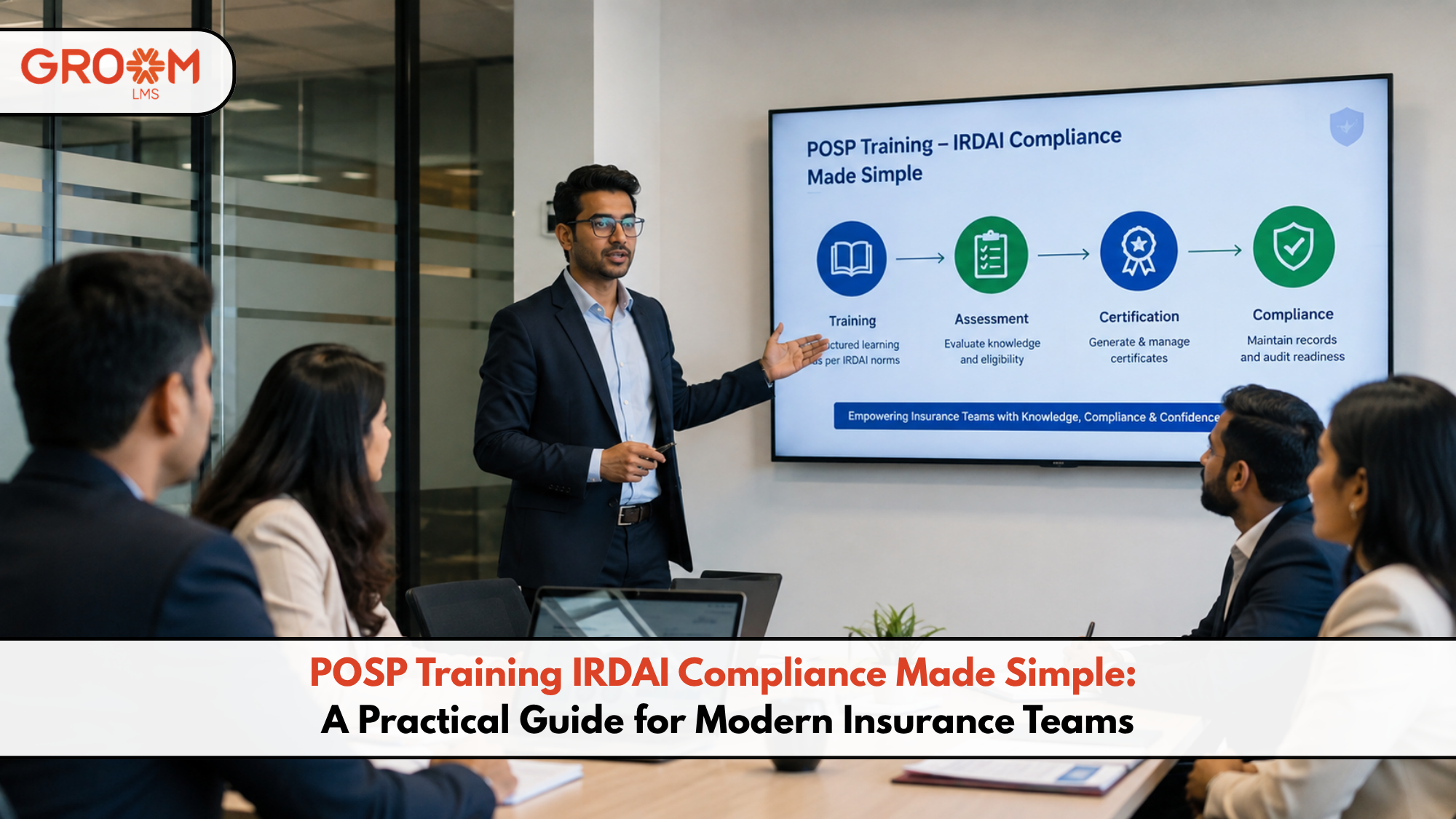
What Should a Modern POSP Training Workflow Include?
A strong workflow should make compliance easier without making learning complicated.
Here is a practical structure.
Candidate onboarding
Start by creating a central learner profile.
Capture relevant information required by the organisation and applicable regulatory process. This gives the training team a consistent starting point.
Course assignment
Next, assign the appropriate POSP training program.
Instead of manually sending course links, an LMS can automatically enrol learners into the required learning path.
Structured learning
Break training into logical modules.
For example:
- Insurance fundamentals
- Applicable product knowledge
- Customer interaction
- Policy-related concepts
- Regulatory responsibilities
- Ethical selling practices
- Assessment preparation
This makes the learning journey easier to follow.
Assessment
After training, learners can complete the required assessment or examination process.
An LMS can help organisations manage practice tests, knowledge checks, assessment attempts, and results.
However, organisations should distinguish between internal LMS assessments and any examination that must be conducted through an authorised process.
Certification and documentation
Once applicable requirements are fulfilled, the organisation can manage certificates and related documentation digitally.
This reduces dependence on paper-based records.
Reporting
Finally, managers should be able to view training status through dashboards.
Useful reports can include:
- Enrolment status
- Completion rates
- Assessment results
- Certificate status
- Learner progress
- Training history
This creates a clearer compliance trail.
How Automation Simplifies POSP Training
Automation does not replace compliance responsibilities. Instead, it reduces the administrative work surrounding them.
For instance, consider an insurance organisation onboarding 500 new POSPs.
A manual workflow could require the training team to:
- Create learner records.
- Send course information.
- Track attendance or completion.
- Follow up with incomplete learners.
- Monitor assessments.
- Generate reports.
- Maintain certificates.
- Organise training records.
That is a lot of repetitive work.
With a modern LMS, several of these activities can follow predefined workflows.
Automated reminders
Learners can receive reminders about incomplete modules, upcoming assessments, or pending activities.
Therefore, training teams spend less time chasing learners manually.
Automated enrolment
New learners can be assigned relevant courses based on predefined workflows.
This helps create a consistent onboarding experience.
Centralised records
Training activity, assessment results, and certificates can remain connected to individual learner profiles.
As a result, administrators have a clearer view of learner history.
Dashboard-based monitoring
Managers can quickly identify completed, pending, and overdue training.
This makes decision-making faster and more transparent.
Practical Example: A Growing Insurance Team
Imagine an insurance intermediary onboarding 300 POSPs over three months.
Initially, the training team manages everything through spreadsheets.
After a few weeks, problems start appearing.
Some learners have completed training but have not been marked correctly. Others have missed assessments. Managers also need to search through multiple folders for records.
Now consider the same process through a centralised LMS.
How GroomLMS Can Support Insurance Training Teams
GroomLMS is designed to help organisations manage digital learning without creating unnecessary technical complexity.
For insurance teams, the platform can support workflows around:
- Digital course delivery
- Learner management
- Assessments
- Certifications
- Training dashboards
- Automated learning workflows
- Progress tracking
- Reporting
- Scalable employee training
The biggest advantage is operational independence.
Teams can create and manage learning programs without requiring IT support for every update. That becomes particularly useful when training programs need frequent changes.
For example, an L&D manager can manage course structures, learner groups, assessments, and training activities from a central platform.
GroomLMS also supports scalable digital learning environments for organisations that need to train distributed teams.
A Simple Compliance Checklist for Insurance Teams
Before launching or reviewing a POSP training program, teams can ask:
- Is the learner eligibility process clearly defined?
- Are the applicable IRDAI requirements verified?
- Is the prescribed training structure reflected in the program?
- Are assessments properly documented?
- Are learner completion records maintained?
- Are certificates managed systematically?
- Can administrators retrieve training records quickly?
- Are dashboards available for monitoring?
- Are incomplete learners automatically identified?
- Can the system scale as the organisation grows?
These questions can expose operational gaps before they become larger problems.
IRDAI guidance for POSP-Life Insurance, for instance, specifies training, examination, certification, appointment, POS code allocation, and record-maintenance requirements. It also requires training and examination records to be maintained for the specified period.
Therefore, a good LMS should support the organisation’s compliance process rather than simply host videos.
Best Practices for Managing POSP Training Digitally
Technology works best when the underlying workflow is already clear.
Follow these practices to create a smoother training operation.
Keep compliance requirements separate from convenience features
First identify what regulations require.
Then decide which activities can be automated.
This prevents technology from becoming a substitute for regulatory interpretation.
Build role-based learning paths
Not every learner needs the same training experience.
Create learning paths according to relevant roles, product categories, and organisational requirements.
Keep records organised
Training records should be easy to retrieve.
A centralised system can reduce the risk of information becoming scattered across spreadsheets and email threads.
Use dashboards proactively
Do not wait until the end of the month to discover incomplete training.
Instead, use dashboards to identify gaps continuously.
Review content regularly
Insurance regulations, products, processes, and organisational policies can change.
Therefore, review training content periodically and update it when necessary.
Make learning mobile-friendly
Insurance teams may operate across offices, branches, and field locations.
Mobile-friendly learning can make training more accessible for distributed teams.
Why a Scalable LMS Matters for Modern Insurance Teams
Insurance training is no longer limited to a classroom and a printed manual.
Modern teams need learning environments that can support distributed employees, faster onboarding, digital assessments, automated communication, and reliable reporting.
At the same time, compliance processes require discipline and documentation.
That combination makes an LMS particularly valuable.
A scalable platform can bring learning activities into one environment while reducing repetitive administrative work.
More importantly, it allows L&D teams to take ownership of training operations.
With GroomLMS, organisations can build digital learning programs, manage learners, deliver assessments, issue certifications, and monitor progress through a centralised system.
The goal is simple: make training easier to operate while creating a more consistent learner experience.
Conclusion
IRDAI POSP Training does not have to become an administrative maze. With the right workflow, insurance organisations can make training easier to launch, monitor, document, and scale.
The key is to look beyond course delivery.
A modern POSP training process should connect onboarding, learning, assessments, certification, records, reporting, and ongoing monitoring. At the same time, organisations must continue to verify the latest applicable IRDAI requirements and ensure that their internal processes remain compliant.
Technology can then take care of much of the repetitive work.
GroomLMS helps organisations create and manage scalable digital learning programs through a centralised LMS. It supports course delivery, assessments, certifications, learner management, dashboards, and training automation.
For modern insurance teams, this can mean less manual administration and more time focused on building capable, compliant, and confident teams.
Ultimately, simplified learning management is not just about saving administrative hours. It is about creating a training system that can grow with the organisation.
Transform Your Corporate Learning with GroomLMS
Discover how GroomLMS empowers your organization to streamline training, enhance learner engagement, and deliver impactful learning experiences with an AI-powered LMS built for growth.
Contact Us | Join GroomLMS | Chat on WhatsApp
Frequently Asked Questions (FAQs)
What is IRDAI POSP Training?
IRDAI POSP Training refers to the training required for eligible Point of Sales Persons under applicable IRDAI requirements. The specific requirements can vary according to the insurance segment and applicable regulatory directions.
How can an LMS help with POSP training?
An LMS can centralise course delivery, learner management, assessments, certifications, progress tracking, and reporting. It can also automate reminders and reduce repetitive administrative work.
Can online learning be used for insurance employee training?
Yes. Organisations can use digital learning platforms to deliver structured training, learning resources, assessments, and knowledge checks. However, any regulatory requirement involving a specific examination or authorised process must be followed separately.
How does training automation improve compliance management?
Training automation helps organisations consistently assign courses, monitor progress, send reminders, maintain records, and generate reports. This creates a more organised training workflow and improves visibility.
How can GroomLMS support insurance training programs?
GroomLMS can help insurance organisations manage digital courses, learners, assessments, certifications, dashboards, and training workflows from a centralised platform. It can support scalable learning programs while reducing dependence on IT teams for routine training management.