
Corporate compliance is no longer limited to annual policy briefings or employee handbooks. Organizations operate in environments where regulations, internal policies, technologies, and workplace expectations continue to evolve. As a result, employees need regular opportunities to understand the rules that affect their roles and responsibilities.
Traditional classroom-based compliance programs can become difficult to coordinate when employees work across multiple offices, locations, or schedules. Furthermore, manually managing attendance, assessments, certificates, and training records can increase the administrative workload for HR and L&D teams.
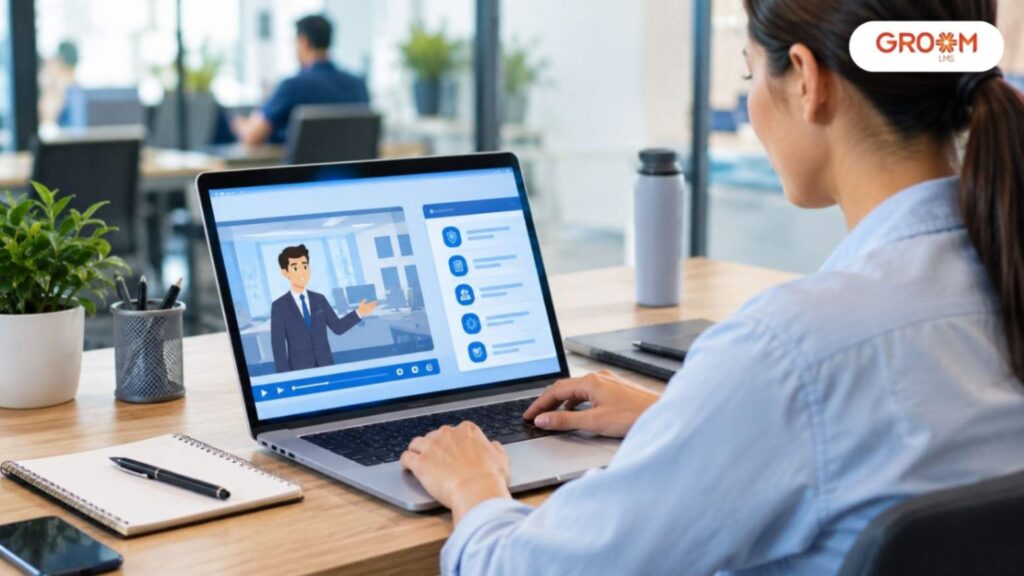
This is where online compliance training for corporates becomes valuable. Digital training allows organizations to deliver standardized learning experiences while giving employees flexible access to important compliance topics. GroomLMS supports this approach by providing organizations with a centralized learning environment for courses, assessments, certifications, analytics, dashboards, and digital training management.
What Is Online Compliance Training for Corporates?
Online compliance training for corporates refers to the use of digital learning platforms and courses to educate employees about organizational policies, legal requirements, industry regulations, ethical standards, and workplace responsibilities.
Instead of requiring employees to attend the same classroom session, organizations can provide compliance learning through an online environment.
Depending on the organization’s requirements, online compliance training can include:
- Workplace conduct training
- POSH awareness
- Data privacy and protection
- Cybersecurity awareness
- Anti-bribery and anti-corruption
- Workplace health and safety
- Code of conduct
- Information security
- Regulatory compliance
- Ethics training
- Industry-specific compliance
The objective is not simply to complete a course. Effective compliance learning should help employees understand expectations and apply them in realistic workplace situations.
Why Is Corporate Compliance Training Important?
Compliance policies only become meaningful when employees understand how they apply to everyday work.
For example, an organization may have a detailed data protection policy. However, employees still need to know how to handle confidential information, identify potential risks, and report incidents.
Similarly, a workplace conduct policy may describe unacceptable behavior. Employees also need to understand appropriate workplace behavior and the channels available for reporting concerns.
Therefore, compliance training connects organizational policies with employee actions.
A structured program can help organizations:
- Communicate important policies consistently
- Improve employee awareness
- Standardize training across locations
- Document training participation
- Reinforce expected workplace behavior
- Identify knowledge gaps
- Support ongoing learning
Challenges of Traditional Compliance Training
Traditional compliance training can work for smaller groups. However, managing it at scale creates several challenges.
Scheduling Difficulties
Employees may work different shifts or operate from different locations. Arranging a common classroom session can therefore become difficult.
Inconsistent Delivery
Different trainers may explain the same policy differently. Digital learning can provide greater consistency in how core information is presented.
Administrative Work
Tracking attendance, completion, assessments, and certificates manually can consume considerable time.
Limited Accessibility
Employees who cannot attend a scheduled session may need additional arrangements. Online courses provide greater flexibility because employees can access them according to the organization’s learning schedule.
Difficulty With Continuous Training
Compliance is not always a one-time activity. Organizations may need refresher training when policies or requirements change.
Digital learning makes it easier to organize recurring programs.
How Online Compliance Training Supports Modern Corporates
Online learning provides a centralized approach to compliance education.
Instead of managing different training materials separately, organizations can organize their programs within a digital learning environment.
For example, an organization could create a compliance learning path containing:
- Code of Conduct
- Data Privacy
- Cybersecurity Awareness
- Workplace Safety
- POSH Awareness
- Final Compliance Assessment
Employees can then complete the required modules according to their assigned learning path.
This approach creates a more structured learning journey.
Key Benefits of Online Compliance Training
Consistent Learning Across the Organization
One of the major advantages of digital compliance training is standardization.
Employees across different offices can receive the same core learning content, instructions, and assessments.
This can help organizations maintain consistency while allowing departments to introduce role-specific training where required.
Flexible Employee Access
Online courses can provide employees with more flexibility than fixed classroom sessions.
Employees can access training through an organization’s learning platform according to the assigned schedule and available learning windows.
This can be particularly useful for organizations with distributed teams or different working schedules.
Centralized Training Management
An LMS can bring different aspects of compliance learning together.
L&D and HR teams can manage:
- Course assignments
- Employee enrollments
- Learning paths
- Assessments
- Certificates
- Completion records
- Reports
- Training data
This reduces the need to maintain multiple disconnected records.
Easier Progress Tracking
Compliance programs often require organizations to know whether employees have completed assigned training.
Digital platforms can provide visibility into learner progress and completion.
Depending on the LMS capabilities, administrators can review dashboards and reports to identify completed, pending, or overdue training.
Interactive Learning Experiences
Compliance training does not have to consist entirely of text and presentations.
Organizations can use multimedia, scenarios, animations, quizzes, and knowledge checks.
For example, an animated cybersecurity scenario could show an employee receiving a suspicious email. Learners can then answer a question about the appropriate response.
This approach can make compliance concepts more practical.
Designing Effective Online Compliance Courses
Technology alone does not make compliance training effective. Content and instructional design remain equally important.
Keep Learning Objectives Clear
Each module should have specific learning objectives.
Use Practical Examples
Employees need to understand how policies apply to their work.
Therefore, use examples based on realistic situations.
Instead of only defining conflicts of interest, a course could present a scenario involving an employee and a supplier and ask learners to determine the appropriate action.
Break Complex Topics Into Modules
Large compliance topics can become overwhelming.
Breaking them into smaller modules can make the learning experience easier to navigate.
For example:
Data Privacy Training
- Understanding Personal Data
- Data Handling Responsibilities
- Secure Data Sharing
- Common Risks
- Incident Reporting
- Final Assessment
Add Assessments
Assessments can help organizations check whether employees understand important concepts.
Common formats include:
- Multiple-choice questions
- Scenario-based questions
- Knowledge checks
- Matching activities
- Situational assessments
Assessments should test practical understanding rather than simply asking employees to recall definitions.
The Role of an LMS in Online Compliance Training
An LMS acts as the central infrastructure for managing digital compliance learning.
Rather than storing courses separately, organizations can use an LMS to create a structured learning environment.
GroomLMS provides capabilities for digital course management, multimedia learning, assessments, certifications, analytics, dashboards, SCORM, xAPI, and virtual instructor-led training.
How to Keep Compliance Training Engaging
Compliance topics can sometimes feel repetitive. Therefore, organizations should focus on relevance and learner interaction.
Some practical approaches include:
Use Scenario-Based Learning
Show employees realistic situations and ask them to choose an appropriate response.
Use Short Knowledge Checks
Insert questions throughout the course rather than relying only on a final assessment.
Add Visual Learning
Use illustrations, animations, infographics, and videos where they support understanding.
Connect Policies to Real Work
Explain how a compliance requirement affects employees’ actual responsibilities.
Provide Immediate Feedback
When learners answer a question, explain why the answer is correct or incorrect.
These techniques can transform compliance training from passive information consumption into active learning.
Measuring Online Compliance Training
Training completion is an important metric, but it should not be the only measurement.
Organizations can consider several indicators, such as:
- Course completion
- Assessment performance
- Learner participation
- Knowledge-check results
- Certification status
- Training attendance
- Recurring training completion
Analytics can help L&D teams identify where learners may require additional support.
For example, if employees consistently perform poorly on one assessment topic, the organization may need to review the relevant course content.
Best Practices for Corporate Compliance Training
Organizations can strengthen their online compliance programs by following a few principles:
Keep content current: Review training whenever policies, processes, or applicable requirements change.
Make learning role-specific: Not every employee needs identical compliance training.
Use multiple formats: Combine text, animation, video, scenarios, and assessments when appropriate.
Track completion: Maintain centralized records of assigned and completed learning.
Use assessments: Check whether employees understand important concepts.
Provide refresher learning: Reinforce critical topics periodically instead of treating compliance as a one-time activity.
Review analytics: Use learning data to identify areas that need improvement.
Online Compliance Training and the Future of Corporate Learning
Corporate learning is increasingly moving toward digital, flexible, and data-driven models. Compliance training is part of this broader transformation.
Future-ready compliance programs can combine multimedia learning, scenario-based activities, assessments, analytics, and automated learning workflows.
Artificial intelligence can also support areas such as content development, personalization, and learning assistance. However, organizations still need appropriate human review to ensure that compliance information remains accurate and aligned with organizational requirements.
The fundamental principle remains unchanged: employees need clear information, relevant examples, and opportunities to demonstrate understanding.
How GroomLMS Supports Online Compliance Training for Corporates
GroomLMS provides a centralized environment for organizations looking to manage digital employee learning.
Through its LMS capabilities, organizations can deliver multimedia courses, create assessments, issue certificates, monitor learner activity, and use analytics to understand training performance.
The platform also supports SCORM and xAPI, along with virtual instructor-led training and other digital learning capabilities.
For corporate compliance programs, this creates an integrated environment where learning content and training management can work together.
As a result, organizations can move beyond isolated compliance courses and build structured learning programs that are easier to deliver, monitor, and scale.
Conclusion
Online compliance training for corporates provides a structured approach to educating employees about workplace policies, regulations, ethical responsibilities, and organizational expectations. By moving compliance learning into a digital environment, organizations can improve accessibility, standardize training, simplify administration, and gain greater visibility into learner progress.
However, effective compliance training requires more than simply putting policy documents online. Organizations should focus on clear learning objectives, practical scenarios, interactive assessments, relevant content, and continuous improvement.
An LMS can bring these elements together. With digital course management, multimedia learning, assessments, certifications, analytics, and reporting capabilities, GroomLMS helps organizations create a centralized environment for managing corporate learning.
The result is a more organized approach to compliance education that supports employees while helping organizations manage training at scale.
Simplify Online Compliance Training with GroomLMS
Deliver structured, engaging, and trackable compliance training through one centralized LMS. GroomLMS helps organizations manage courses, assessments, certifications, learner progress, and training analytics with ease.
Contact Us | Join GroomLMS | Chat on WhatsApp
Frequently Asked Questions (FAQs)
What is online compliance training for corporates?
Online compliance training for corporates uses digital courses and learning platforms to educate employees about organizational policies, regulations, workplace responsibilities, ethics, and compliance requirements.
What topics can be covered through online compliance training?
Common topics include POSH, cybersecurity, data privacy, workplace safety, code of conduct, anti-bribery, ethics, information security, and industry-specific compliance.
What are the benefits of online compliance training?
It can provide flexible learning access, consistent content delivery, centralized training management, easier progress tracking, digital assessments, and structured training records.
Can an LMS track corporate compliance training?
Yes. An LMS can help organizations assign courses, monitor completion, conduct assessments, issue certificates, and generate learning reports.
How does GroomLMS support corporate compliance training?
GroomLMS provides course management, multimedia learning, assessments, certifications, analytics, dashboards, SCORM, xAPI, and virtual instructor-led training capabilities for structured digital learning programs.