
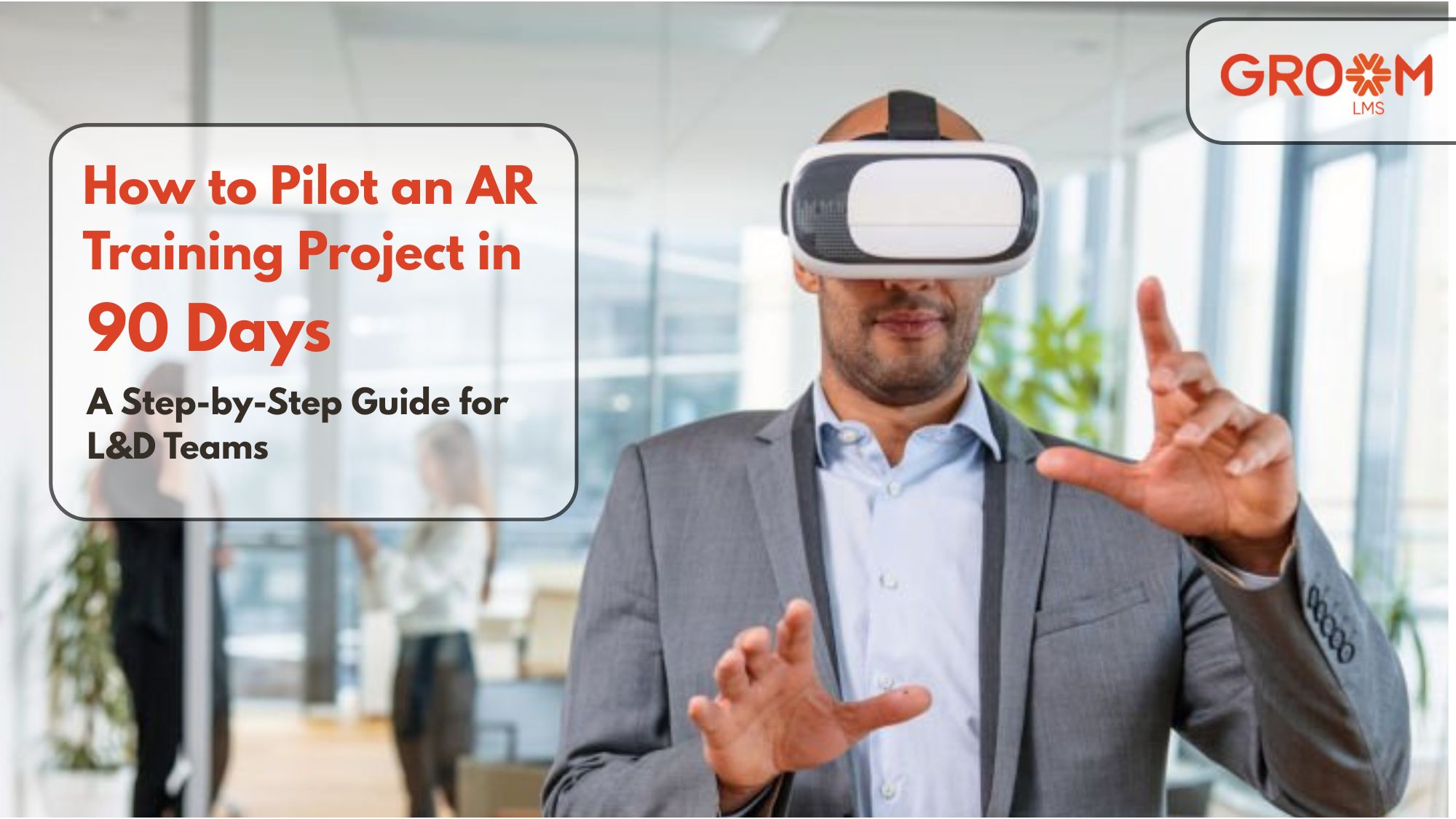
Organizations are constantly searching for new ways to improve employee learning. Traditional training methods often struggle to maintain engagement, especially when employees need hands-on experience in complex environments.
This challenge has led many organizations to explore Augmented Reality (AR) training. AR brings learning into real-world contexts, allowing employees to practice tasks, follow guided instructions, and gain practical experience without operational risks.
However, many training leaders hesitate to begin because they assume AR projects require extensive budgets, large technical teams, and long implementation timelines.
The good news is that understanding how to pilot an AR training project can help organizations test AR learning quickly and efficiently before making a larger investment.
With a structured roadmap and a scalable learning platform like GroomLMS, organizations can manage content delivery, learner tracking, assessments, and reporting from a single system while minimizing technical complexity.
Why Organizations Are Investing in AR Training
AR training combines digital information with real-world environments. Employees can view instructions, simulations, and interactive guidance through mobile devices, tablets, or AR headsets.
Companies are increasingly adopting AR because it helps:
- Improve knowledge retention
- Reduce training time
- Increase learner engagement
- Support remote and distributed teams
- Enhance workplace safety
- Deliver consistent training experiences
Industries such as manufacturing, healthcare, logistics, retail, and field services are already using AR to improve workforce performance.
Before rolling out organization-wide programs, however, it is important to understand how to pilot an AR training successfully.
The 90-Day AR Training Pilot Framework
A successful AR pilot focuses on testing value, gathering feedback, and measuring outcomes.
Here is a practical 90-day roadmap.
Phase 1: Define Objectives and Use Cases (Days 1–15)
Start with a clear business problem.
Avoid implementing AR simply because it is a new technology. Instead, identify training challenges that AR can solve.
Examples include:
- Equipment operation training
- Safety procedures
- Maintenance workflows
- Onboarding programs
- Field technician guidance
- Compliance training
Ask the following questions:
- What problem are we solving?
- Who will participate?
- How will success be measured?
- What business outcomes do we expect?
At this stage, GroomLMS can help centralize learning objectives, participant enrollment, communication, and pilot planning activities.
Create Success Metrics Early
Define measurable outcomes before launching the pilot.
Potential metrics include:
- Training completion rates
- Knowledge retention scores
- Assessment performance
- Time-to-competency
- Employee confidence levels
- Error reduction rates
Without clear metrics, it becomes difficult to evaluate pilot success.
Phase 2: Build the AR Learning Experience (Days 16–45)
Once objectives are established, begin creating the AR learning content.
Keep the pilot simple.
Many organizations fail because they attempt to build large-scale experiences immediately.
Instead, focus on:
- One department
- One workflow
- One training challenge
For example, a manufacturing company might create an AR experience that guides employees through machine setup procedures.
Design Effective AR Content
Successful AR training experiences should be:
- Interactive
- Task-oriented
- Easy to navigate
- Focused on real-world application
Include:
- Step-by-step instructions
- Visual overlays
- Safety reminders
- Interactive checkpoints
- Knowledge assessments
GroomLMS can support content distribution, learner access management, assessments, certifications, and reporting throughout the pilot.
Train Internal Stakeholders
Before launching the pilot, prepare managers and facilitators.
They should understand:
- Pilot objectives
- Technology requirements
- User expectations
- Feedback collection processes
This preparation significantly improves adoption rates.
Phase 3: Launch and Monitor the Pilot (Days 46–75)
This phase represents the real-world test.
Select a manageable pilot group.
A typical pilot might involve:
- 20 to 100 employees
- One business unit
- One location
- One specific job role
The goal is to gather meaningful data while minimizing operational disruption.
Provide Structured Support
Even intuitive technologies require support during adoption.
Offer:
- Quick-start guides
- Help resources
- Manager support sessions
- FAQ documentation
Using GroomLMS, administrators can automate notifications, track learner progress, and provide centralized support resources.
Collect Feedback Continuously
Gather insights throughout the pilot rather than waiting until the end.
Useful feedback methods include:
- Surveys
- Interviews
- Assessment results
- Observation reports
- User satisfaction ratings
Questions to ask include:
- Was the training easy to use?
- Did it improve understanding?
- Were there technical issues?
- Would employees use it again?
Continuous feedback allows rapid adjustments.
Phase 4: Measure Results and Prepare for Scale (Days 76–90)
The final stage focuses on evaluation.
This is where organizations determine whether the AR initiative should expand.
Review the metrics established during Phase 1.
Compare pilot performance against previous training methods.
Key areas to evaluate include:
Learning Effectiveness
Measure:
- Assessment improvements
- Knowledge retention
- Skills application
Business Impact
Assess:
- Productivity improvements
- Reduced errors
- Faster onboarding
- Improved compliance
User Adoption
Analyze:
- Completion rates
- Engagement levels
- User satisfaction
- Manager feedback
This evaluation process is critical when determining how to pilot an AR training project successfully and build a business case for future investment.
Common Mistakes to Avoid
Many AR pilots fail because organizations overlook basic implementation principles.
Avoid these common mistakes:
Trying to Scale Too Quickly
Start small.
Validate results before expanding.
Focusing on Technology Instead of Outcomes
The objective is improved performance, not simply deploying AR tools.
Ignoring Change Management
Employees need guidance and communication throughout the process.
Failing to Track Metrics
Without measurable outcomes, leadership may struggle to justify future investments.
Using Disconnected Systems
Managing content, assessments, learners, and reporting across multiple platforms creates unnecessary complexity.
A centralized platform like GroomLMS simplifies administration and improves visibility.
How GroomLMS Supports AR Training Initiatives
Organizations exploring how to pilot an AR training project need more than innovative content. They also need a reliable learning infrastructure.
GroomLMS helps organizations:
- Launch learning programs quickly
- Manage learners independently
- Deliver digital content at scale
- Automate enrollments and notifications
- Conduct assessments and certifications
- Track learning performance
- Generate detailed analytics and reports
Because GroomLMS requires minimal technical dependency, L&D teams can manage AR pilot programs without waiting for extensive IT involvement.
This flexibility allows organizations to focus on learner outcomes rather than platform management.
Conclusion
Understanding how to pilot an AR training allows organizations to explore emerging learning technologies without committing to large-scale deployments immediately. By defining clear objectives, focusing on a specific use case, collecting meaningful data, and measuring business outcomes, organizations can make informed decisions about future AR investments.
Equally important is having a learning platform that simplifies administration and supports growth. GroomLMS enables organizations to launch, manage, automate, and scale learning initiatives efficiently, making it easier for L&D teams to execute successful AR training pilots and future digital learning programs.
CTA – Request a Demo
Ready to simplify your next training initiative?
Discover how GroomLMS can help you launch, manage, automate, and scale innovative learning programs, including AR training pilots, without ongoing technical complexity.
Start simplifying training today and request a demo of GroomLMS.
Frequently Asked Questions (FAQs)
What is an AR training project?
An AR training project uses augmented reality technology to provide interactive learning experiences that combine digital content with real-world environments.
How long does it take to pilot an AR training project?
Most organizations can successfully pilot an AR training project in 90 days by following a structured implementation roadmap and focusing on a specific use case.
Why should organizations start with a pilot before full AR deployment?
A pilot helps validate learning outcomes, measure ROI, identify challenges, and gather employee feedback before investing in a larger rollout.
How can an LMS support AR training programs?
An LMS helps manage learners, deliver supporting content, automate training workflows, conduct assessments, track progress, and generate performance reports.
Which industries benefit most from AR training?
Manufacturing, healthcare, logistics, retail, field services, construction, and technical operations commonly benefit from AR training because it improves hands-on learning and operational performance.