
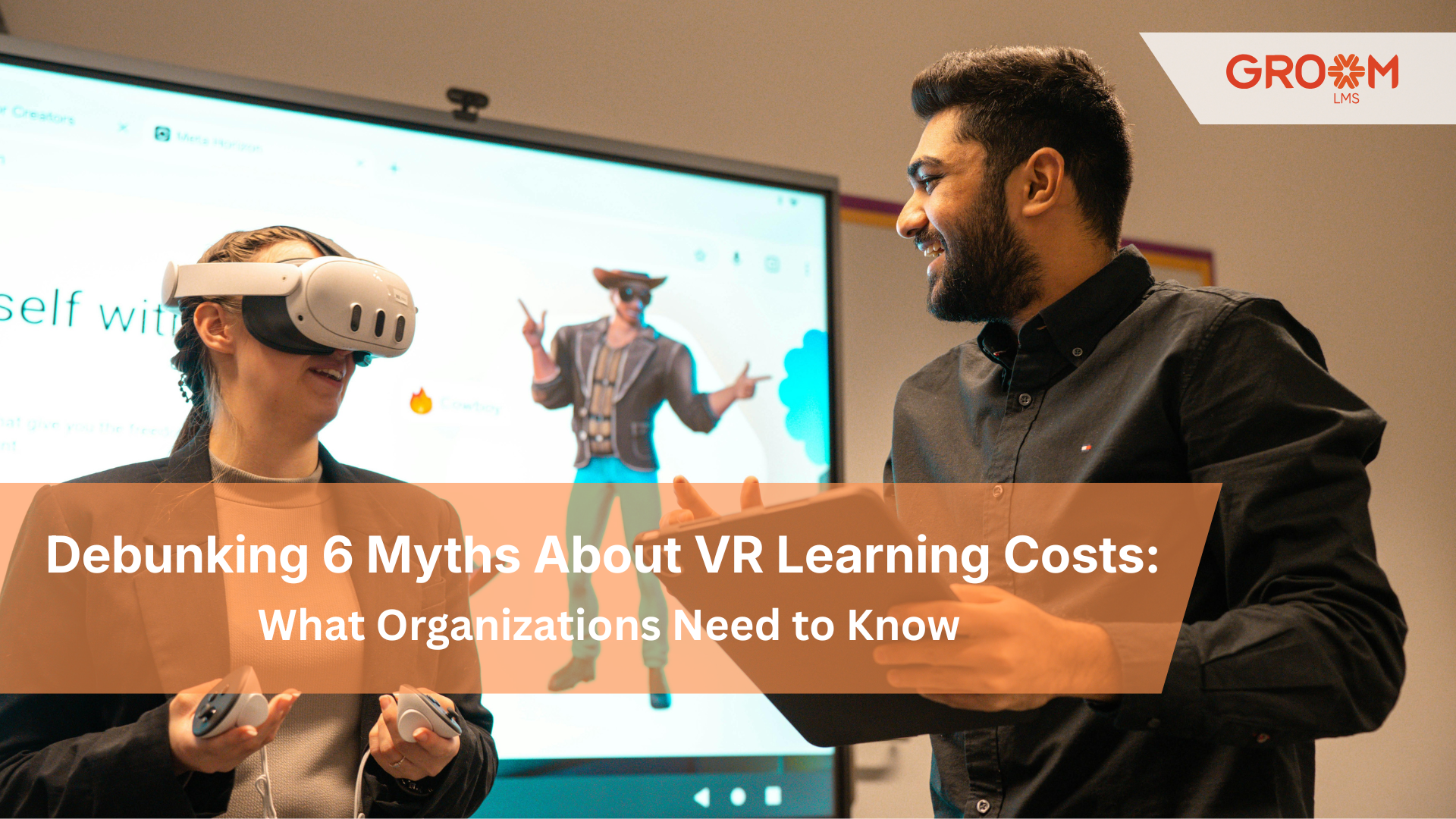
Virtual Reality (VR) has transformed many industries. From healthcare and manufacturing to corporate training, organizations now use immersive learning experiences to improve engagement and knowledge retention.
Yet despite its growing popularity, many businesses hesitate to adopt VR training. The biggest reason is often the perceived cost.
Decision-makers frequently assume that VR requires expensive equipment, large technical teams, and significant upfront investments. As a result, they postpone exploring a technology that could improve learning outcomes and reduce training inefficiencies.
The reality is quite different.
Modern VR solutions have become more accessible, scalable, and cost-effective than ever before. Combined with flexible learning platforms such as GroomLMS, organizations can manage and scale innovative training programs without depending heavily on IT teams.
Let’s examine six common myths about VR learning costs and uncover the facts behind them.
Why Organizations Misjudge VR Learning Costs
\Many assumptions about VR training originated years ago when hardware was expensive and content development options were limited.
Today, however, organizations benefit from:
- Affordable VR devices
- Cloud-based learning ecosystems
- Scalable content delivery
- Flexible subscription models
- Improved development tools
Consequently, businesses can introduce VR training programs with far less investment than many expect.
Myth #1: VR Training Is Only for Large Enterprises
One of the most common misconceptions is that only large corporations can afford VR learning.
Reality: Small and Mid-Sized Organizations Can Benefit Too
The cost of VR technology has decreased significantly over the past decade. Many providers now offer flexible deployment options suitable for startups, growing businesses, and mid-sized enterprises.
Organizations can begin with:
- A small pilot project
- One training module
- A limited number of users
After validating results, they can expand gradually.
This phased approach reduces financial risk while allowing teams to measure training effectiveness before scaling.
Example
A company onboarding 100 employees annually may start with a VR safety orientation program before expanding to leadership or technical training.
Myth #2: VR Hardware Costs Are Prohibitively Expensive
When people think about VR, they often imagine costly headsets and specialized equipment.
Reality: Hardware Is More Affordable Than Ever
Modern VR headsets are considerably less expensive than earlier generations.
Additionally, organizations can:
- Share devices across departments
- Schedule training sessions in batches
- Use standalone headsets that require minimal setup
As hardware prices continue to decline, the barrier to entry becomes much lower.
Moreover, the long-term savings from reduced instructor time and travel expenses often offset equipment investments.
Myth #3: VR Content Development Always Costs a Fortune
Many organizations assume every VR training experience must be custom-built from scratch.
Reality: Development Options Are More Flexible
While highly customized simulations can require larger budgets, many training needs do not demand complex development.
Organizations can choose:
- Off-the-shelf VR content
- Template-based experiences
- Modular training programs
- Industry-specific simulations
This flexibility allows businesses to align development costs with their actual training objectives.
Cost-Saving Tip
Start with standardized content for common topics such as:
- Workplace safety
- Compliance training
- Customer service
- Equipment operation
Then customize only where necessary.
Myth #4: VR Requires a Dedicated Technical Team
Another common concern involves ongoing management and maintenance.
Reality: Modern Platforms Simplify Administration
Today’s learning technology ecosystem is designed for ease of use.
Organizations no longer need large IT departments to manage training programs.
Platforms such as GroomLMS help teams:
- Launch learning programs quickly
- Automate enrollments
- Track learner progress
- Generate reports
- Manage certifications
As a result, HR and L&D teams can independently administer learning initiatives without relying heavily on technical resources.
This reduces operational costs while improving efficiency.
Myth #5: Traditional Training Is Always Cheaper
At first glance, classroom training may appear less expensive than VR learning.
However, direct costs tell only part of the story.
Reality: Total Training Costs Often Favor VR
Traditional training frequently involves:
- Travel expenses
- Venue costs
- Instructor fees
- Scheduling challenges
- Productivity loss
VR training can reduce many of these recurring expenses.
Consider This Scenario
A manufacturing company trains employees across multiple locations.
With traditional methods, trainers travel repeatedly to conduct sessions.
With VR learning:
- Training content is developed once.
- Employees access the same experience consistently.
- Training can be repeated without additional instructor costs.
Over time, this model often delivers significant savings.
Myth #6: VR Learning Does Not Deliver Enough ROI
Some leaders question whether immersive learning justifies the investment.
Reality: Improved Outcomes Can Generate Strong Returns
Research consistently shows that immersive learning can improve:
- Engagement
- Knowledge retention
- Practical skill application
- Learner confidence
Better learning outcomes often translate into:
- Faster onboarding
- Fewer workplace errors
- Increased productivity
- Reduced retraining costs
When organizations evaluate the full impact of training effectiveness, VR frequently demonstrates measurable value.
How GroomLMS Supports Scalable VR Learning Programs
Technology alone does not create successful training initiatives.
Organizations also need a reliable platform to manage, track, and scale learning experiences.
GroomLMS helps businesses streamline training operations through:
Centralized Learning Management
- Course administration
- User management
- Assessment tracking
- Certification management
Easy Program Scaling
Organizations can expand training programs without increasing administrative complexity.
Automation Features
- Automated enrollments
- Progress tracking
- Reporting dashboards
- Learning workflows
Reduced IT Dependency
L&D teams can independently manage training initiatives, making implementation faster and more cost-effective.
This combination allows organizations to focus on learning outcomes rather than technical challenges.
Best Practices for Managing VR Learning Costs
If your organization is considering VR training, follow these practical steps:
1. Start Small
Launch a pilot project and measure results before expanding.
2. Focus on High-Impact Use Cases
Prioritize training areas where immersive learning offers clear advantages.
3. Leverage Existing Learning Infrastructure
Integrate VR experiences into your broader learning strategy.
4. Measure Outcomes
Track:
- Completion rates
- Knowledge retention
- Employee performance
- Training efficiency
5. Scale Gradually
Expand only after demonstrating business value.
This approach helps maximize ROI while controlling costs.
Conclusion
The conversation around VR learning costs is often driven by outdated assumptions rather than current realities. Modern VR technology is more accessible, affordable, and scalable than ever before. Organizations no longer need enterprise-level budgets or large technical teams to deliver immersive learning experiences.
By understanding the facts behind these common myths, businesses can make more informed training decisions and unlock new opportunities for employee development. When combined with a flexible learning platform like GroomLMS, VR training becomes easier to manage, automate, and scale across the organization.
The future of workplace learning is increasingly immersive—and it may be more affordable than you think.
CTA – Request a Demo
Ready to Simplify and Scale Your Training Programs?
Whether you’re exploring VR learning, employee onboarding, compliance training, or skill development initiatives, GroomLMS helps your team launch and manage learning programs with ease.
Request a Demo today and discover how GroomLMS can help you automate training, reduce administrative effort, and create engaging learning experiences at scale.
Frequently asked questions (FAQs)
What are VR learning costs for businesses?
VR learning costs typically include hardware, content development, platform management, and implementation expenses. However, modern solutions offer flexible pricing options that make VR training more affordable than many organizations expect.
Is VR training suitable for small and mid-sized businesses?
Yes. Many small and medium-sized organizations successfully implement VR training through pilot programs and scalable deployment models that fit their budgets.
Can an LMS manage VR training programs?
Absolutely. A learning management system such as GroomLMS can organize, track, report, and scale VR training alongside other learning programs.
Does VR training require IT expertise?
Not necessarily. Modern LMS platforms and user-friendly VR solutions allow HR and L&D teams to manage training programs with minimal technical support.
How does VR improve employee training?
VR creates immersive experiences that improve engagement, knowledge retention, practical skill development, and learner confidence.