Imagine asking employees to complete a mandatory training course filled with slide after slide of dense text. Most learners quickly lose focus, skim through the content, or simply click “Next” without absorbing the information. As a result, organizations invest significant time and resources into training programs that deliver little long-term impact.
Today’s workforce expects learning experiences that are engaging, interactive, and easy to understand. Whether employees are learning compliance policies, product knowledge, software processes, or leadership skills, they retain information better when it is presented visually rather than through lengthy paragraphs.
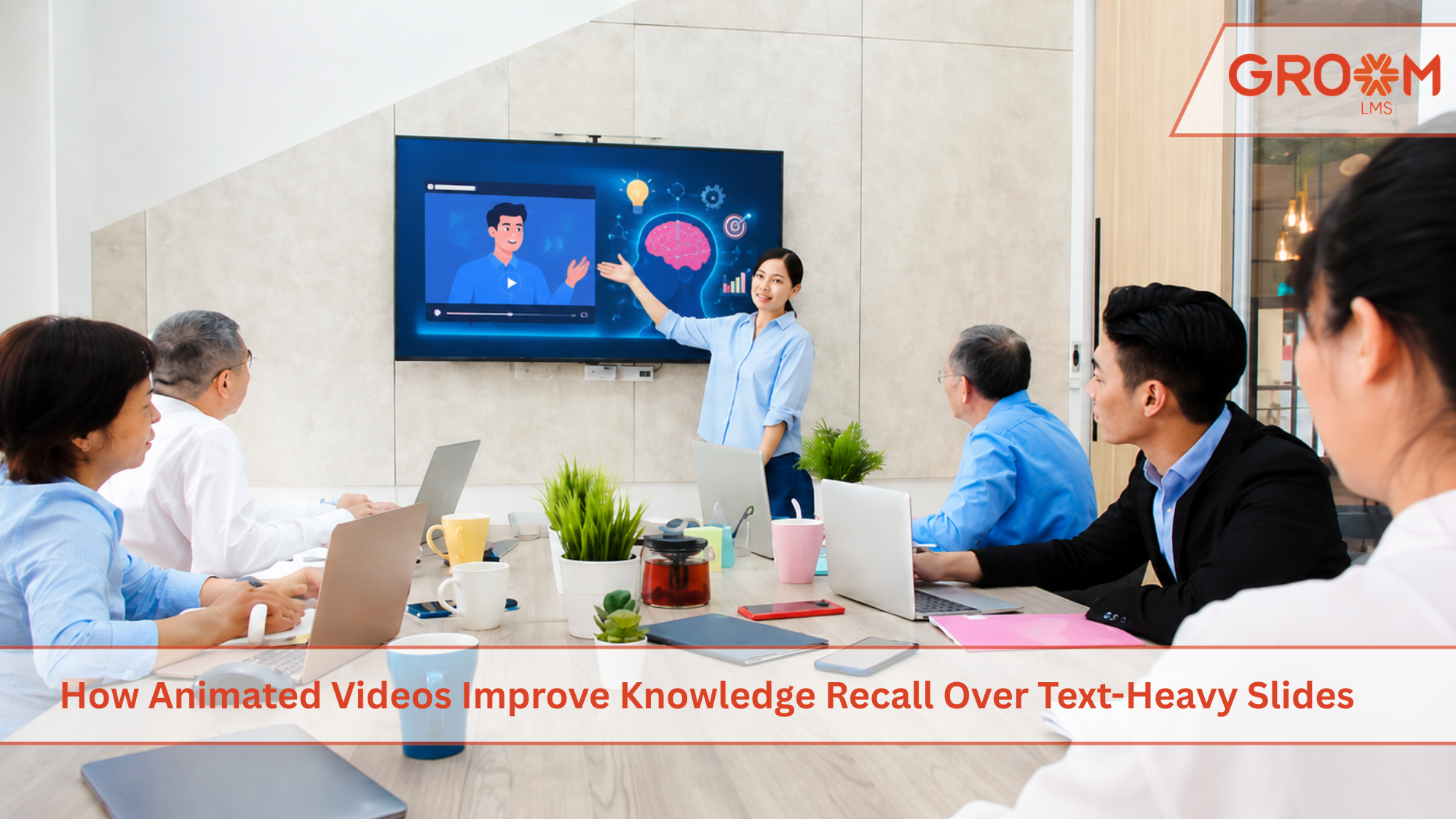
This is why animated videos have become an essential part of modern corporate learning. Instead of overwhelming learners with text-heavy slides, animation combines visuals, storytelling, narration, and motion to simplify complex concepts and improve memory retention.
With GroomLMS, organizations can easily create, deliver, and manage engaging e-learning experiences using multimedia-rich content, including animated videos, without relying on continuous IT support. The result is more effective learning, better knowledge retention, and a workforce that is confident in applying what they learn.
Why Knowledge Recall Matters in Employee Training
Training is only valuable when employees remember and apply what they have learned.
Knowledge recall directly affects:
- Employee productivity
- Workplace safety
- Compliance adherence
- Customer experience
- Operational efficiency
- Business performance
When employees forget training shortly after completing a course, organizations often face repeated mistakes, inconsistent performance, and additional retraining costs.
Improving knowledge recall ensures learning translates into better workplace outcomes.
The Problem with Text-Heavy Training Slides
Traditional e-learning often relies on long paragraphs, bullet points, and static presentations.
While these methods deliver information, they rarely keep learners engaged.
Common challenges include:
Information Overload
Large blocks of text overwhelm learners and reduce concentration.
Low Engagement
Reading multiple slides without interaction quickly becomes monotonous.
Poor Retention
Employees may complete training but struggle to remember important details later.
Reduced Motivation
Learners are less likely to finish courses when content feels repetitive.
Limited Real-World Context
Static slides often fail to demonstrate how concepts apply in everyday work situations.
Why Animated Videos Improve Knowledge Recall
Animated videos present information in a way that aligns with how the brain naturally processes and remembers content.
Instead of simply reading text, learners experience information through movement, narration, graphics, and storytelling.
This combination improves understanding and long-term retention.
1. Visual Learning Makes Concepts Easier to Remember
The human brain processes visuals much faster than text.
Animation transforms abstract ideas into clear visual examples that employees can easily understand.
For example, rather than describing a cybersecurity attack in paragraphs, an animated video can demonstrate how the attack occurs and how employees should respond.
Visual demonstrations make learning more memorable.
2. Storytelling Creates Emotional Connections
People remember stories far better than isolated facts.
Animated training videos often present workplace situations that learners can relate to.
For example:
A customer service representative handles an unhappy customer.
A manager addresses workplace harassment.
An employee identifies a phishing email.
These realistic scenarios help learners connect information with everyday responsibilities.
3. Animation Simplifies Complex Topics
Some training topics involve complicated processes.
Examples include:
- Financial compliance
- Healthcare procedures
- Manufacturing safety
- Software workflows
- Data security policies
Animation breaks these topics into smaller, easier-to-understand steps.
Instead of reading technical explanations, learners watch each stage unfold visually.
This reduces confusion and improves comprehension.
4. Audio and Visual Learning Reinforce Memory
Animated videos combine narration with visuals.
This multi-sensory approach strengthens learning because employees receive information through both sight and hearing.
As a result, learners are more likely to remember key concepts after completing the course.
5. Motion Maintains Attention
Static slides often struggle to hold attention.
Animation introduces movement, transitions, and visual cues that keep learners focused throughout the lesson.
Better attention naturally leads to stronger knowledge retention.
Animated Videos vs. Text-Heavy Slides
| Animated Videos | Text-Heavy Slides |
|---|---|
| Highly engaging | Often monotonous |
| Easier to understand | Can overwhelm learners |
| Strong knowledge retention | Lower recall rates |
| Demonstrates real scenarios | Explains concepts theoretically |
| Encourages course completion | Higher learner drop-off |
| Supports visual learning | Relies mainly on reading |
Organizations increasingly use animation because it improves both learner engagement and learning outcomes.
Practical Example
Consider an organization introducing a new customer onboarding process.
Traditional Approach
Employees receive a 40-slide presentation filled with policies and procedures.
Many learners skim the content and struggle to remember the steps during actual customer interactions.
Animated Learning Approach
The same onboarding process is converted into:
- Short animated videos
- Interactive scenarios
- Voice-guided explanations
- Knowledge checks
- Real workplace examples
Employees not only complete the course faster but also remember the workflow more effectively.
This leads to improved service quality and fewer onboarding errors.
How GroomLMS Supports Animated Learning
Creating engaging training should not require complex software or technical expertise.
GroomLMS makes it easy for organizations to integrate animated videos into their learning programs.
The platform supports:
- Multimedia-rich e-learning content
- Interactive learning modules
- Video-based training
- Assessments and quizzes
- Learning paths
- Certifications
- Progress tracking
- Analytics dashboards
- Virtual instructor-led training
Learning and development teams can independently upload, organize, and manage animated content while monitoring learner performance through intuitive dashboards.
Best Practices for Using Animated Videos in Training
To maximize knowledge recall, organizations should follow these practices.
Keep Videos Short
Microlearning videos between two and five minutes maintain learner attention.
Focus on One Learning Objective
Each video should teach a single concept.
Avoid covering multiple topics in one lesson.
Combine Animation with Assessments
Follow videos with quizzes or interactive activities.
This reinforces learning immediately.
Use Real Workplace Scenarios
Employees learn better when examples mirror their daily responsibilities.
Update Content Regularly
Business processes evolve.
Animated videos should reflect current policies, regulations, and organizational practices.
Measuring the Success of Animated Training
Organizations should evaluate learning effectiveness using measurable outcomes.
Track metrics such as:
- Course completion rates
- Quiz scores
- Knowledge retention
- Employee feedback
- Certification completion
- Time spent learning
- Workplace performance improvements
With GroomLMS, administrators gain access to detailed analytics and reporting tools that help identify learning gaps and continuously improve training programs.
The Future of Corporate Learning
Employee expectations continue to evolve.
Modern learners prefer interactive, visual, and flexible learning experiences over lengthy presentations.
Organizations that embrace animation create training that employees enjoy completing and remember long after the course ends.
As digital transformation accelerates, animated learning will continue to play an important role in onboarding, compliance, leadership development, product training, and customer service education.
By combining engaging multimedia with a scalable learning platform like GroomLMS, organizations can deliver training that drives measurable business results.
Conclusion
Animated videos have transformed the way organizations deliver employee training by making learning more engaging, memorable, and practical. Unlike text-heavy slides, animations simplify complex concepts through visuals, storytelling, and real-world scenarios that improve knowledge recall and learner engagement. As businesses continue to adopt digital learning, creating impactful training experiences becomes essential for workforce development. GroomLMS enables organizations to seamlessly integrate animated videos, assessments, certifications, and interactive learning into one scalable platform. With easy course management and powerful analytics, GroomLMS helps businesses build effective training programs that employees not only complete but also remember and apply in their daily work.
CTA – Request a Demo
Explore GroomLMS Today
Whether you’re training employees, partners, or customers, GroomLMS helps you deliver learning that drives results.
Request a demo, sign up to experience the platform, or contact us to find the right solution for your organization.
Frequently Asked Questions (FAQs)
Why do animated videos improve knowledge recall in employee training?
Animated videos combine visuals, narration, and storytelling, making information easier to understand and remember than traditional text-heavy slides.
Can GroomLMS support video-based employee training?
Yes. GroomLMS supports animated videos, multimedia content, assessments, certifications, and interactive learning experiences within a single learning management platform.
Are animated videos suitable for compliance training?
Absolutely. Animated videos simplify complex regulations, demonstrate real workplace scenarios, and help employees better retain compliance-related information.
How can organizations measure the effectiveness of animated training?
Organizations can track course completion rates, assessment scores, learner engagement, certifications, knowledge retention, and analytics through GroomLMS reporting dashboards.
Which types of training benefit most from animated videos?
Animated videos work well for onboarding, compliance, software training, product knowledge, customer service, leadership development, workplace safety, and process-based learning.