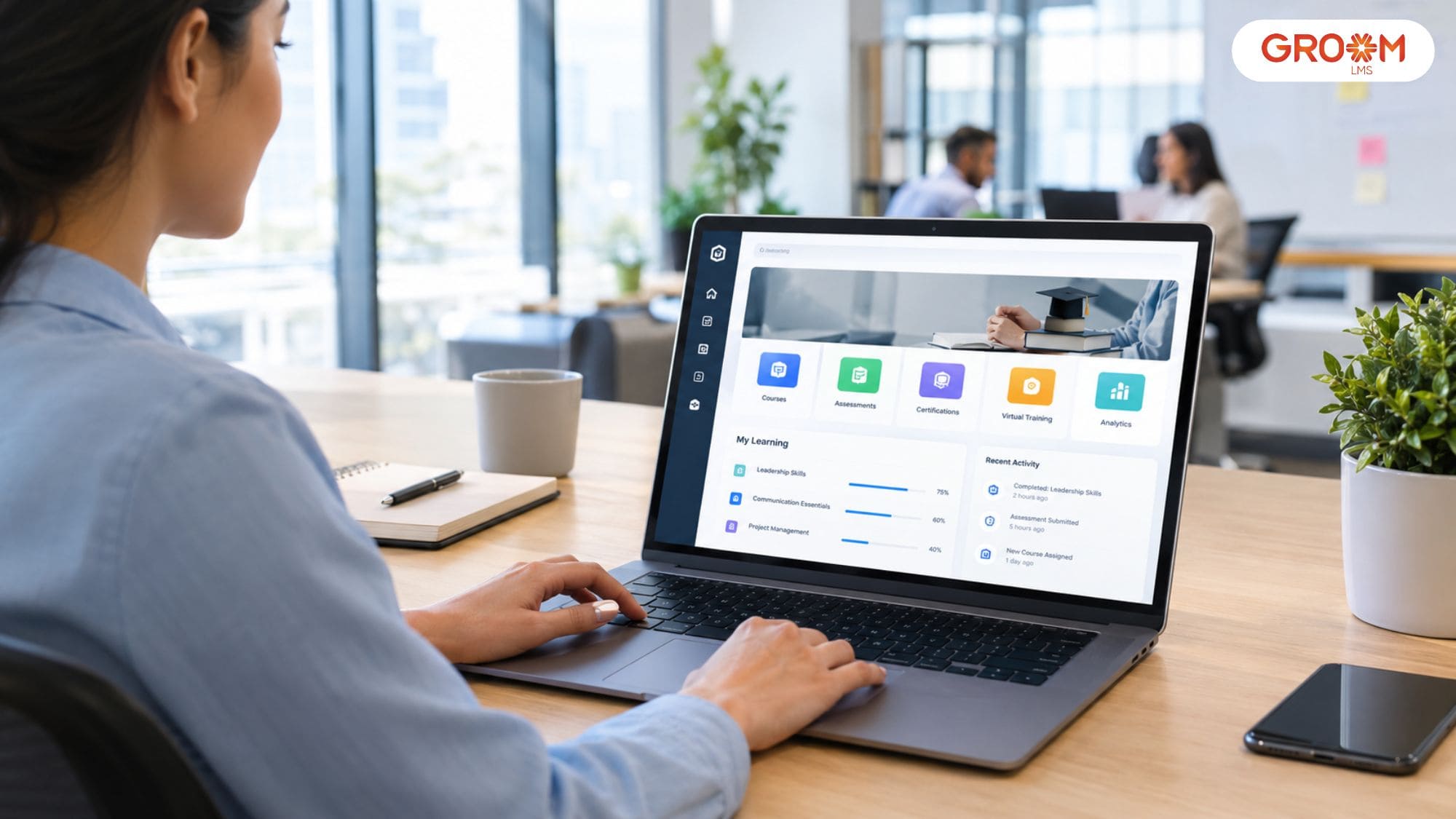
When performance drops, managers often respond by arranging another training session. However, the real problem may not be a lack of training. Employees might need different skills, more practice, or support with specific tasks.
Without reliable learning data, deciding who needs training becomes guesswork. Some employees repeat topics they already understand, while others miss essential learning opportunities. This wastes time and makes it harder to connect training with business goals.
An AI-Powered LMS for Corporate Training can help organisations make better-informed decisions by combining learning activity, assessment results, and performance-related information where available. Instead of treating every employee the same, training teams can identify patterns and investigate where additional support may be useful.
For HR leaders, learning and development teams, and corporate training managers, early skill-gap identification can make training more focused and relevant. GroomLMS provides learning management capabilities that organisations can evaluate when improving course delivery, assessments, and progress monitoring.
The key is to use technology as a guide, not as the sole judge of employee ability. With clear goals, appropriate data, and thoughtful follow-up, organisations can plan training that addresses genuine needs before skill gaps affect wider performance.
Why Skill Gaps Are Difficult to Identify Early
Skill gaps occur when employees lack the knowledge or abilities required to perform specific tasks effectively. These gaps may emerge when roles change, new tools are introduced, or business requirements evolve.
Traditional training methods often reveal problems only after performance issues appear. Managers may notice repeated mistakes, missed targets, or delays before recognising the underlying learning need.
Several challenges make early identification difficult:
- Limited visibility: Managers cannot always see which skills employees have mastered.
- Generic training plans: Teams assign the same courses to everyone, regardless of experience.
- Scattered information: Assessment scores, training records, and feedback sit in separate systems.
- Delayed responses: Organisations review skill requirements only during annual performance evaluations.
- Unclear priorities: Training teams struggle to distinguish urgent skill gaps from optional development needs.
Consider a sales team introducing a new customer relationship management system. Some employees may need help with reporting, while others struggle with data entry or customer follow-ups.
Assigning everyone the same introductory course may not address these differences. A more targeted approach identifies specific learning needs and directs employees towards relevant support.
An AI-Powered LMS for Corporate Training can help surface patterns in learning data. However, organisations still need clear skill definitions and appropriate assessments to interpret those patterns accurately.
How an AI-Powered LMS for Corporate Training Identifies Skill Gaps
An AI-Powered LMS for Corporate Training can support skill-gap analysis by bringing relevant learning information together and helping teams identify areas that deserve attention. The exact capabilities depend on the platform, available data, and configured tools.
Analysing Assessment Results
Assessments help organisations understand whether employees have grasped essential concepts. Results can reveal recurring mistakes or topics where additional practice may be useful.
For example, employees completing cybersecurity training may repeatedly struggle with questions about suspicious links. Training managers can review the results and provide focused guidance on phishing recognition.
Assessment results should be interpreted alongside other evidence. A low score may reflect unclear questions, language barriers, or insufficient preparation rather than a genuine lack of ability.
Reviewing Learning Progress
Course completion records show whether employees have finished assigned learning. When combined with assessment results, these records can help distinguish participation from understanding.
An employee might complete every module but still struggle to apply the concepts. Another employee might demonstrate strong knowledge but need practical experience.
Learning progress reports help managers identify cases that require further investigation instead of assuming course completion proves competence.
Finding Patterns Across Teams
When data is available and appropriate to use, AI-supported analysis can help identify recurring learning needs across departments or job roles.
For instance, repeated assessment difficulties among new managers may indicate a need for stronger training in feedback, delegation, or performance conversations.
These patterns can help L&D teams prioritise learning interventions. They should not automatically become individual performance judgments without further review.
Supporting Personalised Learning Recommendations
Some AI-enabled learning systems can recommend resources based on learner activity, assessment outcomes, or defined development goals.
An employee who struggles with a particular topic might receive relevant lessons or additional practice. Someone who already demonstrates the required knowledge may benefit from more advanced content.
Recommendations should remain relevant to the employee’s role and the organisation’s learning objectives. Managers should also provide alternatives when the suggested material does not meet an individual’s needs.
Turning Skill-Gap Insights into Targeted Training
Identifying a gap is only the beginning. Organisations must turn the information into practical learning actions that improve employee capability.
A useful process connects business requirements, evidence of current skills, and suitable training interventions.
- Define the required skills. Identify the knowledge and abilities employees need for their roles. Use job responsibilities, process changes, compliance requirements, and manager feedback to establish priorities.
- Assess current capabilities. Use appropriate assessments, practical tasks, employee self-evaluations, and manager observations. Choose methods that reflect real job requirements.
- Compare requirements with evidence. Identify differences between expected and demonstrated skills. Record uncertainties rather than treating incomplete data as proof of a gap.
- Assign relevant learning. Match employees with suitable courses, guided practice, mentoring, or supervised work. Avoid assigning unnecessary training simply because it is available.
- Measure progress. Repeat relevant assessments or review practical performance after training. Check whether employees can apply what they learned.
- Update development plans. Use the findings to refine future learning priorities and address any remaining gaps.
For example, a customer support team may need to improve its handling of difficult conversations. Managers could assess relevant scenarios, identify common weaknesses, and assign focused modules on listening and de-escalation.
After training, employees could complete another scenario-based assessment. Managers could then review the results and provide additional coaching where needed.
This process makes training more purposeful. It also helps organisations distinguish between a knowledge gap and a workplace issue that training alone cannot resolve.
What to Look for in an AI-Powered LMS for Corporate Training
Not every platform offers the same AI capabilities. Organisations should evaluate actual functionality instead of choosing a system based on the AI label alone.
Useful Learning Data and Reporting
Look for clear reports covering enrolment, completion, assessment performance, and learner progress. These provide a foundation for identifying training needs and monitoring participation.
Ask whether reports can be filtered by role, department, course, or other relevant categories. Also confirm whether the available data supports the decisions your team wants to make.
Relevant Assessment Tools
Assessments should measure knowledge or skills connected to the learning objectives. Depending on the training programme, this may involve quizzes, scenario-based questions, or practical evaluations.
The platform should make it possible to review results and identify areas requiring further instruction.
Appropriate AI Capabilities
Ask precisely what the platform’s AI features do. Can they recommend learning resources, summarise patterns, or help interpret learning data? What information do they require, and how are recommendations generated?
Request demonstrations using realistic scenarios. Confirm limitations and avoid assuming that AI can accurately assess every workplace skill.
Privacy and Human Oversight
Employee learning records can contain sensitive information. Organisations should understand how data is collected, accessed, stored, and used.
Managers should review important recommendations, explain relevant decisions, and provide employees with opportunities to correct inaccurate information.
How GroomLMS Can Support Corporate Training Management
GroomLMS provides learning management capabilities that organisations can evaluate when improving how they create, deliver, and monitor employee training.
Course management helps teams organise learning materials around defined training objectives. Assessments can support knowledge checks, while progress tracking and reporting help training managers review participation and completion.
These capabilities can provide useful information when identifying potential skill gaps. For example, teams can review assessment outcomes to find topics that require clearer instruction or additional learning resources.
However, learning data alone does not establish an employee’s complete skill level. Organisations should combine available reports with practical assessments, manager feedback, and job-related evidence.
When evaluating GroomLMS for corporate training, consider whether its available features and configuration support your specific workflow. Review reporting requirements, course delivery needs, and the process for assigning follow-up learning.
You can explore the GroomLMS features page to assess relevant capabilities. Before implementation, test representative training scenarios and confirm that the platform fits your team’s needs.
The aim is to make training easier to organise and monitor while giving employees learning opportunities that address genuine development needs.
Conclusion
Waiting for performance problems to reveal missing skills can leave employees without the support they need. A more proactive approach helps organisations identify learning priorities earlier and respond with relevant training.
An AI-Powered LMS for Corporate Training can help teams review assessment results, monitor learning progress, and recognise patterns that deserve further investigation. These insights can support targeted development plans instead of assigning identical courses to every employee.
However, technology works best when combined with clear skill requirements, reliable assessments, employee feedback, and manager judgment. AI recommendations should guide decisions rather than replace human evaluation. Organisations must also handle employee data responsibly and explain how learning information is used.
GroomLMS offers learning management capabilities that organisations can evaluate when organising courses, assessments, and training progress. The right setup can help L&D teams manage learning activities more effectively and make better use of available training information.
Start by identifying the skills that matter most to your organisation. Establish a practical way to assess them, provide focused learning, and review progress over time.
With a structured approach, your organisation can move beyond guesswork and build training programmes that respond to employees’ actual development needs.
Build More Targeted Training with GroomLMS
Discover how GroomLMS empowers your organization to streamline training, enhance learner engagement, and deliver impactful learning experiences with an AI-powered LMS built for growth.
Contact Us | Join GroomLMS | Chat on WhatsApp
Frequently Asked Questions (FAQs)
What is a skill gap in corporate training?
A skill gap is the difference between the skills an employee currently demonstrates and the skills required to perform their role effectively.
Can AI identify skill gaps without assessments?
AI may identify patterns in available learning or performance-related data, but reliable skill-gap analysis usually requires suitable assessments and additional evidence.
How often should organisations assess employee skill gaps?
Review skill gaps during regular development cycles and whenever job responsibilities, tools, processes, or business requirements change significantly.
Can an AI-powered LMS recommend individual learning paths?
Some platforms can recommend learning resources based on available learner data, assessment results, and development goals. The specific capabilities depend on the system.
Is an AI-Powered LMS for Corporate Training suitable for small businesses?
Yes. Small businesses can evaluate an AI-Powered LMS for Corporate Training based on their budget, workforce needs, available features, and capacity to manage employee learning.