Employees do not want to spend several minutes searching through an LMS just to find one training course. They want the right information quickly, especially when learning needs to fit around a busy workday.
For L&D teams, the challenge is different. They need to create training, assign courses, track progress, manage assessments, and report results without constantly depending on IT support.
This is where a Voice Search Optimized LMS can make a difference. Instead of relying only on menus and filters, employees can use natural-language searches to find relevant learning content more easily.
Imagine an employee asking, “Which compliance training do I need to complete?” rather than opening multiple course categories. That small change can remove friction from the learning experience.
However, voice search is only one part of the bigger picture. A useful workplace LMS should also make training management simple, support automation, and scale as the organization grows.
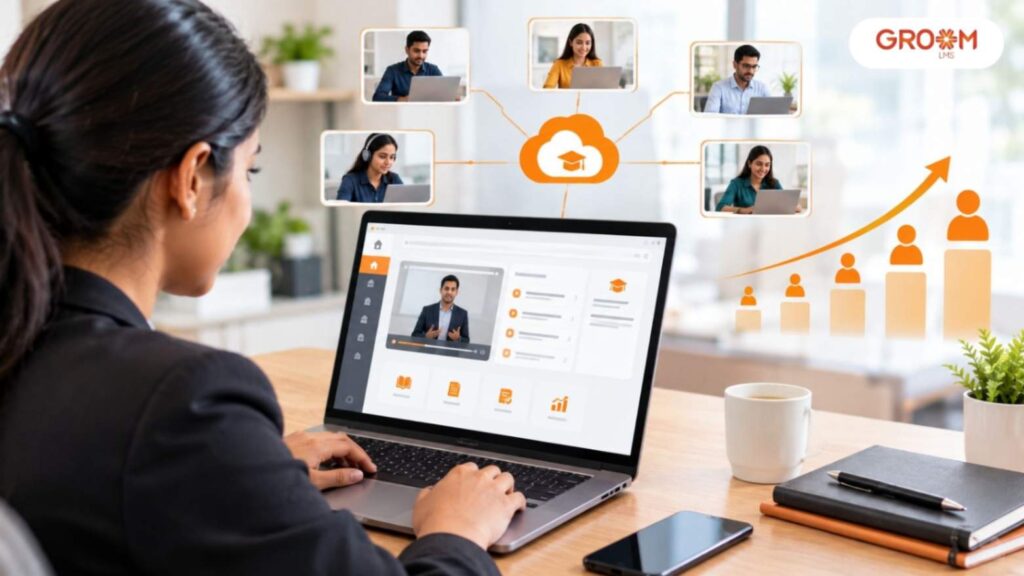
GroomLMS brings these capabilities together, helping organizations manage digital learning with less technical dependency and a more streamlined learner experience.
What Is a Voice Search Optimized LMS?
A Voice Search Optimized LMS is a learning management system designed to support natural-language and voice-based searches for learning content.
Traditional LMS searches often depend on specific course names or keywords. Voice search allows employees to phrase requests more naturally.
For example, an employee could search for:
- “Find my onboarding course.”
- “Show me leadership training.”
- “What compliance training is due this month?”
This approach can make course discovery easier, particularly when an organization has a large learning library.
More importantly, voice search should work alongside a well-organized LMS. Clear course names, useful descriptions, structured learning paths, and relevant metadata still matter.
Therefore, organizations should view voice search as part of a broader effort to make workplace learning easier to navigate.
Why Voice Search Matters for Workplace Learning
Workplace learning often competes with meetings, deadlines, customer requirements, and everyday responsibilities. As a result, even small barriers can make employees less likely to engage with training.
Voice-enabled search can reduce one of those barriers: finding the right content.
Faster course discovery
Employees can describe what they need instead of remembering the exact course title.
For example, someone looking for manager training may search for “courses for new team leaders.” A natural-language approach can make the experience feel more intuitive.
A simpler learner experience
Employees already use conversational search in many digital services. Bringing a similar experience into workplace learning can make an LMS feel more familiar.
This matters because employees should spend their time learning, not figuring out how to navigate the platform.
Better access to learning resources
Voice-based interaction can provide another way for employees to access learning content. This can be especially useful when learners are working across different devices or need information quickly.
However, organizations should still prioritize clear navigation and accessible course design. Voice search should add convenience rather than replace a good user experience.
How an LMS Can Make Employee Training More Efficient
Voice search can improve how employees find training. Yet L&D teams also need efficient tools for managing what happens behind the scenes.
A modern LMS can automate many routine activities.
For example, when a new employee joins an organization, the LMS can assign relevant onboarding courses. It can then track completion, send reminders, record assessment results, and help managers monitor progress.
Without automation, these tasks can quickly become repetitive.
With the right system, L&D teams can spend less time chasing completion updates and more time improving course quality and employee development.
Simplify training workflows
A well-designed workflow can connect different parts of the learning process.
A typical employee training journey might look like this:
Training assignment → Course completion → Assessment → Certification → Progress tracking
This creates a consistent process while reducing manual intervention.
Manage growing training needs
Training becomes more complicated as an organization grows. More employees mean more courses, assignments, reports, and compliance requirements.
An LMS should therefore be able to support growing learning programs without making administration unnecessarily complicated.
GroomLMS helps organizations create and manage scalable digital learning programs while reducing dependence on technical teams for routine LMS management.
How to Prepare Your LMS for Voice Search
Organizations do not need to completely rebuild their learning strategy to make content easier to discover through voice search.
Instead, start with the basics.
Use language employees actually use
Course titles should be clear and specific.
For example, “Cybersecurity Awareness Training for Employees” is easier to understand than an internal code such as “SEC-M04.”
Natural language also helps employees know what they will learn before opening a course.
Organize content around learning needs
Employees usually think about what they need, not how the LMS categorizes information.
Someone may search for “training for first-time managers” rather than knowing which department owns that course.
Therefore, structure your content around roles, skills, tasks, and common training requirements.
Keep learning paths clear
Avoid making employees jump between multiple sections to complete one learning objective.
Instead, connect relevant courses, assessments, and certifications into straightforward learning paths.
This creates less friction and makes progress easier to understand.
Where GroomLMS Fits Into Smarter Workplace Learning
A Voice Search Optimized LMS can make content discovery easier. However, organizations also need the tools to manage learning after employees find that content.
GroomLMS supports organizations with a range of digital learning capabilities, including course management, assessments, certifications, virtual training, and learning analytics.
Its scalable approach also helps organizations manage changing training requirements without creating unnecessary technical complexity.
For L&D teams, this can mean greater control over everyday learning operations. They can manage training programs, monitor progress, and use learning data to understand how employees are engaging with training.
GroomLMS also supports organizations that want to build structured digital learning experiences without managing several disconnected systems.
The result is a more centralized approach to workplace learning, where content, learners, training activities, and reporting can be managed within one learning environment.
A Simple Example of Voice-Enabled Workplace Learning
Consider a company onboarding a group of new employees.
Without an efficient LMS, employees may receive several emails containing different training links. They then have to work out which courses apply to them and keep track of what they have completed.
Now imagine a more streamlined experience.
An employee searches for “my onboarding training.” The LMS helps them locate the relevant learning content. Required courses can then be assigned automatically, while progress is tracked in the background.
After completing the required training, the employee takes an assessment. The organization can record the result and manage certification where required.
Meanwhile, the L&D team can monitor overall completion without manually checking every employee.
The technology is doing the repetitive work, while employees get a clearer learning journey.
What to Look for in a Modern LMS
Voice search is useful, but it should not be the only factor when choosing an LMS.
Organizations should also consider how easily the platform supports everyday learning operations.
Look for an LMS that provides:
- Simple course creation and management
- Automated training workflows
- Assessments and certifications
- Learner progress tracking
- Reports and analytics
- Scalable learning programs
- Easy administration
- Reduced technical dependency
Most importantly, consider the experience from both sides.
Employees need a platform that is easy to use. L&D teams need one that is easy to manage.
When both experiences work well, organizations can deliver training more consistently and spend less time dealing with unnecessary administrative tasks.
The Future of Workplace Learning Is Becoming More Conversational
The way people search for information is changing. Instead of typing short keywords, users increasingly communicate with digital tools through complete questions and natural language.
Workplace learning can benefit from the same shift.
A Voice Search Optimized LMS can help employees find relevant training with less navigation. At the same time, automation can help L&D teams manage assignments, progress, assessments, and reporting more efficiently.
However, the real value comes from combining these capabilities with good learning design.
Clear content, logical learning paths, useful search functionality, and simple administration all contribute to a better experience.
Organizations do not need to chase every new technology trend. Instead, they should focus on removing the friction that prevents employees from learning effectively.
That is where a platform such as GroomLMS can support the transition toward simpler, more scalable digital learning.
Conclusion
Workplace learning works best when employees can find what they need without unnecessary effort.
A Voice Search Optimized LMS can make course discovery more natural by allowing employees to search using everyday language. This can reduce navigation time and make digital learning more convenient.
However, voice search alone does not solve every training challenge. Organizations also need automation, clear learning paths, assessments, certifications, progress tracking, and useful reporting.
By bringing these capabilities together, L&D teams can spend less time managing repetitive tasks and more time improving employee learning.
GroomLMS provides a scalable digital learning environment that helps organizations manage training, assessments, certifications, virtual learning, and analytics with less technical dependency.
As workplace learning continues to evolve, simplicity will become increasingly important. Employees should be able to find training easily, while L&D teams should have the tools to manage learning without unnecessary complexity.
A smarter LMS is ultimately not about adding more features. It is about making the entire learning journey easier, faster, and more useful.
Transform Your Corporate Learning with GroomLMS
Discover how GroomLMS empowers your organization to streamline training, enhance learner engagement, and deliver impactful learning experiences with an AI-powered LMS built for growth.
Contact Us | Join GroomLMS | Chat on WhatsApp
Frequently Asked Questions(FAQs)
What is a voice search optimized LMS?
A voice search optimized LMS makes learning content easier to find through natural-language and voice-based queries. It can help learners locate courses and resources faster.
How can voice search improve employee training?
Voice search can reduce the time employees spend navigating menus and searching for courses. It provides a more natural way to find relevant learning content.
What features should a modern workplace LMS have?
A modern LMS should offer course management, assessments, certifications, automation, analytics, mobile learning, learner management, and scalable infrastructure.
Can an LMS automate employee training?
Yes. Modern LMS platforms can automate course assignments, reminders, assessments, progress tracking, certifications, and reporting.
Is GroomLMS suitable for large organizations?
Yes. GroomLMS provides scalable learning solutions that can support businesses, institutions, and organizations with growing training requirements.