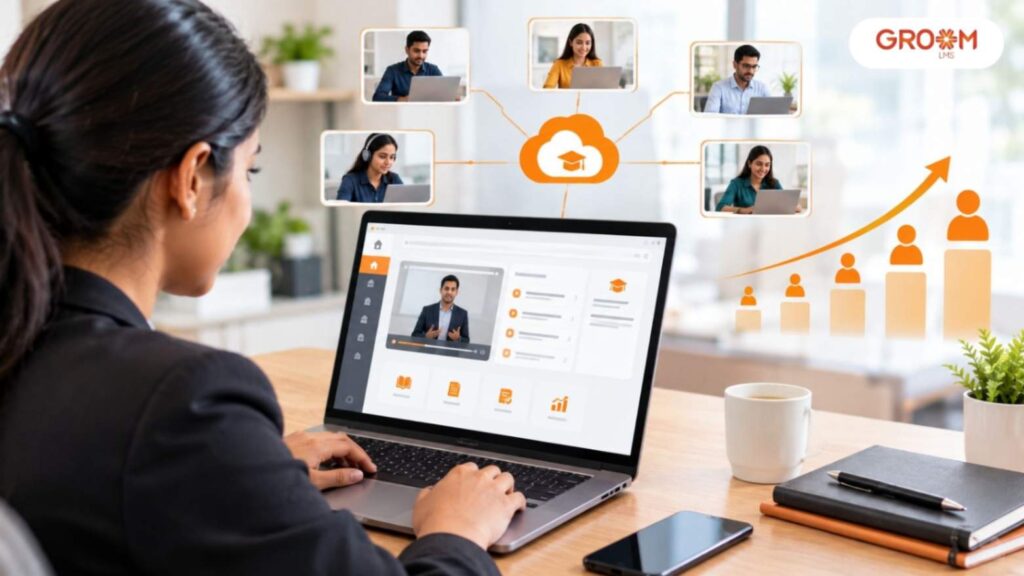

Corporate training in India is moving beyond classroom sessions, spreadsheets, and disconnected learning resources. Organizations increasingly need digital platforms that can deliver training consistently, support employees across locations, and provide managers with clear visibility into learning progress. As workforces become more distributed, technology has become an important part of how businesses organize and scale employee development.
A Learning Management System (LMS) provides a centralized environment for creating, delivering, managing, and tracking training. However, organizations now have many deployment options, including self-hosted, hosted, and cloud-based solutions. Among these, a SaaS-based LMS offers a subscription-based approach in which the software is accessed online while infrastructure, platform maintenance, and updates are generally managed by the service provider.
For Indian businesses evaluating the best training platforms in India, the focus should not simply be on the number of features. Organizations need to consider scalability, ease of implementation, learner experience, reporting, security, integrations, content compatibility, and overall training objectives. Platforms such as GroomLMS demonstrate how a modern SaaS-based approach can help businesses manage structured digital learning without creating unnecessary technical complexity.
What Is a SaaS-Based LMS?
SaaS stands for Software as a Service. A SaaS-based LMS is a learning management system delivered through the internet, usually through a subscription model.
Instead of installing and maintaining the LMS infrastructure internally, organizations access the platform through a web browser. The service provider typically manages areas such as platform hosting, maintenance, updates, and technical infrastructure.
This model can make LMS adoption more accessible for organizations that want to launch digital learning without building a large internal technology environment.
A SaaS LMS can support activities such as:
- Course creation and management
- Employee enrollment
- Learning paths
- Assessments and quizzes
- Certifications
- Learner tracking
- Training reports
- Multimedia learning
- Virtual instructor-led training
- Compliance training
- Role-based learning
Why Are SaaS-Based LMS Platforms Growing in India?
Indian businesses operate across a wide range of industries, workforce sizes, and geographic locations. A manufacturing organization may need to train employees across multiple facilities, while a technology company may have teams working remotely across different cities.
Traditional training models can become difficult to coordinate as organizations grow. Employees may have different schedules, managers may need different reports, and training content may require frequent updates.
A SaaS-based LMS can provide a centralized digital environment that makes it easier to:
Standardize learning: Deliver consistent training content across departments and locations.
Scale training: Add new learners and courses without building a new infrastructure environment for every expansion.
Improve accessibility: Allow employees to access learning through internet-connected devices.
Simplify administration: Centralize course assignment, learner management, assessments, and reporting.
Support continuous learning: Deliver onboarding, compliance, upskilling, and refresher training through the same environment.
What Makes a Training Platform One of the Best Options?
The term “best” can mean different things for different organizations. A small company may prioritize affordability and simplicity, while a large enterprise may need advanced integrations, extensive reporting, and complex learning structures.
Therefore, businesses should evaluate an LMS against their own requirements rather than selecting a platform simply because it appears on a popular list.
Ease of Implementation
A SaaS platform should be straightforward to set up and manage. Complicated implementation can delay training initiatives and increase dependency on technical teams.
Scalability
The platform should be able to support increasing numbers of employees, courses, departments, and training programs as the organization grows.
Course Management
L&D teams need efficient ways to create, upload, organize, update, and assign learning content.
Learner Tracking
Managers should be able to monitor course completion, assessment performance, learner progress, and certification status.
Reporting and Analytics
Useful reports help L&D teams understand whether employees are participating in training and where additional learning may be required.
Integration Capabilities
A corporate LMS may need to work with HR systems, communication tools, identity systems, content standards, or other business applications.
Security and Access Management
Training platforms handle employee information and organizational content. Businesses should therefore evaluate security practices, access controls, permissions, and data management.
Key Features to Look for in a SaaS-Based LMS
A modern SaaS-based LMS should support more than basic course delivery.
Course Authoring
Course authoring capabilities allow organizations to create structured learning content using text, video, documents, assessments, and multimedia.
Learning Paths
Learning paths can organize multiple courses into a structured sequence. This is useful for onboarding, leadership development, compliance programs, and role-based training.
Assessments and Quizzes
Assessments help organizations determine whether learners understand the material rather than simply confirming that they opened a course.
Certifications
Digital certificates can provide evidence that employees completed specific training requirements.
Analytics and Dashboards
Dashboards give L&D teams a centralized view of learner activity, completion, performance, and other training indicators.
SCORM and xAPI Support
Organizations with existing e-learning libraries should check whether the LMS supports relevant content standards. SCORM and xAPI can be particularly important when businesses work with standardized digital learning content.
Virtual Instructor-Led Training
A combination of self-paced learning and live virtual sessions can support blended training programs.
Mobile Accessibility
Employees may need to complete training away from their desks. Mobile-friendly learning can improve accessibility for distributed and frontline workforces.
SaaS-Based LMS vs Traditional LMS
The difference between SaaS and traditional LMS deployment is largely related to how the technology is delivered and managed.
| Factor | SaaS-Based LMS | Traditional Self-Hosted LMS |
|---|---|---|
| Deployment | Online/cloud-based | Organization-managed infrastructure |
| Infrastructure | Usually managed by provider | Managed by organization |
| Updates | Generally handled by provider | Often managed internally |
| Accessibility | Accessible through internet-connected devices | Depends on organizational setup |
| Scalability | Typically easier to expand | May require additional infrastructure |
| Technical dependency | Lower internal infrastructure dependency | Greater internal IT involvement |
| Maintenance | Provider-managed | Organization-managed |
| Cost model | Usually subscription-based | May involve licensing and infrastructure costs |
The appropriate model depends on organizational requirements. Companies that want greater control over infrastructure may consider self-hosted solutions, while businesses seeking simpler deployment may prefer SaaS.
Best Training Platform Features for Indian Businesses
Organizations in India often operate with diverse workforces, multiple locations, different levels of digital familiarity, and varied training requirements.
A useful LMS should therefore support several types of learning.
Employee Onboarding
New employees can be assigned structured learning paths covering company policies, workplace processes, systems, culture, and role-specific requirements.
Compliance Training
Organizations can manage recurring compliance programs and maintain digital records of completion.
Upskilling and Reskilling
Learning teams can use courses and learning paths to support employee development as job requirements evolve.
Leadership Development
Managers and future leaders can receive targeted learning programs covering communication, decision-making, people management, and strategic skills.
Product and Process Training
Businesses can train employees on new products, services, software, workflows, and internal processes.
Customer and Partner Training
Some organizations need to extend learning beyond employees. External learning portals can help businesses train customers, partners, distributors, or other stakeholders.
Benefits of Using a SaaS-Based LMS
Faster Deployment
A cloud-based subscription model can reduce the need for organizations to establish and maintain their own LMS infrastructure.
Lower Infrastructure Dependency
Businesses can reduce the need for extensive internal infrastructure management because much of the technical environment is handled by the service provider.
Flexible Learning Access
Employees can access assigned training from different locations, supporting remote and hybrid work environments.
Easier Scalability
Training programs can expand as organizations add employees, departments, locations, and courses.
Centralized Administration
L&D teams can manage courses, learners, assessments, certificates, and reports from a single environment.
Better Training Visibility
Analytics and reporting can provide managers with clearer insights into learner progress and training performance.
Continuous Learning
A SaaS LMS can support ongoing learning rather than limiting training to occasional classroom sessions.
How to Choose the Right SaaS-Based LMS in India
Choosing a platform should begin with business requirements rather than features alone.
1. Define your training objectives
Identify whether the primary requirements are onboarding, compliance, upskilling, customer training, leadership development, or a combination.
2. Identify your learner groups
Consider employee numbers, departments, locations, job roles, and whether external audiences will also require access.
3. Review content requirements
Determine whether you need SCORM, xAPI, video, documents, assessments, virtual training, or interactive content.
4. Evaluate administration
Check how easily administrators can create courses, enroll learners, assign training, generate reports, and update content.
5. Assess integrations
Identify the systems that the LMS needs to connect with before implementation.
6. Consider scalability
Think beyond current requirements. The selected platform should support future growth without creating unnecessary operational complexity.
7. Test the learner experience
A technically capable LMS is not useful if employees find it difficult to navigate. A pilot program can help evaluate usability before wider deployment.
Common Mistakes Businesses Make When Selecting an LMS
Organizations sometimes choose an LMS based on a long feature list without considering actual training requirements.
Common mistakes include:
- Selecting a platform without defining learning objectives
- Focusing only on price
- Ignoring learner experience
- Not checking content compatibility
- Overlooking reporting requirements
- Failing to evaluate integrations
- Not testing the platform with actual learners
- Choosing a system that cannot scale with business growth
A structured evaluation process can reduce these risks and make LMS implementation more effective.
How GroomLMS Fits the SaaS-Based LMS Model
GroomLMS is designed to make digital learning accessible, interactive, and easier to manage for businesses. Its platform supports capabilities such as course creation, learning management, assessments, certifications, analytics, learner tracking, multimedia learning, and standardized e-learning content.
For organizations evaluating training platforms in India, GroomLMS can be considered when the objective is to centralize corporate learning while reducing unnecessary technical dependency.
Businesses can use the platform for employee onboarding, compliance training, professional development, role-based learning, and other structured training initiatives. The SaaS approach also provides organizations with a practical way to manage digital learning as their training requirements evolve.
Measuring LMS Success
Selecting a platform is only the beginning. Organizations should measure whether the LMS is actually improving their training process.
Important indicators can include:
- Course completion rates
- Assessment performance
- Learner engagement
- Training time
- Certification completion
- Learning path completion
- Department-level participation
- Knowledge assessment results
- Training-related compliance gaps
These metrics can help L&D teams identify what is working and where learning programs need improvement.
The Future of SaaS-Based Corporate Learning
Corporate learning is becoming increasingly connected to automation, analytics, artificial intelligence, personalized learning, and skills development.
SaaS-based LMS platforms are positioned to support this evolution because organizations can access new platform capabilities without rebuilding their entire learning infrastructure.
Future learning environments are likely to place greater emphasis on personalized learning paths, automated training workflows, AI-assisted content development, skills-based learning, richer analytics, and learning experiences that connect training with broader business objectives.
The role of an LMS is therefore moving beyond course storage. It is becoming a central component of how organizations manage knowledge, employee development, compliance, and continuous learning.
Conclusion
A SaaS-based LMS can provide Indian businesses with a flexible approach to managing employee training without placing the entire technology infrastructure burden on internal teams. From course management and assessments to learner tracking, reporting, and certifications, the right platform can bring multiple training activities into one centralized environment.
When evaluating the best training platforms in India, organizations should focus on their specific requirements rather than selecting a platform based solely on popularity. Scalability, usability, content compatibility, reporting, security, integrations, and learner experience should all be considered before making a decision.
For businesses looking to modernize corporate learning, GroomLMS provides a SaaS-based environment for creating, delivering, and managing structured digital training programs.
Modernize Your Corporate Training
The right LMS should make learning easier to manage while giving employees a better way to develop their skills.
Explore GroomLMS to build scalable digital learning programs for onboarding, compliance, upskilling, and employee development.
Contact Us | Join GroomLMS | Chat on WhatsApp
Frequently Asked Questions (FAQs)
What is a SaaS-based LMS?
A SaaS-based LMS is a cloud-delivered learning management system that organizations access online, generally through a subscription model. The service provider typically manages the underlying infrastructure and platform maintenance.
Why should businesses use a SaaS-based LMS?
A SaaS LMS can provide flexible access to training, easier deployment, centralized administration, scalability, and reduced dependency on internally managed LMS infrastructure.
What features should businesses look for in a SaaS LMS?
Important features can include course management, learning paths, assessments, certifications, learner tracking, analytics, reporting, SCORM/xAPI support, integrations, mobile accessibility, and security controls.
Is a SaaS LMS suitable for small businesses?
Yes. SaaS platforms can be suitable for small businesses because they can reduce infrastructure requirements and allow organizations to start with their immediate training needs and scale as they grow.
Can a SaaS LMS support compliance training?
Yes. SaaS-based LMS platforms can be used to deliver compliance courses, assign mandatory learning, track completion, conduct assessments, and maintain training records.