Organizations across industries need reliable ways to evaluate knowledge, measure practical skills, and determine whether individuals are prepared for specific professional responsibilities. From hiring new employees to evaluating existing workforce capabilities, assessments help businesses make informed decisions. However, general-purpose tests may not always measure the specialized knowledge and competencies required for different industries.
As job roles become more specialized, businesses need assessment methods that reflect real workplace requirements. A test designed for a banking professional, for example, may need to evaluate financial knowledge, customer handling, and regulatory awareness. In contrast, an assessment for a technical employee may focus on troubleshooting, technical concepts, and problem-solving abilities. Industry-focused assessments can make evaluations more relevant to the responsibilities being measured.
Industry-specific online tests offer a digital approach to creating and delivering assessments tailored to particular sectors, job roles, and professional competencies. With GroomLMS, organizations can manage digital learning and assessment activities within a centralized learning environment, helping connect knowledge evaluation with employee training, skill development, and ongoing professional learning.
What Are Industry-Specific Online Tests?
Industry-specific online tests are digital assessments designed to evaluate the knowledge, skills, and competencies required in a particular industry, profession, or job role.
Unlike generic assessments that measure broad abilities, these tests focus on subject-specific knowledge and practical situations relevant to a defined field.
For example, a financial services organization may use assessments to evaluate employees’ understanding of financial products, customer verification procedures, and internal policies. A manufacturing company may assess knowledge of equipment safety, quality standards, and operational procedures.
Depending on the purpose, industry-specific online tests may include multiple-choice questions, scenario-based questions, technical exercises, case studies, and knowledge checks.
These assessments can be used throughout the professional development cycle, including recruitment, onboarding, training, certification, and periodic skill evaluation.
Why Are Industry-Specific Online Tests Important?
A candidate or employee may perform well on a general knowledge test but still lack the expertise required for a particular role. Industry-specific assessments help organizations evaluate competencies that are directly relevant to professional responsibilities.
1. Evaluate Relevant Knowledge
Industry-focused tests help determine whether candidates or employees understand the concepts, terminology, procedures, and standards associated with their field.
This allows organizations to assess knowledge against more clearly defined role requirements.
2. Support Better Recruitment Decisions
Recruitment teams need ways to evaluate candidates beyond resumes and interviews.
A role-specific online assessment can provide additional information about a candidate’s technical knowledge, decision-making, and understanding of relevant workplace situations.
Although assessments should not be the sole basis for hiring, they can contribute to a more structured selection process.
3. Identify Employee Skill Gaps
Organizations need to understand where employees may require additional training.
Assessment results can highlight areas where learners demonstrate strong understanding and topics that need further development.
L&D teams can use these insights to plan targeted learning interventions.
4. Standardize Evaluations
When assessments are designed around consistent criteria, organizations can evaluate individuals using the same core questions and scoring standards.
This can help reduce unnecessary variations between assessment sessions, departments, or locations.
5. Support Professional Development
Industry-specific assessments can help employees understand their current capabilities and identify areas for improvement.
When connected with appropriate training resources, assessment results can guide continuous learning and professional growth.
Industries That Can Benefit From Online Assessments
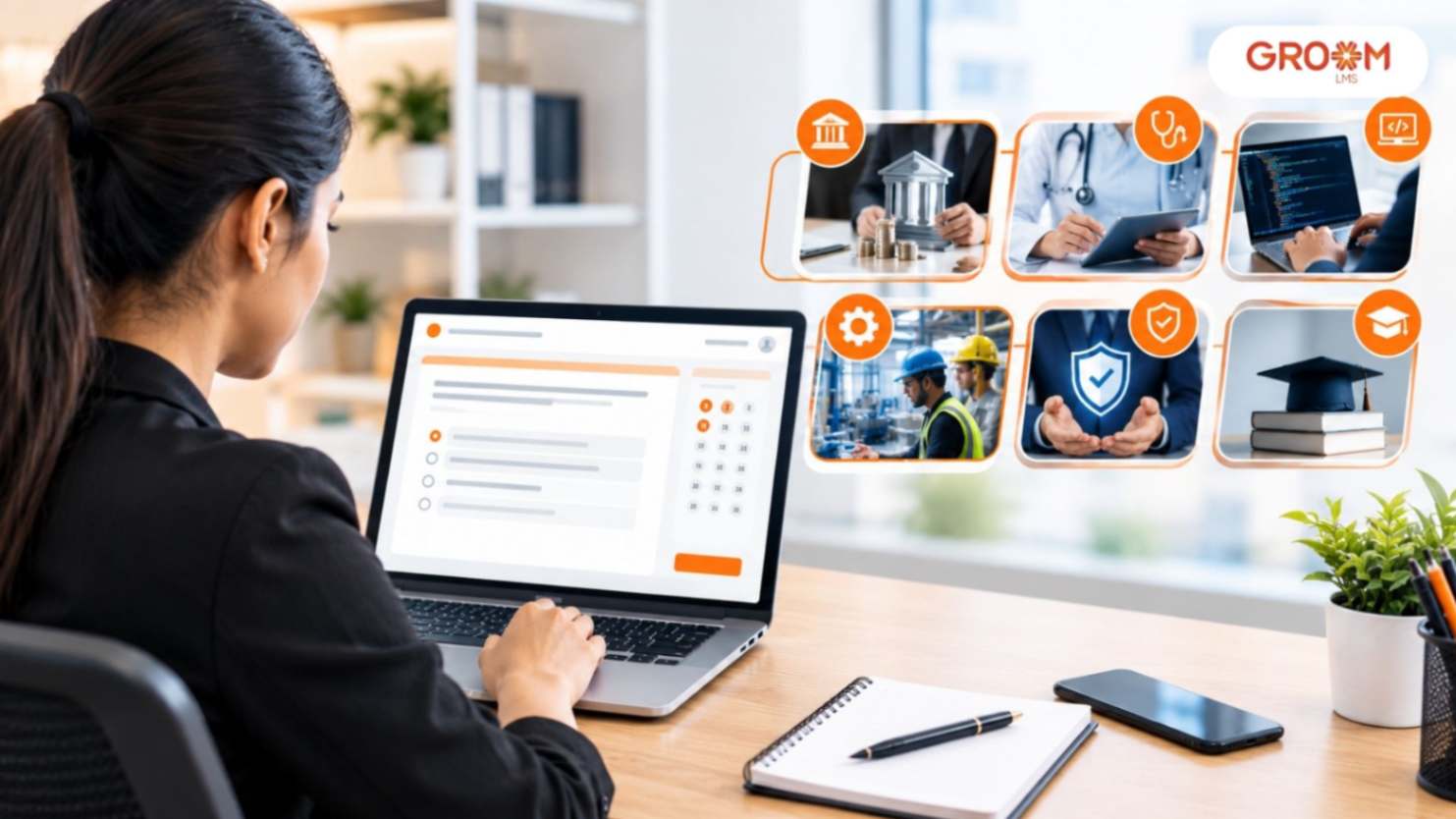
Different industries require different knowledge areas and practical competencies. Online assessments can be customized to reflect these differences.
Banking and Financial Services
Banks and financial service providers need employees who understand financial products, customer service procedures, transaction processes, and applicable internal policies.
Industry-specific tests can evaluate knowledge of banking operations, financial inclusion, customer verification, fraud awareness, and risk management.
For example, an assessment for banking correspondents could cover customer onboarding, basic banking services, digital transactions, and responsible customer support.
Healthcare and Medical Education
Healthcare organizations require professionals with specialized knowledge and an understanding of relevant procedures.
Online tests can evaluate theoretical knowledge, clinical concepts, patient safety awareness, and professional protocols.
However, online assessments should complement practical evaluation and supervised competency checks where hands-on skills are required.
Information Technology
IT organizations often need to assess technical knowledge and problem-solving abilities.
Assessments can cover programming concepts, cybersecurity awareness, database management, networking, software testing, and troubleshooting.
Depending on the role, organizations may combine objective questions with coding exercises or practical technical tasks.
Manufacturing and Engineering
Manufacturing and engineering roles often involve equipment, technical specifications, operational procedures, and workplace safety.
Industry-specific tests can evaluate knowledge of quality standards, maintenance procedures, technical drawings, safety practices, and production workflows.
These assessments can help identify areas where employees need further instruction before performing specialized tasks.
Insurance and Risk Management
Insurance professionals need to understand policy concepts, customer requirements, risk assessment, documentation, and relevant organizational procedures.
Online tests can evaluate product knowledge, claims processes, customer communication, and compliance awareness.
Organizations can also use assessments to reinforce knowledge when products, policies, or internal procedures change.
Education and Professional Certification
Educational institutions, training providers, and certification organizations can use online assessments to evaluate subject knowledge and learning outcomes.
Tests can be aligned with course objectives, professional competencies, or certification requirements.
The assessment design should reflect the qualification being evaluated and any applicable examination standards.
Key Features of Effective Industry-Specific Online Tests
An effective assessment should do more than present questions on a screen. Its design should reflect the skills being evaluated and provide useful information about learner performance.
Customized Question Banks
Question banks allow organizations to organize questions according to subjects, competencies, difficulty levels, or job roles.
For example, a banking assessment may contain separate question groups for customer service, financial products, and operational procedures.
A well-maintained question bank can also support the creation of different test versions while keeping the assessment aligned with its objectives.
Multiple Question Formats
Different competencies require different assessment methods.
Common question formats include:
- Multiple-choice questions
- True-or-false questions
- Matching questions
- Scenario-based questions
- Short-answer questions
- Practical exercises, where supported
Multiple-choice questions may be suitable for checking conceptual knowledge, while scenario-based questions can evaluate how learners apply information in workplace situations.
Automated Scoring
Automated scoring can reduce the time required to evaluate objective questions.
It also helps organizations apply consistent scoring rules across assessment attempts.
Questions that require human judgment, such as certain written responses or complex practical tasks, may still need manual review.
Timed Assessments
Some assessments require a defined time limit to reflect examination conditions or evaluate performance under time constraints.
Timing should be appropriate to the assessment objective. Excessively short limits can measure speed rather than the intended knowledge or competency.
Performance Reports
Assessment reports can help administrators understand how individuals and groups perform.
Depending on the platform’s capabilities, reports may include scores, completion status, question-level performance, and other assessment indicators.
These insights can guide training decisions and identify subjects that require additional attention.
How Industry-Specific Online Tests Support Employee Training
Online assessments are particularly useful when integrated into a structured employee learning program.
Before Training: Establish a Baseline
A pre-training assessment can help determine what employees already know.
For example, an organization introducing a new cybersecurity program could assess employees’ understanding of phishing, password security, and data handling before delivering the course.
The results can help trainers identify areas requiring greater emphasis.
During Training: Reinforce Understanding
Short knowledge checks can be included throughout a course to reinforce important concepts.
Instead of waiting until the end of a long training program, organizations can evaluate understanding at different stages.
This gives learners opportunities to recognize and address knowledge gaps.
After Training: Evaluate Learning Outcomes
A post-training assessment can help determine whether employees have understood the material covered in the program.
Comparing pre-training and post-training results may provide useful evidence of changes in knowledge, although assessment scores alone do not establish improvements in workplace performance.
During Ongoing Development: Monitor Progress
Industries, technologies, and workplace processes continue to evolve.
Periodic assessments can help organizations review employee knowledge and identify when refresher learning may be necessary.
This makes assessment part of continuous professional development rather than a one-time activity.
Challenges in Implementing Industry-Specific Online Tests
Although online assessments offer flexibility, organizations need to address several considerations to make them effective.
Keeping Questions Relevant
An assessment can quickly become outdated when products, technologies, procedures, or applicable requirements change.
Organizations should review question banks regularly and involve appropriate subject-matter experts in the process.
Avoiding Ambiguous Questions
Questions should be clear, accurate, and directly connected to the intended learning objective.
Ambiguous wording can produce misleading results because employees may misunderstand the question rather than lack the required knowledge.
Maintaining Assessment Integrity
Online assessments may need safeguards to reduce unauthorized assistance or misuse.
Depending on the assessment’s importance, organizations can consider randomized question sets, controlled access, appropriate time limits, identity verification, or proctoring options where available and suitable.
Assessment security measures should be proportionate to the risk and respect learner privacy.
Making Assessments Accessible
Tests should be designed with different learner needs in mind.
Clear instructions, readable content, accessible navigation, and compatibility with relevant devices can help reduce unnecessary barriers.
Interpreting Results Correctly
A low score does not always mean an employee lacks the required ability. The learner may have misunderstood the instructions, experienced a technical issue, or encountered an assessment that did not accurately measure the intended competency.
Organizations should interpret results alongside other relevant evidence and provide opportunities for appropriate review or further training.
Best Practices for Creating Industry-Specific Online Tests
Organizations can improve assessment quality by following a structured design process.
Define the competency: Identify the knowledge or skill that the assessment needs to measure.
Understand the target audience: Consider the learners’ roles, experience levels, and professional responsibilities.
Use realistic scenarios: Include examples that reflect relevant workplace situations.
Choose suitable question formats: Match the assessment format to the competency being evaluated.
Review question quality: Check accuracy, clarity, relevance, and difficulty.
Set transparent evaluation criteria: Make scoring rules and completion requirements clear.
Provide useful feedback: Where appropriate, explain incorrect answers and direct learners toward relevant learning resources.
Review assessment data: Use performance patterns to improve training content and question design.
These practices help ensure that online tests remain meaningful rather than becoming simple completion exercises.
The Role of an LMS in Managing Industry-Specific Online Tests
A Learning Management System (LMS) can help organizations connect assessments with broader learning and development activities.
Instead of managing tests, training materials, and learner records separately, organizations can use a centralized platform to coordinate many aspects of digital learning.
Depending on the platform’s available features, an LMS may support course-based assessments, quiz creation, learner assignments, scoring, completion tracking, certifications, and reporting.
For example, a company could create a role-specific learning program that includes an introductory course, a set of industry-focused knowledge checks, and a final assessment.
Administrators can then review available results to identify learners who may need additional support.
When selecting an LMS, organizations should confirm that its assessment features support their required question types, scoring rules, reporting needs, integrations, and security expectations.
How GroomLMS Supports Digital Assessment and Learning
GroomLMS provides a centralized environment for managing digital learning programs, including course management, assessments, certifications, analytics, dashboards, and learner progress tracking.
These capabilities can support organizations that want to connect industry-specific knowledge evaluation with structured training and employee development.
For example, an organization could organize learning materials around role-specific competencies, incorporate assessments into appropriate courses, and use available reports to monitor learner progress.
A training team could also review assessment performance to identify topics that may require clearer explanations or additional learning resources.
By bringing learning activities and assessment management together, GroomLMS can help organizations organize their digital training initiatives more efficiently.
Organizations should evaluate the platform’s available assessment functionality against their specific requirements before implementation, particularly when they need advanced question formats, specialized scoring, proctoring, or industry-specific examination workflows.
Measuring the Effectiveness of Industry-Specific Online Tests
Assessment success should be measured by more than the number of tests completed.
Organizations can begin by reviewing participation, completion rates, scores, and the distribution of results across relevant groups.
Question-level analysis can reveal whether learners repeatedly struggle with a particular concept. If many employees answer the same question incorrectly, the issue may involve the training content, the question wording, or a genuine knowledge gap.
For training programs, organizations can also compare pre-training and post-training results to evaluate changes in knowledge.
Where appropriate, assessment findings can be considered alongside workplace observations, supervisor feedback, quality measures, and other relevant performance indicators.
This broader approach helps organizations understand whether their assessments are providing useful information for recruitment, training, and professional development.
Conclusion
Industry-specific online tests help organizations evaluate the knowledge and competencies that matter most within their sectors. From banking and healthcare to IT, manufacturing, insurance, and professional education, customized assessments can make evaluations more relevant to specific roles and responsibilities.
However, effective testing requires more than transferring generic questions to an online format. Organizations need clearly defined competencies, relevant questions, appropriate scoring methods, accessible assessment experiences, and regular content reviews.
An LMS can help connect assessments with courses, learner progress, certifications, and training reports. GroomLMS provides a centralized environment for managing digital learning and assessment activities, helping organizations incorporate knowledge evaluation into broader employee development initiatives.
By combining well-designed assessments with relevant training and continuous improvement, businesses can build a more structured approach to measuring skills and supporting professional growth.
Build a Smarter Digital Assessment Strategy
Bring learning and assessment activities together in a centralized environment with GroomLMS. Organize digital courses, evaluate learner progress, and support structured employee development.
Contact Us | Join GroomLMS | Chat on WhatsApp
Frequently Asked Questions (FAQs)
What are industry-specific online tests?
Industry-specific online tests are digital assessments designed to evaluate the knowledge and skills required in a particular industry, profession, or job role.
Which industries can use online assessments?
Banking, healthcare, information technology, manufacturing, insurance, education, and many other industries can use online assessments to evaluate relevant knowledge and competencies.
How do industry-specific online tests help recruitment?
They provide additional information about candidates’ role-related knowledge and skills, helping recruitment teams make more structured decisions alongside interviews and other evaluation methods.
Can online tests be used for employee training?
Yes. Organizations can use pre-training assessments, knowledge checks, and post-training tests to identify knowledge gaps and evaluate learning outcomes.
What types of questions can industry-specific tests include?
Depending on the assessment platform, tests may include multiple-choice questions, true-or-false questions, matching activities, scenario-based questions, short answers, and practical exercises.