Employee learning has become an important part of business growth. Organizations need to help employees understand company policies, develop professional skills, learn new technologies, and adapt to changing responsibilities. However, managing training across departments, locations, and job roles can become complicated when businesses rely on classroom sessions, spreadsheets, emails, and disconnected learning resources.
Traditional training methods may work for small teams, but they often create administrative challenges as organizations expand. HR and L&D teams need a reliable way to organize learning content, assign relevant courses, monitor employee progress, assess knowledge, and evaluate training outcomes. Without a centralized system, maintaining consistency and identifying learning gaps can require significant time and effort.
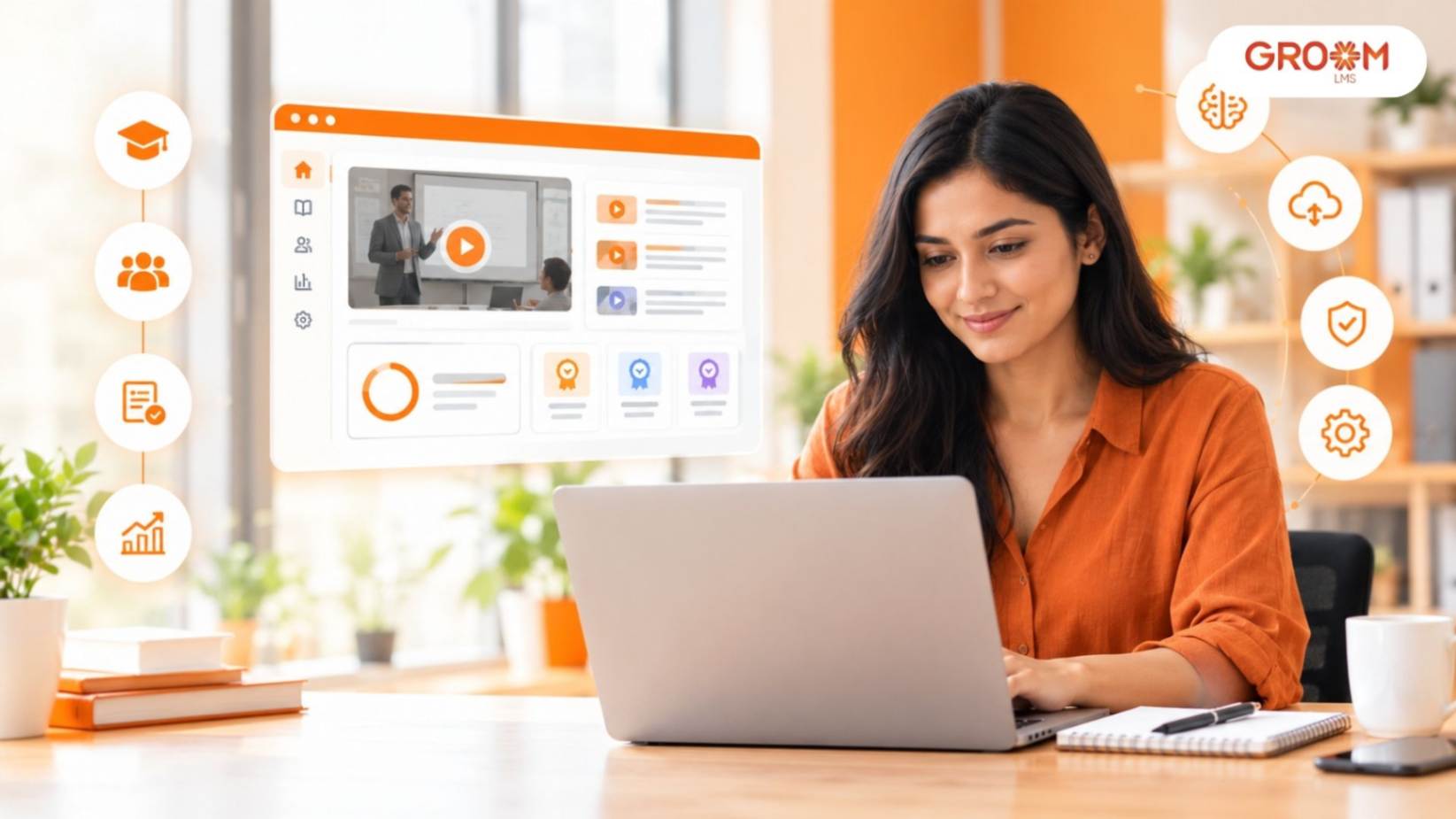
A corporate learning management system provides a structured digital environment for managing these activities. GroomLMS helps organizations organize, deliver, and track employee learning through capabilities such as course management, assessments, certifications, learner tracking, analytics, and reporting. By bringing important training activities together, businesses can create a more organized approach to employee development.
What Is a Corporate Learning Management System?
A corporate learning management system, commonly known as a corporate LMS, is a digital platform that helps organizations create, deliver, manage, and measure employee training programs.
Unlike a system used only to host online courses, a corporate LMS can support multiple stages of the employee learning journey. It can help organizations manage onboarding, compliance training, professional development, leadership programs, product education, and role-specific learning.
Depending on the platform’s capabilities, a corporate LMS can provide:
- Course creation and management
- Employee enrollment and user management
- Role-based learning paths
- Video and multimedia learning
- Assessments and quizzes
- Certifications and completion records
- Learner progress tracking
- Training analytics and reports
- Virtual instructor-led training
- Learning content management
By centralizing these activities, an LMS can help HR and L&D teams reduce dependence on disconnected tools and maintain better visibility into training programs.
Why Do Businesses Need a Corporate LMS?
Organizations increasingly need training that can adapt to changing business requirements, employee responsibilities, and workforce structures.
A corporate LMS can help address several common training challenges.
1. Managing Training Across Multiple Locations
Businesses with employees working across different offices, branches, or regions may find it difficult to organize consistent classroom training.
A centralized learning platform allows organizations to distribute standardized training content across locations. Employees can access assigned learning through the digital environment according to organizational access policies and available technology.
This approach can support consistent communication of company policies, product information, and operational procedures.
2. Simplifying Employee Onboarding
New employees need to understand the organization’s culture, processes, systems, and expectations.
A corporate LMS can organize onboarding into structured learning paths that cover company introductions, workplace policies, role-specific training, product knowledge, and assessments.
HR teams can monitor progress and identify outstanding training activities without relying entirely on manual follow-ups.
3. Supporting Continuous Skill Development
Employee development should continue beyond the initial onboarding period.
As technologies, customer expectations, and business processes evolve, employees may need to strengthen existing skills or learn new ones.
A corporate LMS can provide ongoing learning opportunities through professional development courses, technical training, leadership programs, and role-specific learning paths.
4. Improving Training Visibility
L&D teams need to understand whether employees are participating in and completing assigned training.
An LMS can provide reports on course completion, assessment performance, learner progress, and certification status, depending on the platform’s features.
This visibility helps organizations identify employees who need additional support and training programs that may require improvement.
5. Reducing Administrative Complexity
Managing training through spreadsheets, emails, and separate documents can create repetitive work.
A corporate LMS can centralize course assignments, learner records, assessments, and reporting. Where automation is available, it can also simplify reminders, notifications, and other recurring tasks.
This allows training teams to focus more on learning quality and less on administrative coordination.
Key Features of a Corporate Learning Management System
Choosing a corporate LMS requires an understanding of the capabilities needed to support the organization’s training strategy.
Course Creation and Management
A corporate LMS should provide a structured way to create, organize, publish, update, and manage training content.
Depending on the platform, courses may include videos, presentations, documents, quizzes, interactive modules, and other digital learning materials.
Centralized course management also makes it easier to maintain learning resources as business requirements change.
Role-Based Learning Paths
Employees in different roles often require different training.
For example, sales employees may need product knowledge and customer communication training, while managers may require leadership development and performance management learning.
Role-based learning paths help organizations assign relevant courses according to job responsibilities, departments, experience, or development goals.
Assessments and Quizzes
Course completion alone does not necessarily demonstrate understanding.
Assessments and quizzes can help organizations evaluate learner knowledge and reinforce important concepts.
Scenario-based questions are particularly useful when employees need to apply information to realistic workplace situations.
Certifications
Some training programs require formal completion records or certificates.
An LMS with certification capabilities can help organizations document learning achievements and manage certification-related workflows.
For mandatory training, businesses should ensure that their recordkeeping and certification processes meet applicable internal and external requirements.
Analytics and Reporting
Training data can help organizations understand how employees interact with learning programs.
Useful reporting capabilities may include:
- Course completion rates
- Assessment scores
- Learner progress
- Training participation
- Certification status
- Department-level performance
- Learning activity
These insights can help L&D teams identify knowledge gaps and improve future training programs.
Multimedia and Interactive Learning
Employees may engage with learning content differently depending on the subject and format.
A corporate LMS that supports multimedia learning can help organizations combine videos, presentations, interactive activities, quizzes, and practical scenarios.
Using suitable formats can make training more accessible and relevant to different learning objectives.
Integration Capabilities
Organizations may already use HRMS, CRM, communication, and other business applications.
LMS integration capabilities can help connect learning with existing systems and workflows. Before selecting a platform, businesses should verify which integrations are supported and whether they meet their technical requirements.
Types of Corporate Training an LMS Can Support
A corporate learning management system can support different learning needs throughout an employee’s time with an organization.
Employee Onboarding
Structured onboarding introduces new employees to company policies, workplace processes, tools, organizational culture, and role-specific responsibilities.
Compliance Training
Organizations can use an LMS to deliver and track training related to workplace conduct, data protection, cybersecurity, ethics, safety, and other relevant compliance topics.
Training content should reflect the organization’s industry, responsibilities, and applicable requirements.
Technical and Professional Upskilling
Employees may need to develop technical, digital, communication, analytical, or other professional skills as business requirements evolve.
An LMS can organize learning paths around these development objectives.
Leadership Development
Managers and future leaders can follow structured programs covering communication, decision-making, team management, conflict resolution, and leadership responsibilities.
Product and Sales Training
Sales and customer-facing teams need accurate information about products, services, processes, and customer requirements.
A corporate LMS can provide centralized learning resources and assessments to help these employees maintain product knowledge.
Process and System Training
When organizations introduce new software or revise internal processes, employees may need targeted training.
Digital courses and demonstrations can help communicate the new workflows and provide employees with resources they can revisit when necessary.
Corporate LMS vs. Traditional Training Methods
Traditional training can still be useful, particularly when employees need hands-on practice, direct discussion, or supervised instruction. However, relying exclusively on classroom sessions can make training more difficult to coordinate at scale.
| Training Area | Traditional Approach | Corporate LMS |
|---|---|---|
| Course delivery | Often depends on scheduled sessions | Supports structured digital learning |
| Accessibility | May require attendance at a specific time and place | Can provide flexible access, depending on setup |
| Progress tracking | May involve manual records | Supports centralized digital tracking |
| Assessments | Often managed separately | Can include online quizzes and assessments |
| Reporting | May require manual compilation | Can provide reports and dashboards |
| Content updates | Materials may need to be redistributed | Centralized content can be updated and reassigned |
| Scalability | More coordination may be needed as groups grow | Supports training across larger learner populations, subject to platform capacity |
The best approach depends on organizational requirements. Many businesses combine an LMS with instructor-led sessions, practical exercises, and workplace coaching to create a blended learning experience.
Benefits of Using a Corporate Learning Management System
When implemented with clear objectives, a corporate LMS can provide operational and learning benefits.
Centralized Learning Management
Courses, assessments, learner records, and training resources can be organized within one environment, reducing the need to manage multiple disconnected sources.
Flexible Learning Access
Digital learning can help employees access assigned training across different locations and working arrangements, subject to device availability and access policies.
Consistent Training Delivery
Standardized learning content helps organizations communicate core information consistently across teams and departments.
Better Training Accountability
Progress tracking and reporting can help managers understand whether employees have completed assigned learning and which areas require additional attention.
Improved Employee Development
Structured learning paths can help employees develop relevant skills and pursue ongoing professional growth.
More Efficient Administration
Centralized management and available automation features can reduce repetitive tasks such as course assignments, reminders, and completion tracking.
Data-Informed Decisions
Learning analytics can help L&D teams evaluate participation, identify knowledge gaps, and refine training programs.
However, organizations should measure actual results rather than assume that implementing an LMS automatically improves performance.
How to Choose the Right Corporate LMS
Selecting a corporate LMS is a long-term decision. Organizations should evaluate the platform against their current training needs and future development plans.
Define Your Learning Objectives
Identify the main problems the LMS should address.
These may include improving onboarding, standardizing compliance training, supporting employee upskilling, or reducing manual training administration.
Clear objectives make platform evaluation more focused.
Evaluate Usability
The platform should be practical for both employees and administrators.
Consider how easily users can access courses, navigate learning paths, complete assessments, and find relevant resources.
Assess Scalability
Consider the number of employees who will use the platform and how training requirements may change as the organization grows.
Review available capacity, administrative capabilities, and options for expanding learning programs.
Review Reporting Capabilities
Determine which metrics managers and L&D teams need to monitor.
Ensure that the platform’s reports and dashboards provide the information required to evaluate participation, progress, and learning performance.
Check Integration Requirements
Review how the LMS will work with existing business applications.
Confirm the availability of required integrations, data exchange options, and technical support before implementation.
Consider Security and Data Management
Employee records and training data should be handled appropriately.
Review user permissions, access controls, data management practices, and other relevant security capabilities in line with organizational policies.
Compare Total Cost and Support
Evaluate subscription costs, implementation requirements, content migration, training, support, and future expansion.
A suitable LMS should provide value relative to the organization’s requirements rather than simply offer the largest number of features.
Best Practices for Implementing a Corporate LMS
A successful implementation requires more than selecting software. Organizations should develop a clear plan for introducing the platform and encouraging adoption.
Start with a pilot: Test the LMS with a small employee group before expanding it across the organization.
Organize learning content: Review existing materials, remove outdated resources, and structure courses around clear objectives.
Create role-based learning paths: Assign training according to job responsibilities rather than providing every employee with identical content.
Communicate the purpose: Explain how the platform will support employee development and training management.
Provide administrator training: Ensure that HR and L&D teams understand how to manage courses, learners, assessments, and reports.
Measure performance: Track relevant indicators and use the results to improve training programs.
Review content regularly: Update learning resources when organizational processes, technologies, or applicable requirements change.
How GroomLMS Supports Corporate Learning
GroomLMS provides a centralized environment for organizations looking to manage employee learning through digital tools.
Its capabilities include course management, multimedia learning, assessments, certifications, analytics, dashboards, learner tracking, SCORM, xAPI, and virtual instructor-led training.
These capabilities can support different learning initiatives within one learning environment.
For example, an organization can create onboarding courses for new employees, assign compliance training to relevant departments, and develop professional learning paths for managers and technical teams.
Training administrators can organize courses and monitor learner progress through the platform’s available tracking and reporting features.
GroomLMS can also support organizations that want to move beyond isolated training activities and establish a more structured approach to employee development.
By bringing learning content and training management together, organizations can create a more consistent learning experience while gaining better visibility into training activity.
Measuring the Success of a Corporate LMS
Organizations should evaluate an LMS using metrics that reflect their learning objectives.
Course Completion
Track whether employees complete assigned courses within the expected timeframe.
Assessment Performance
Review assessment results to determine whether learners understand important concepts.
Learner Engagement
Examine participation and activity data to identify modules that may need improvement.
Skill Development
Where appropriate, evaluate whether employees are progressing through role-based learning paths and developing targeted capabilities.
Administrative Efficiency
Assess whether the LMS has reduced manual work related to course assignments, reminders, tracking, and reporting.
Employee Feedback
Gather feedback about course relevance, accessibility, content quality, and the overall learning experience.
Business Outcomes
Where reliable evidence is available, examine whether training contributes to relevant business improvements, such as more consistent processes or faster onboarding.
No single metric provides a complete picture. Combining learner data, employee feedback, and relevant business indicators creates a stronger evaluation framework.
The Future of Corporate Learning Management Systems
Corporate learning is evolving alongside changes in technology, workforce expectations, and business requirements.
Modern learning environments increasingly emphasize flexible access, role-based development, interactive content, learning analytics, and continuous skill building.
Artificial intelligence may further support content development, personalized learning recommendations, learner assistance, and the analysis of training data. However, organizations need appropriate human review to maintain content accuracy, protect information, and ensure that learning recommendations remain relevant.
Skills-based learning is also becoming important as businesses identify the capabilities employees need for changing roles and responsibilities.
In this environment, a corporate LMS can serve as more than a repository for online courses. It can provide the infrastructure for organizing learning, monitoring development, and connecting employee training with broader organizational objectives.
Conclusion
A corporate learning management system helps organizations create a more structured approach to employee training and development. From onboarding and compliance to technical upskilling and leadership development, an LMS can centralize learning activities, simplify administration, and provide greater visibility into employee progress.
Choosing the right platform requires careful consideration of usability, scalability, course management, assessments, analytics, integrations, security, and long-term learning objectives.
GroomLMS provides organizations with capabilities for managing courses, delivering multimedia learning, conducting assessments, tracking progress, and reviewing training data. These features can help businesses organize their learning programs and support employee development as training needs evolve.
Ultimately, successful corporate learning is not simply about making courses available online. It is about providing relevant learning experiences, measuring progress, and helping employees develop the knowledge and skills required to contribute effectively.
Build a More Connected Employee Learning Experience
Bring employee training, assessments, certifications, and progress tracking into a centralized learning environment with GroomLMS.
Create structured learning programs that support onboarding, compliance, professional development, and continuous employee growth.
Contact Us | Join GroomLMS | Chat on WhatsApp
Frequently Asked Questions (FAQs)
What is a corporate learning management system?
A corporate learning management system is a digital platform that helps organizations create, deliver, manage, and measure employee training programs.
Why do companies need a corporate LMS?
Companies can use a corporate LMS to centralize training, standardize learning content, track employee progress, manage assessments, simplify administration, and support continuous development.
What features should a corporate LMS include?
Important capabilities may include course management, learning paths, assessments, certifications, learner tracking, analytics, reporting, multimedia support, and relevant integrations.
Can a corporate LMS support employee onboarding?
Yes. Organizations can create structured onboarding programs covering company policies, role-specific responsibilities, tools, processes, product knowledge, and assessments.
Can a corporate LMS be used for compliance training?
Yes. A corporate LMS can help organizations deliver compliance courses, assign learning, monitor completion, conduct assessments, and maintain training records. Organizations should ensure that their processes meet applicable requirements.