
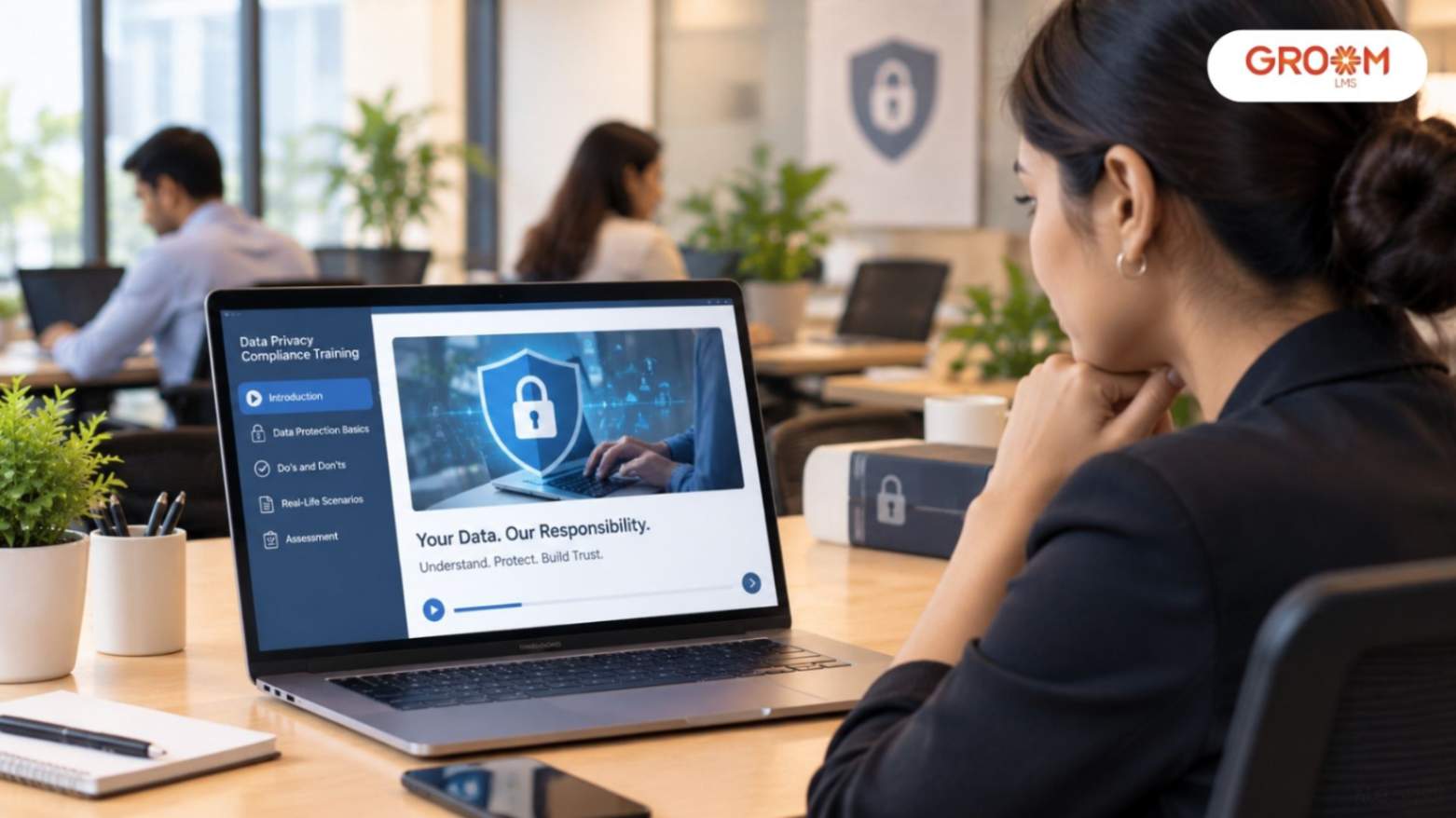
Data has become one of the most valuable assets for modern businesses. Organizations collect and process customer information, employee records, financial details, business documents, and other sensitive data across multiple systems and platforms. As digital operations continue to expand, protecting this information is no longer only an IT responsibility. Every employee who handles data has a role to play in maintaining privacy and security.
However, having privacy policies in place does not automatically ensure that employees understand how to follow them. Employees may unintentionally share confidential information, use unsecured channels, mishandle documents, or fail to recognize potential privacy risks. Data privacy compliance training helps organizations turn privacy policies into practical workplace behaviors by giving employees the knowledge and awareness they need to handle information responsibly.
With organizations increasingly adopting digital learning for compliance and workforce development, platforms such as GroomLMS can help businesses deliver structured privacy training, manage learning programs, track employee progress, and maintain visibility across their workforce. A well-designed digital training strategy can make privacy education more consistent, accessible, and measurable.
What Is Data Privacy Compliance Training?
Data privacy compliance training is an organized learning program designed to educate employees about responsible data handling, privacy requirements, organizational policies, and appropriate workplace practices.
The purpose is not simply to teach employees legal terminology. Effective training should help employees understand how privacy principles apply to their everyday responsibilities.
For example, employees may need to understand:
- What constitutes personal or sensitive information
- How data should be collected and stored
- Who can access specific information
- When information can be shared
- How to identify potential privacy risks
- What to do when a privacy incident occurs
- Why organizational privacy policies must be followed
The exact training requirements can vary depending on the organization’s industry, geography, data-processing activities, and applicable regulations. Therefore, training should be aligned with the organization’s actual privacy responsibilities rather than relying on generic content alone.
Why Is Data Privacy Compliance Training Important?
A privacy-first workplace depends on informed employees. Even sophisticated security systems can be undermined by simple human mistakes. Regular privacy training helps organizations address this human element.
1. Improves Employee Awareness
Employees interact with organizational data every day. Training helps them recognize which information requires additional care and understand the potential consequences of inappropriate data handling.
2. Reduces Human Error
Accidental disclosures, incorrect sharing, weak handling practices, and unauthorized access can create unnecessary privacy risks. Practical training can help employees recognize and avoid these situations.
3. Supports Organizational Compliance
Privacy regulations and internal policies create responsibilities for organizations that collect or process personal information. Training helps employees understand the procedures they are expected to follow.
4. Builds Accountability
When employees understand their individual responsibilities, privacy becomes part of everyday work rather than a responsibility limited to the legal, compliance, or IT department.
5. Strengthens Customer Trust
Customers and business partners expect organizations to handle their information responsibly. A strong privacy culture can support confidence in how an organization manages personal information.
“Privacy becomes stronger when responsible data handling is treated as a daily workplace behavior, not an occasional compliance exercise.”
Key Topics to Include in Data Privacy Compliance Training
An effective program should reflect the organization’s data environment and employee responsibilities. Common training areas include:
Personal Data Awareness
Employees should understand what personal information is and why it requires appropriate protection. Examples may include names, contact details, identification information, financial information, employee records, or other information associated with identifiable individuals.
Data Collection and Usage
Employees should know why information is collected, how it can be used, and what internal policies govern its processing.
Access and Authorization
Training should explain the importance of accessing information only when employees have a legitimate business requirement and appropriate authorization.
Secure Data Sharing
Employees often share information through email, cloud platforms, collaboration tools, and other digital channels. Training should explain appropriate sharing practices and common risks.
Data Retention and Disposal
Employees should understand organizational requirements around retaining, archiving, and securely disposing of information.
Privacy Incident Awareness
Employees should know how to identify and report potential privacy incidents. Early reporting can help the appropriate teams investigate and respond according to organizational procedures.
Phishing and Social Engineering
Privacy training can also address deceptive communications that attempt to obtain confidential information or credentials.
Common Challenges in Traditional Privacy Training
Despite its importance, privacy training can be difficult to manage manually.
One-Time Training
Employees may complete privacy training during onboarding and receive little reinforcement afterward. Without regular learning, important concepts can become less memorable.
Generic Content
A single course may not be equally relevant to every employee. An HR professional, finance employee, salesperson, and IT administrator may handle different types of information and face different privacy risks.
Manual Tracking
Using spreadsheets or disconnected records can make it difficult for HR and compliance teams to monitor completion, assessment performance, certifications, and overdue training.
Limited Visibility
Without centralized reporting, organizations may struggle to identify departments or employee groups that require additional training.
Difficulty Scaling
As organizations grow, maintaining consistent privacy education across locations, teams, and employee groups becomes increasingly complex.
How to Build Effective Data Privacy Compliance Training
A strong privacy training program should combine relevant content, practical learning, assessments, and continuous reinforcement.
1. Identify Training Requirements
Begin by identifying the types of data employees handle, applicable privacy obligations, organizational policies, and common privacy risks.
2. Segment Employees by Role
Role-based learning can make training more relevant. Employees should receive the privacy knowledge that relates directly to their responsibilities.
3. Use Realistic Scenarios
Instead of relying entirely on definitions, use workplace situations.
4. Add Assessments
Quizzes and knowledge checks can help determine whether employees understand important concepts. Assessments can also highlight areas where additional learning may be required.
5. Reinforce Learning Regularly
Privacy awareness should not end when an employee completes a course. Refresher modules, short learning activities, policy updates, and periodic assessments can reinforce responsible behavior.
6. Keep Training Updated
Privacy requirements, organizational policies, technologies, and business processes can change. Training content should therefore be reviewed and updated regularly.
Role of an LMS in Data Privacy Compliance Training
A Learning Management System can provide a centralized environment for managing privacy education.
An LMS can help organizations:
- Assign privacy courses to employees
- Create role-based learning paths
- Deliver multimedia learning content
- Conduct assessments and quizzes
- Track completion status
- Monitor learner performance
- Issue certificates
- Generate training reports
- Identify learning gaps
- Manage recurring or refresher training
This centralized approach can reduce administrative work while giving HR, L&D, and compliance teams greater visibility into workforce learning.
For organizations managing multiple compliance programs, an LMS can also bring privacy training together with other areas such as cybersecurity, workplace compliance, ethics, and regulatory awareness.
Benefits of Digital Data Privacy Compliance Training
Moving privacy education to a structured digital learning environment can provide several practical benefits.
Consistent Learning
Employees across different teams and locations can receive standardized training based on organizational requirements.
Flexible Access
Digital learning allows employees to access training according to their schedules and organizational learning policies.
Better Tracking
Training administrators can monitor completion, assessment results, and learner progress from a centralized platform.
Improved Engagement
Interactive content, scenarios, quizzes, multimedia, and knowledge checks can make privacy concepts easier to understand.
Scalable Training
Digital programs can support privacy education as organizations expand their workforce or operate across multiple locations.
Easier Reporting
Centralized reporting can help organizations maintain better visibility into training status and identify outstanding learning requirements.
How to Measure Data Privacy Compliance Training Effectiveness
Completion rates alone do not show whether employees understand privacy responsibilities. Organizations should consider multiple measures.
Completion Rate: How many assigned employees completed the required training?
Assessment Scores: Are employees demonstrating an understanding of key privacy concepts?
Knowledge Gaps: Which topics generate the most incorrect responses?
Learner Engagement: Are employees actively participating in the training?
Feedback: Do employees find the training relevant and understandable?
Incident Trends: Where appropriate, organizations can examine whether recurring training-related issues are being identified and addressed.
Combining these indicators can provide a more complete picture of training effectiveness.
Best Practices for a Privacy-First Training Program
Organizations can strengthen their approach by following several practical practices:
- Make privacy training role-specific rather than completely generic.
- Use simple language so employees can understand practical responsibilities.
- Include realistic workplace scenarios to encourage decision-making.
- Use assessments and knowledge checks to reinforce important concepts.
- Provide refresher training at appropriate intervals.
- Keep content aligned with organizational policies and applicable requirements.
- Track training centrally using an LMS.
- Use analytics to identify learning gaps.
- Update content when policies, processes, or requirements change.
- Promote privacy as an organizational culture, not just a mandatory course.
How GroomLMS Supports Data Privacy Compliance Training
A structured LMS can make it easier to transform privacy requirements into an organized employee learning program.
GroomLMS enables organizations to manage digital learning through features such as course management, assessments, certifications, learner tracking, analytics, and reporting. These capabilities can support organizations in creating structured compliance learning experiences for different employee groups.
For example, organizations can develop role-based privacy courses, assign learning paths, conduct assessments, monitor completion, and use reports to maintain visibility into workforce training.
GroomLMS can also support broader compliance learning strategies, allowing organizations to manage privacy awareness alongside other corporate training requirements within a centralized learning environment.
The objective is not simply to provide employees with information. It is to create a repeatable learning process that helps employees understand privacy responsibilities and apply them in their everyday work.
The Future of Data Privacy Compliance Training
As businesses become increasingly digital, privacy education will continue to evolve. Employees may work with cloud applications, AI-powered tools, collaboration platforms, customer databases, mobile devices, and other technologies that create new data-handling considerations.
Future privacy training is likely to become more personalized, continuous, and data-driven. Organizations can use learning analytics to identify knowledge gaps, provide targeted learning, and adapt training based on employee roles.
Scenario-based learning, microlearning, interactive assessments, and AI-supported learning experiences can also help make privacy education more relevant and engaging.
The larger shift is from one-time compliance training to continuous privacy awareness.
Conclusion
Data privacy is not solely a legal, compliance, or technology responsibility. Employees across an organization influence how information is collected, accessed, shared, stored, and handled.
Effective data privacy compliance training helps organizations build awareness, reduce avoidable mistakes, support internal policies, and encourage responsible data-handling behaviors. When supported by a centralized LMS, privacy education can become easier to deliver, track, measure, and scale.
A privacy-first workplace begins with informed employees. By combining relevant content, practical scenarios, assessments, continuous learning, and centralized reporting, organizations can make privacy awareness a consistent part of their workplace culture.
Build a Privacy-First Learning Culture
Give your employees structured, engaging, and measurable compliance learning with GroomLMS.
Contact Us | Join GroomLMS | Chat on WhatsApp
Frequently Asked Questions (FAQs)
What is data privacy compliance training?
Data privacy compliance training educates employees about responsible data handling, privacy policies, organizational procedures, and appropriate practices for protecting personal and sensitive information.
Who should complete data privacy compliance training?
Employees who collect, access, process, store, or share personal or sensitive information should receive training relevant to their responsibilities.
How often should privacy compliance training be provided?
The appropriate frequency depends on organizational policies, employee roles, applicable requirements, and changes to privacy practices. Many organizations combine initial training with periodic refresher learning.
What should data privacy training include?
Common topics include personal data awareness, secure data handling, access controls, information sharing, retention and disposal, incident reporting, phishing awareness, and organizational privacy policies.
How can an LMS improve privacy compliance training?
An LMS can centralize course delivery, assignments, assessments, completion tracking, certifications, analytics, and reporting, making privacy training easier to manage at scale.