
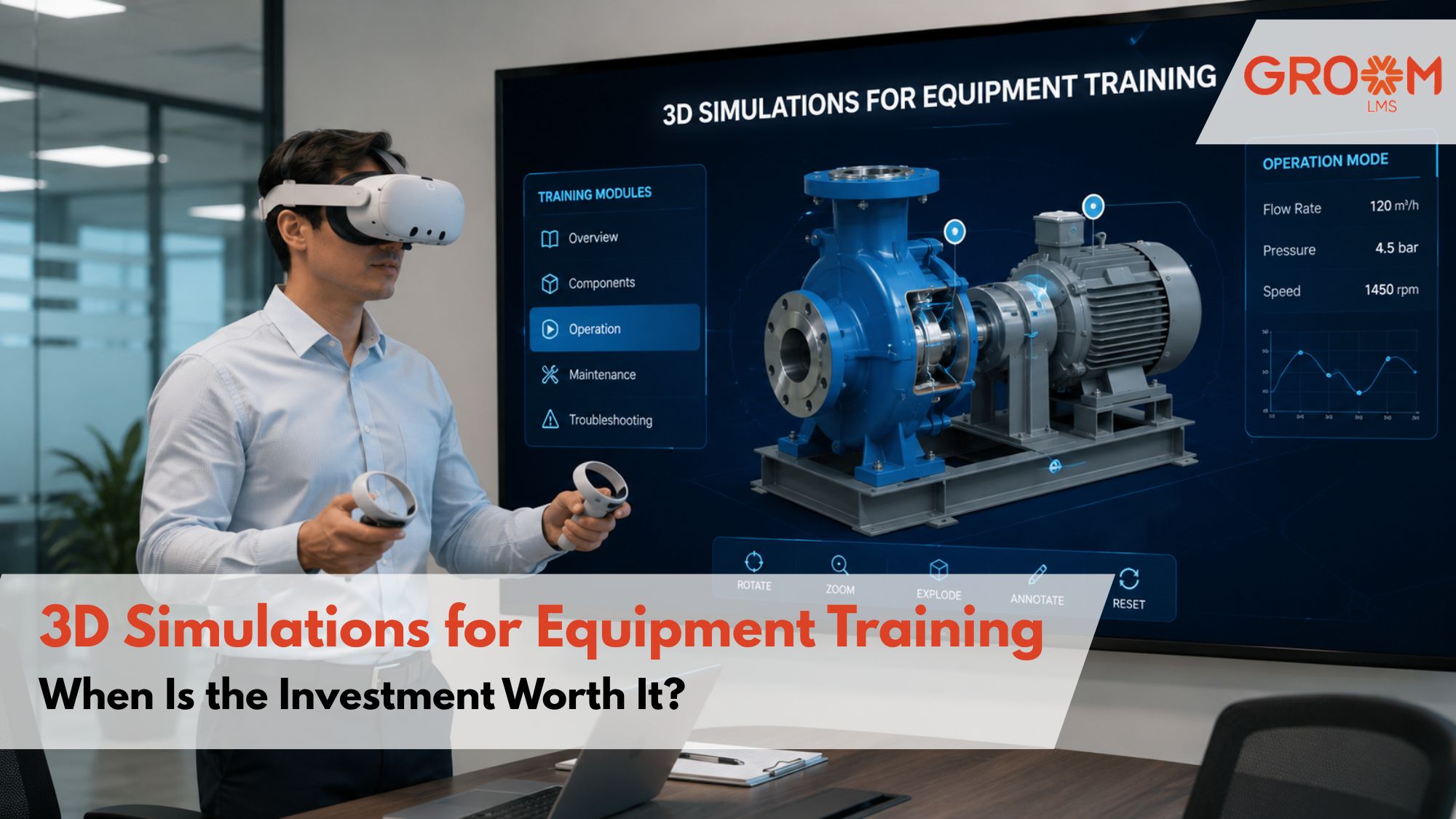
Training employees on complex equipment has always been challenging. Organizations need workers to gain practical experience, yet real-world training often comes with risks, costs, and operational disruptions.
For industries such as manufacturing, healthcare, logistics, energy, and construction, equipment mistakes can result in safety incidents, downtime, damaged assets, and productivity losses. As a result, many organizations are exploring 3D simulations for equipment training as a modern learning solution.
However, a common question remains: Is the investment actually worth it?
The answer depends on several factors, including training objectives, equipment complexity, workforce size, and expected return on investment. While 3D simulation training can significantly improve learning outcomes, it may not be necessary for every training program.
In this article, we explore when organizations should invest in simulation-based learning, where the biggest benefits appear, and how platforms like GroomLMS can help manage and scale digital training initiatives effectively.
What Are 3D Simulations for Equipment Training?
3D simulation training creates a virtual environment where learners can interact with equipment, tools, and processes without using physical machinery.
Instead of reading manuals or watching videos, employees can:
- Explore equipment virtually
- Practice procedures safely
- Perform maintenance tasks
- Identify operational risks
- Learn troubleshooting processes
- Repeat exercises multiple times
This creates a hands-on learning experience while reducing real-world training risks.
Why Traditional Equipment Training Often Falls Short
Many organizations still rely heavily on classroom instruction and supervised on-site training.
Although these methods remain valuable, they present several challenges:
Limited Equipment Availability
Training equipment is often needed for daily operations. As a result, learners may receive limited practice time.
High Training Costs
Organizations frequently spend money on:
- Instructor-led sessions
- Travel expenses
- Equipment setup
- Production downtime
- Safety supervision
Safety Risks
New employees may make mistakes during training. Consequently, organizations face higher safety concerns and potential equipment damage.
Inconsistent Learning Experiences
Different trainers may deliver information differently. Therefore, learner outcomes can vary significantly across locations.
When Is the Investment Worth It?
Not every organization requires advanced simulation technology. However, certain situations make the investment highly valuable.
1. Equipment Is Expensive or Difficult to Access
When equipment costs millions of dollars or remains unavailable for training purposes, simulations become highly practical.
Examples include:
- Industrial machinery
- Medical devices
- Aviation systems
- Power plant equipment
- Mining equipment
Rather than waiting for access, employees can begin learning immediately in a virtual environment.
2. Safety Risks Are High
Safety is one of the strongest business cases for simulation-based learning.
Organizations can allow learners to practice dangerous procedures without exposing them to actual risks.
Examples include:
- Hazardous material handling
- Electrical maintenance
- Heavy machinery operation
- Emergency response procedures
Employees gain confidence before working in real-world environments.
3. Mistakes Are Extremely Costly
Some industries cannot afford operational errors.
A single mistake may result in:
- Equipment damage
- Production delays
- Regulatory issues
- Customer dissatisfaction
- Financial losses
Simulation training allows employees to learn from mistakes without business consequences.
4. Large-Scale Workforce Training Is Required
Organizations with multiple locations often struggle to deliver consistent training.
Simulation programs can be distributed digitally across regions, ensuring every learner receives the same experience.
This becomes especially valuable when:
- Opening new facilities
- Expanding operations
- Onboarding large employee groups
- Supporting global teams
5. Frequent Skill Refreshers Are Necessary
Many technical roles require ongoing learning.
Instead of organizing repeated classroom sessions, organizations can provide simulation modules that employees access whenever needed.
As a result, knowledge retention improves while training costs decrease.
Situations Where 3D Simulations May Not Be Necessary
While simulation training offers significant advantages, it is not always the best investment.
Organizations may achieve better results with simpler learning methods when:
- Equipment is relatively simple
- Training occurs infrequently
- Employee numbers are small
- Risks are minimal
- Procedures rarely change
In these cases, videos, interactive courses, job aids, and instructor-led sessions may provide sufficient learning outcomes.
Measuring the ROI of Simulation-Based Training
Before investing, organizations should evaluate measurable business benefits.
Consider tracking the following metrics:
Training Efficiency
- Reduced training time
- Faster onboarding
- Increased learner completion rates
Safety Improvements
- Fewer workplace incidents
- Reduced compliance violations
- Lower equipment damage rates
Operational Performance
- Faster task execution
- Reduced downtime
- Improved productivity
Cost Savings
- Lower instructor costs
- Reduced travel expenses
- Less equipment wear and tear
- Fewer operational disruptions
Organizations that measure these outcomes can build a stronger business case for investment.
A Practical ROI Example
Imagine a manufacturing company onboarding 500 technicians annually.
Traditional training requires:
- Dedicated instructors
- Production equipment access
- Travel and accommodation costs
- Multiple training sessions
By implementing simulation-based learning:
- Employees train before entering production areas
- Instructor time decreases
- Equipment downtime reduces
- Knowledge retention improves
Over several years, these operational savings often exceed the initial development investment.
Combining Simulations with an LMS for Better Results
Creating simulations is only part of the solution.
Organizations also need a reliable platform to:
- Deliver training content
- Track learner progress
- Manage certifications
- Automate assignments
- Generate compliance reports
- Monitor training effectiveness
Without centralized management, even the most advanced simulations can become difficult to scale.
How GroomLMS Supports Simulation-Based Learning
Organizations using simulation training often need a scalable learning ecosystem to manage programs efficiently.
GroomLMS helps training teams:
- Launch learning programs quickly
- Manage users independently
- Automate enrollments
- Track completion rates
- Monitor certifications
- Generate training reports
- Scale learning across locations
Because the platform requires minimal technical dependency, L&D teams can focus on learning outcomes rather than system administration.
Best Practices Before Investing in Simulation Training
Before committing resources, evaluate these factors carefully.
Identify Critical Training Needs
Focus on areas where mistakes carry significant operational or safety consequences.
Calculate Long-Term Savings
Consider:
- Reduced downtime
- Lower travel costs
- Faster onboarding
- Improved productivity
Start with High-Impact Use Cases
Avoid simulating every process immediately.
Instead, prioritize:
- Safety-critical tasks
- High-cost equipment
- Complex operational procedures
- Compliance-sensitive activities
Measure Results Continuously
Track learning and business metrics regularly to validate ROI and identify improvement opportunities.
Future Trends in Equipment Training
Advancements in technology continue to improve simulation capabilities.
Organizations are increasingly combining:
- 3D simulations
- Virtual reality (VR)
- Augmented reality (AR)
- AI-powered learning pathways
- Learning analytics
As these technologies become more accessible, simulation-based training will likely become a standard component of workforce development strategies.
Conclusion
Investing in 3D simulations for equipment training makes the most sense when organizations face high safety risks, expensive equipment, complex procedures, or large-scale training requirements. In these situations, simulations can improve knowledge retention, reduce operational risks, and lower long-term training costs.
However, the investment should always align with business objectives and measurable outcomes. Organizations that carefully assess training needs, expected ROI, and scalability requirements are more likely to achieve lasting success.
When combined with a robust learning management platform such as GroomLMS, simulation-based training becomes easier to deploy, manage, track, and scale across the organization. The result is a more efficient, consistent, and future-ready learning ecosystem.
CTA – Request a Demo
Ready to simplify technical training and scale learning programs more effectively?
Explore GroomLMS to discover how your organization can manage digital learning, automate training workflows, track certifications, and support simulation-based learning initiatives from a single platform.
Request a Demo and see how GroomLMS can help transform your training operations.
Frequently Asked Questions (FAQs)
What are 3D simulations for equipment training?
3D simulations are interactive digital environments that allow employees to practice operating equipment, performing procedures, and responding to workplace scenarios safely and virtually.
Which industries benefit most from simulation-based training?
Manufacturing, oil and gas, aviation, healthcare, mining, logistics, utilities, and heavy engineering industries often see the greatest value from simulation-based learning.
Can an LMS deliver 3D simulation training?
Yes. Modern LMS platforms such as GroomLMS can host, track, and manage simulation-based learning programs alongside other training content.
How do 3D simulations improve employee training?
They provide hands-on practice, improve knowledge retention, increase learner confidence, and reduce risks associated with real-world training.
How does GroomLMS support equipment training programs?
GroomLMS helps organizations deliver, manage, automate, and monitor training programs, making it easier to scale learning initiatives while maintaining consistency and compliance.