Employee training often starts with a simple task: get the right people into the right courses. However, the process can quickly become complicated.
HR teams manage employee information, while L&D teams manage training. When these systems operate separately, someone has to move information between them. That means more data entry, more emails, and more opportunities for mistakes.
The problem becomes bigger as the workforce grows. New employees need onboarding. Existing employees need role-specific learning. Some courses also need to be repeated or renewed.
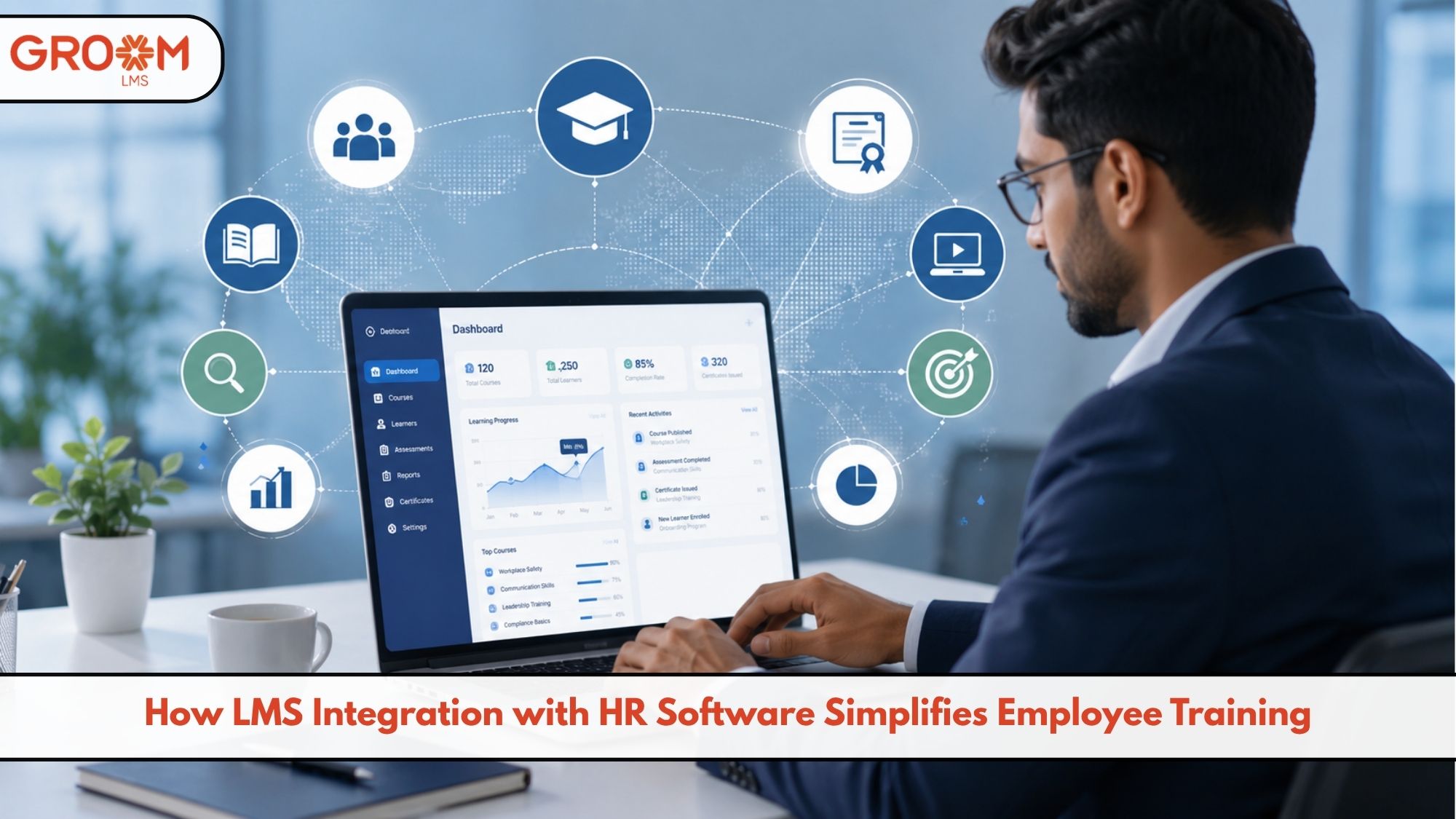
LMS integration with HR software helps connect these processes. Instead of treating employee information and learning as separate tasks, organizations can create a smoother workflow between HR and L&D.
For businesses looking to reduce administrative work, this can make a noticeable difference. GroomLMS helps organizations manage digital learning programs through a centralized platform, giving teams more control over training delivery, tracking, and employee development.
What Is LMS Integration with HR Software?
LMS integration with HR software connects a learning management system with an HRIS, HRMS, or another employee management platform.
The purpose is straightforward: relevant employee information can move between connected systems without requiring teams to enter the same information repeatedly.
For example, HR may already have an employee’s department, job title, joining date, or employment status. An integrated LMS can use relevant information to support learning workflows.
This creates a stronger connection between HR operations and employee development.
According to SHRM, integrating HR technology can reduce redundant data entry and create more connected workforce information.
Why Separate HR and Training Systems Create Extra Work
When employee data and learning data live in different places, HR and L&D teams often have to bridge the gap manually.
Imagine an organization hiring 100 employees. HR enters their details into the HR system. Then, the L&D team may need to add those employees to the LMS, assign courses, and organize them by department.
Now imagine an employee changes departments.
The HR record changes first. Then someone needs to update the LMS. If that second step gets missed, the employee may receive the wrong training.
Manual processes can lead to:
- Duplicate data entry
- Delayed training assignments
- Incorrect learner information
- More follow-up emails
- Scattered training records
- Time-consuming reporting
Therefore, the issue is not simply having two systems. The real problem is making them work as disconnected islands.
How LMS Integration Simplifies Employee Training
LMS integration can make everyday training processes more connected and predictable.
Faster employee onboarding
Onboarding often involves several learning requirements. New hires may need company policies, role-specific training, security awareness, compliance courses, and product knowledge.
With connected HR and learning workflows, organizations can move from employee creation to training assignment more efficiently.
For example, a new employee joins the marketing team. Their HR profile already identifies their department and role. That information can support the assignment of relevant onboarding learning.
As a result, the employee can start learning sooner, while HR and L&D avoid unnecessary manual steps.
Easier role-based training
Not every employee needs the same courses.
A sales representative may need product and communication training. A manager may need leadership development. A new finance employee may need training related to internal processes.
Integration makes it easier to connect employee information with relevant learning requirements.
Consequently, businesses can build more targeted learning journeys instead of assigning the same training to everyone.
Fewer duplicate updates
Employee information changes constantly. People join, leave, transfer, get promoted, or move into new roles.
Without integration, each change may require multiple updates.
A connected environment can reduce this repetition. Therefore, HR and L&D teams spend less time maintaining duplicate records.
SHRM also highlights data quality and system integration as important considerations when organizations implement HR technology.
Training Automation Becomes More Practical
Integration becomes even more useful when organizations want to automate repetitive training activities.
Automate learning assignments
Instead of manually assigning every course, teams can create workflows around employee roles or other relevant criteria.
For example, when someone joins the customer support team, the organization can provide a defined learning path covering product knowledge, customer communication, and required policies.
This creates a more consistent onboarding experience.
Manage recurring training
Some employee training needs regular repetition. Compliance courses, policy refreshers, and certifications may require employees to return to learning periodically.
A connected LMS can help teams create repeatable learning workflows. Rather than rebuilding the process every time, administrators can manage recurring requirements more efficiently.
Reduce manual follow-ups
Training automation also helps with pending learning.
Instead of checking every employee manually, L&D teams can use progress information to identify who still needs to complete assigned courses.
That makes follow-up more focused and less time-consuming.
How Integration Improves Visibility for HR and L&D
One of the biggest advantages of connecting HR and learning systems is better visibility.
Without integration, HR may know who works in each department, while L&D knows who completed training. Bringing these workflows closer together gives teams a clearer picture.
Managers can more easily review:
- Training completion
- Pending courses
- Employee learning progress
- Department-level training needs
- Certification status
This information can support better decisions.
For instance, an L&D manager might notice that employees in one department consistently struggle with a particular training module. Instead of simply sending more reminders, the team can review the content and identify what needs improvement.
In addition, connected workforce data can support broader analysis of employee development and organizational needs. SHRM notes that integrated HR technologies can help organizations build more useful workforce insights.
A Simple HR-to-Learning Workflow
A connected process does not need to be complicated.
Consider this workflow:
- HR creates the employee profile.
- Relevant employee information becomes available to the learning system.
- The LMS identifies the employee’s required learning.
- Relevant courses are assigned.
- The employee completes the training and assessments.
- Progress and completion records are captured.
- HR and L&D can review the results.
This removes unnecessary handoffs.
More importantly, it creates a repeatable process that can work across different employee groups.
What Should You Check Before Integrating an LMS?
Integration can improve efficiency, but organizations should plan it carefully.
Start with your workflow
First, identify where manual work currently happens. Look at onboarding, course assignments, employee transfers, recurring training, and reporting.
Then decide which steps should become automated.
Check system compatibility
Your LMS and HR software need a reliable way to exchange relevant information. Therefore, review available integration methods, supported data fields, and technical requirements before implementation.
SHRM’s HR technology evaluation guidance specifically recommends checking whether a solution can connect with existing HRIS or ATS platforms.
Keep employee data protected
HR systems contain sensitive employee information. For that reason, organizations should review access controls, security measures, data handling, and permissions before connecting platforms.
Only the information needed for the learning workflow should move between systems.
Prepare employees and administrators
Technology works best when people understand how to use it. Explain what is changing, why it matters, and how the new process affects everyday work.
This is especially important because HR technology adoption can suffer when employees do not understand the purpose behind a new system. SHRM recommends addressing change management and user adoption during implementation.
How GroomLMS Supports Smarter Employee Learning
GroomLMS helps organizations create, manage, and scale digital learning programs from a centralized environment.
Its learning capabilities include course delivery, assessments, certifications, virtual training, analytics, and dashboards. These tools can support structured employee learning across onboarding, development, compliance, and role-based training.
GroomLMS also focuses on reducing technical dependency. Organizations can manage their learning environment more independently rather than relying on IT for every routine adjustment.
That becomes particularly useful for growing businesses. As employee numbers and learning requirements increase, teams need a system that can grow without creating unnecessary administrative complexity.
GroomLMS also provides end-to-end e-learning services, including instructional design, multimedia development, assessments, and content localization. Therefore, organizations can combine technology and learning content support when needed.
Best Practices for a Successful LMS Integration
Integration should simplify the employee experience, not make it more complicated.
Start small. Choose one high-value workflow, such as employee onboarding, and improve that process first.
Next, define exactly which employee information the LMS needs. Avoid transferring unnecessary data.
Then, automate the repetitive steps. Course assignments, notifications, recurring learning, and progress tracking are good places to start.
Finally, measure the result. Look at the time saved by HR and L&D teams, training completion, assignment accuracy, and learner experience.
A good integration should make the process feel quieter in the background. Employees get the learning they need, while administrators spend less time moving information around.
Why LMS Integration Matters for Growing Organizations
A growing workforce creates more training activity. More employees mean more onboarding, more role changes, more learning records, and more recurring training.
Without connected systems, administrative work grows along with the workforce.
LMS integration with HR software helps organizations create a more scalable approach. Employee information and learning workflows can work together instead of creating additional manual tasks at every stage.
The result is not simply a faster process. It is a better-organized training environment.
HR can focus more on people operations. L&D can focus more on learning quality. Managers can gain clearer visibility. Employees can receive more relevant training at the right time.
That is the real value of integration.
Conclusion
LMS integration with HR software helps organizations connect employee information with learning workflows. Instead of repeatedly entering data, manually assigning courses, and checking separate systems, HR and L&D teams can create a more streamlined training process.
The benefits become especially valuable during onboarding, role changes, recurring training, and employee development. Moreover, integration can reduce administrative effort while improving visibility into training progress.
However, successful integration starts with a clear process. Organizations should identify repetitive tasks, check system compatibility, protect employee information, and prepare users for the change.
GroomLMS provides a centralized learning environment with course delivery, assessments, certifications, dashboards, analytics, and virtual training capabilities. This gives organizations a practical foundation for managing employee learning as their workforce grows.
Ultimately, LMS integration with HR software is not about connecting two platforms for the sake of technology. It is about removing unnecessary steps between knowing what employees need and delivering the right learning to them.
When HR and learning work together, employee training becomes easier to manage, easier to personalize, and easier to scale.
Connect HR Processes with Smarter Employee Training
Stop moving employee data between disconnected systems. Bring HR and learning workflows closer together with GroomLMS.
Automate training assignments, simplify onboarding, track employee progress, and build scalable learning journeys from one centralized platform.
Contact Us | Join GroomLMS | Chat on WhatsApp
Frequently Asked Questions (FAQs)
What is LMS integration with HR software?
LMS integration with HR software connects a learning management system with an HRIS or HRMS. It allows relevant employee information to support learning and training workflows.
How does LMS integration improve employee training?
It can reduce duplicate data entry, simplify onboarding, support role-based learning, automate recurring training, and improve visibility into employee progress.
Can LMS integration automate employee onboarding?
Yes. An integrated LMS can use relevant employee information to support onboarding workflows and assign appropriate training based on factors such as role or department.
What is the benefit of integrating an LMS with an HRIS?
The main benefit is a more connected employee lifecycle. HR information can support learning assignments, while training records can provide useful insight into employee development.
Can GroomLMS support different employee training needs?
Yes. GroomLMS supports course delivery, assessments, certifications, virtual training, analytics, and dashboards. These capabilities can support onboarding, compliance, employee development, and role-based learning.