
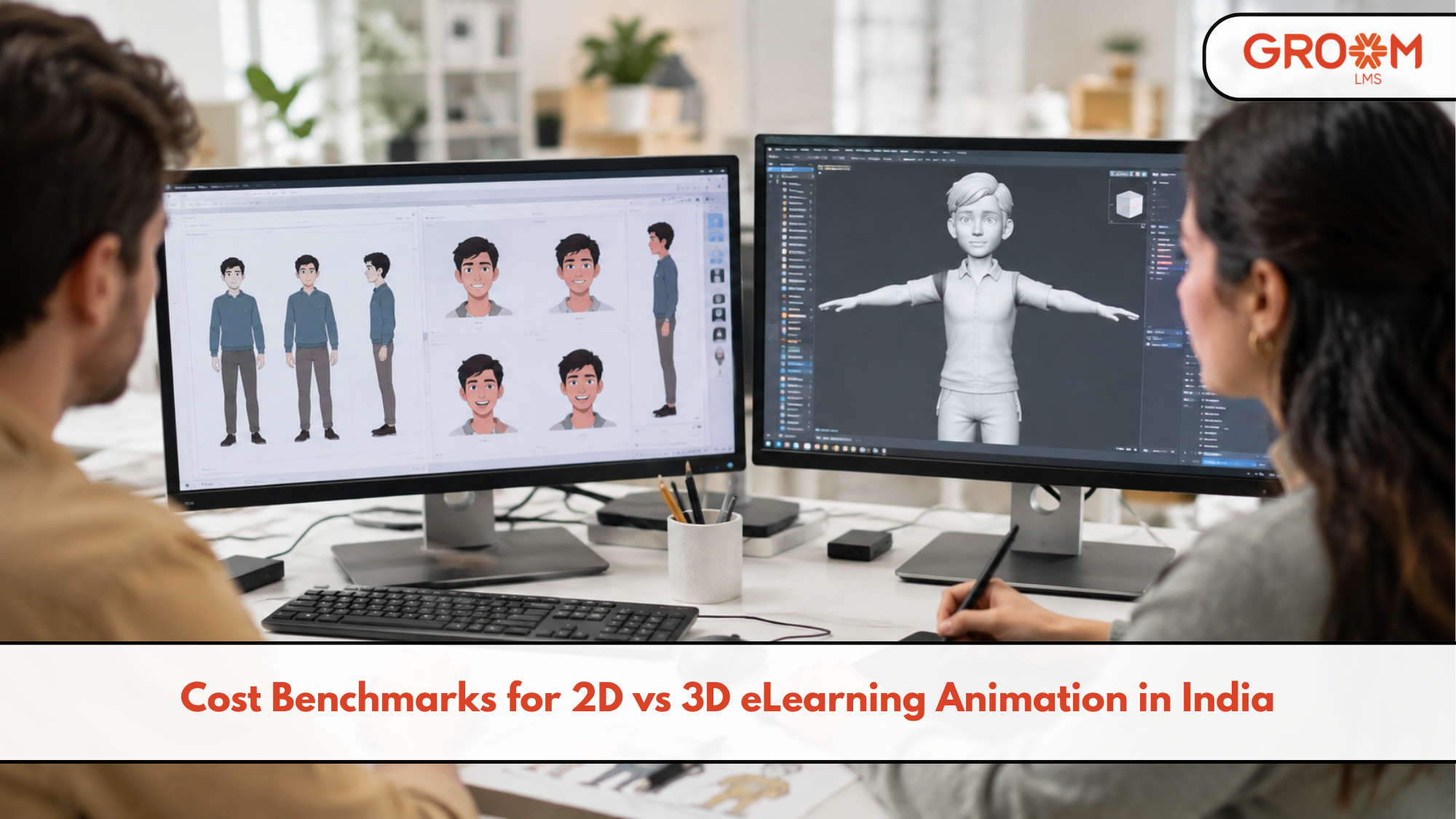
Creating engaging digital learning experiences has become a priority for organizations that want employees to learn faster and retain knowledge longer. As businesses increasingly invest in online training, animated eLearning content has emerged as one of the most effective ways to explain concepts, demonstrate processes, and improve learner engagement.
However, one question often arises before a project begins: Should you choose 2D or 3D animation, and how much will it cost?
The answer depends on several factors, including your learning objectives, audience, content complexity, and budget. While both formats offer unique advantages, understanding their cost differences helps training providers and Corporate L&D teams make informed decisions.
Moreover, choosing the right learning platform is equally important. Once your animated courses are ready, GroomLMS enables organizations to launch, manage, automate, and scale training programs without relying on continuous IT support. As a result, businesses can focus on creating impactful learning experiences instead of managing technical challenges.
Why Animation Matters in eLearning
Animation transforms static learning materials into engaging and memorable experiences. Instead of reading long documents, learners can visualize concepts through motion, storytelling, and interactive scenarios.
Organizations commonly use animation for:
- Employee onboarding
- Compliance training
- Product demonstrations
- Healthcare education
- Manufacturing safety
- Software tutorials
- Sales enablement
- Customer training
Furthermore, animated learning improves knowledge retention while reducing learner fatigue.
Understanding 2D eLearning Animation
2D animation uses flat illustrations, icons, characters, and motion graphics to explain concepts in a visually appealing way.
It is ideal for:
- Compliance courses
- HR policies
- Process training
- Customer service modules
- Soft skills programs
- Product explainers
Advantages of 2D Animation
- Faster production timelines
- Lower development costs
- Easy content updates
- Clean and professional visuals
- Suitable for most corporate training topics
Therefore, organizations looking for cost-effective digital learning often prefer 2D animation.
Understanding 3D eLearning Animation
3D animation creates realistic environments, equipment, products, and characters. It adds depth and realism, making it suitable for highly technical training.
Common use cases include:
- Medical education
- Manufacturing operations
- Engineering training
- Aviation
- Oil and gas
- Equipment simulations
- Laboratory procedures
Because learners can observe realistic movements and environments, 3D animation significantly enhances experiential learning.
Major Factors That Influence Animation Costs
Several variables determine the overall project budget.
Content Complexity
Simple awareness videos cost much less than scenario-based learning with branching interactions.
For example:
- Basic policy explanation
- Character conversations
- Interactive simulations
- Technical demonstrations
The more detailed the animation, the higher the production effort.
Duration of the Course
A five-minute module naturally costs less than a thirty-minute learning program.
Longer courses require:
- Additional illustrations
- More voiceover
- Extra animation
- Quality assurance
- LMS testing
Therefore, project duration directly impacts pricing.
Visual Style
Animation style also affects cost.
Examples include:
- Motion graphics
- Whiteboard animation
- Character animation
- Isometric animation
- Infographic animation
- Realistic 3D simulation
Each style requires different production skills and software.
Instructional Design
Professional eLearning projects involve more than animation.
They typically include:
- Learning objectives
- Storyboarding
- Script writing
- Visual design
- Assessments
- Knowledge checks
- Accessibility reviews
Consequently, comprehensive learning design increases overall value rather than simply increasing cost.
Cost Benchmarks for 2D eLearning Animation in India
The Indian eLearning market offers a wide range of pricing depending on quality and project scope.
Typical benchmark ranges include:
| Project Type | Approximate Cost |
|---|---|
| Basic motion graphics | ₹8,000 to ₹20,000 per minute |
| Standard corporate animation | ₹20,000 to ₹45,000 per minute |
| Premium character-based animation | ₹45,000 to ₹80,000+ per minute |
These estimates generally include animation production. However, services such as instructional design, multilingual voiceovers, assessments, and LMS integration may increase the final investment.
For most employee training programs, 2D animation provides an excellent balance between engagement and affordability.
Cost Benchmarks for 3D eLearning Animation in India
Producing 3D animation requires specialized artists, advanced software, rendering time, and technical expertise.
Typical pricing ranges include:
| Project Type | Approximate Cost |
|---|---|
| Basic 3D animation | ₹50,000 to ₹1,00,000 per minute |
| Industrial simulations | ₹1,00,000 to ₹2,50,000 per minute |
| Advanced medical or engineering simulations | ₹2,50,000 to ₹5,00,000+ per minute |
Although the investment is significantly higher, organizations benefit from highly immersive learning experiences for complex technical subjects.
2D vs 3D Animation: Which Offers Better Value?
Choosing between 2D and 3D animation depends on your training goals rather than simply your budget.
Choose 2D Animation if you need:
- Faster course development
- Lower production costs
- Frequent content updates
- Policy or compliance training
- Soft skills learning
- Large-scale employee onboarding
Choose 3D Animation if you need:
- Equipment demonstrations
- Medical procedures
- Safety simulations
- Engineering concepts
- Product assembly training
- High-risk operational learning
Instead of selecting the most expensive option, organizations should focus on achieving measurable learning outcomes.
How GroomLMS Supports Animated eLearning Delivery
Creating engaging content is only one part of successful corporate training. Delivering, managing, and tracking learning efficiently is equally important.
GroomLMS simplifies this process by enabling organizations to:
- Launch training programs within minutes
- Manage learners independently
- Automate enrollments and assessments
- Track learner progress through dashboards
- Deliver certifications
- Scale training without ongoing technical dependency
Additionally, organizations can combine animated eLearning content with assessments, reporting, virtual learning, and certification workflows on a single platform.
For training providers and Corporate L&D teams, this reduces administrative effort while improving the learner experience.
Best Practices to Maximize Your Animation Budget
To achieve better ROI from animated learning content, consider these recommendations:
- Define learning objectives before production begins.
- Choose the simplest animation style that meets training goals.
- Reuse visual assets wherever possible.
- Develop modular content for easier updates.
- Invest in professional instructional design.
- Select an LMS that supports easy deployment and learner tracking.
- Plan multilingual requirements early in the project.
- Measure learner performance to optimize future content.
By following these practices, organizations can control production costs while delivering engaging and effective digital learning experiences.
Conclusion
Choosing between 2D and 3D eLearning animation ultimately depends on your training objectives, audience, and budget. While 2D animation offers a cost-effective and versatile solution for most corporate training programs, 3D animation provides an immersive learning experience for highly technical, medical, or industrial topics. Understanding the cost benchmarks for each approach allows organizations to allocate resources wisely and maximize the impact of their training investments.
Equally important is having the right platform to deliver and manage your learning content. GroomLMS helps training providers and Corporate L&D teams launch, manage, and scale training programs with ease. From course delivery and learner tracking to assessments and certifications, GroomLMS simplifies every stage of the learning journey, enabling organizations to focus on building a skilled and future-ready workforce.
Transform Your Corporate Learning with GroomLMS
Discover how GroomLMS empowers your organization to streamline training, enhance learner engagement, and deliver impactful learning experiences with an AI-powered LMS built for growth.
Request a Demo | Schedule a Consultation | Chat with Our Team
Frequently Asked Questions
What is the difference between 2D and 3D eLearning animation?
2D eLearning animation uses flat illustrations and motion graphics to explain concepts, making it ideal for compliance, onboarding, and soft skills training. In contrast, 3D animation creates realistic environments and simulations, making it suitable for technical, medical, engineering, and manufacturing training.
Which is more cost-effective for corporate training in India?
For most corporate training programs, 2D animation is more cost-effective because it requires less production time and fewer resources. However, 3D animation offers greater value when learners need realistic visualizations or hands-on simulation experiences.
What factors affect the cost of eLearning animation?
The cost depends on several factors, including animation style, course duration, content complexity, instructional design requirements, voiceovers, language localization, interactivity, and assessment development. Projects with advanced simulations and custom graphics generally require a higher budget.
Can GroomLMS deliver courses with animated eLearning content?
Yes. GroomLMS supports the delivery of animated eLearning courses, including 2D and 3D content. Organizations can manage learners, automate enrollments, conduct assessments, issue certifications, and monitor training progress through a single, easy-to-use platform.
How can organizations reduce the cost of animated eLearning projects?
Organizations can optimize costs by defining clear learning objectives, choosing the appropriate animation style, creating modular content, reusing visual assets, and using a scalable learning platform like GroomLMS to efficiently deploy, manage, and update training programs.