
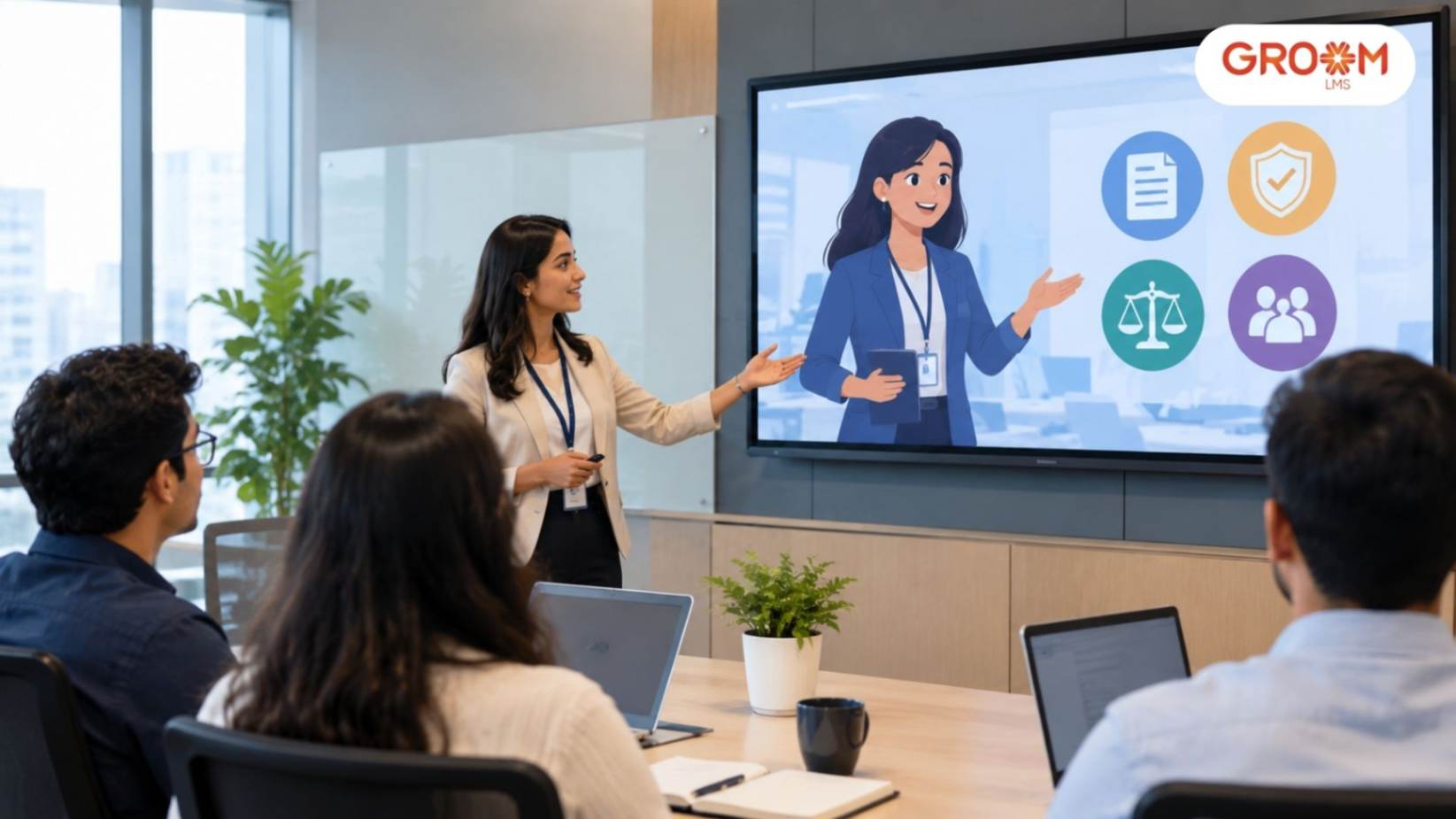
Compliance training has traditionally relied on policy documents, presentations, lengthy manuals, and standard online courses. While these formats can communicate essential information, they do not always make complex rules easy to understand, remember, or apply in real workplace situations.
This challenge is becoming more important as organizations manage training across larger and more diverse workforces. Employees may need to understand topics such as workplace conduct, data privacy, information security, anti-bribery policies, health and safety, and regulatory requirements. Therefore, L&D and compliance teams need learning formats that explain important concepts clearly while maintaining learner engagement.
GroomLMS supports this shift toward more engaging digital learning by providing organizations with a centralized platform for delivering and managing multimedia-based training. With features for assessments, certifications, analytics, dashboards, SCORM, xAPI, and virtual learning, GroomLMS can help organizations integrate engaging compliance content into a structured learning environment. Within this approach, 2D animation for compliance training remains a practical way to turn complex policies into clear visual explanations, relatable scenarios, and actionable learning experiences.
What Makes Compliance Training Difficult to Explain?
Compliance topics often contain terminology, rules, exceptions, procedures, and consequences. Employees may understand individual statements but still struggle to connect them with everyday workplace situations.
For example, a data privacy course might explain several rules regarding confidential information. However, employees may still wonder what they should do when a colleague requests sensitive information through an informal channel.
Similarly, a workplace conduct policy may define inappropriate behavior. Yet, employees may benefit more from seeing a realistic situation and considering the appropriate response.
This creates a need for learning content that can bridge the gap between policy knowledge and practical understanding.
2D animation can help address this gap by converting written information into visual explanations and scenarios.
Why 2D Animation Remains Relevant in 2026
The learning technology landscape continues to evolve. Organizations now have access to interactive simulations, AI-powered learning tools, immersive experiences, virtual environments, and advanced multimedia.
However, newer technology does not automatically create better learning outcomes.
The effectiveness of a learning format depends on factors such as:
- Learning objectives
- Content complexity
- Audience requirements
- Visual clarity
- Interactivity
- Accessibility
- Assessment strategy
- Ease of content maintenance
2D animation performs well when the objective is to explain a concept, demonstrate a situation, or simplify a process.
It can provide enough visual engagement without introducing the production complexity associated with some advanced formats.
It Simplifies Complex Compliance Concepts
Compliance information can be difficult to communicate when presented entirely through text.
Animation provides another layer of explanation.
For instance, instead of presenting a paragraph about conflict of interest, an animated course can show an employee facing a situation involving a supplier. The narration can explain the policy while the visuals demonstrate the scenario.
This combination helps learners connect the rule with a recognizable workplace context.
A simple animated structure can include:
- Situation – Introduce the workplace scenario.
- Problem – Show the compliance issue.
- Explanation – Explain the relevant policy.
- Response – Demonstrate the appropriate action.
- Knowledge Check – Ask learners what they would do.
This structure turns an abstract policy into a more understandable learning experience.
Visual Storytelling Makes Policies More Relatable
Compliance training does not have to feel disconnected from everyday work.
2D animation allows organizations to create characters, environments, conversations, and situations that reflect employees’ experiences.
For example, a cybersecurity course could show an employee receiving a suspicious email. Instead of simply defining phishing, the animation can demonstrate the warning signs and show how the employee should respond.
This storytelling approach gives employees a context for the information.
Consequently, learners can better understand how a policy applies to their daily responsibilities.
It Supports Explainer-Style Learning
Explainer-style training focuses on making a topic easy to understand.
The objective is not necessarily to create an elaborate cinematic experience. Instead, the content should answer three basic questions:
What is the issue?
Why does it matter?
What should the employee do?
2D animation works particularly well for this structure.
Visual elements can demonstrate processes, relationships, workflows, and consequences while narration provides additional explanation.
Therefore, organizations can create concise compliance modules without reducing the topic to a collection of slides.
It Creates Consistency Across Training Programs
Large organizations often deliver multiple compliance programs throughout the year.
Different topics may include:
- POSH training
- Information security
- Anti-bribery and anti-corruption
- Workplace safety
- Data privacy
- Code of conduct
- Regulatory compliance
- Ethics training
A consistent 2D animation style can create visual continuity across these programs.
Organizations can establish common guidelines for:
- Character design
- Typography
- Icons
- Narration style
- Transitions
- Visual language
- Screen layouts
This consistency can make different courses feel like part of the same corporate learning ecosystem.
Animation Can Demonstrate What Text Cannot
Some compliance concepts involve actions and decisions rather than definitions.
Consider workplace safety training.
A written course can explain that employees should follow specific safety procedures. However, animation can demonstrate the correct sequence visually.
Similarly, an animated process can demonstrate how an employee should report an incident, escalate an issue, or respond to a policy violation.
It Works Well With Short Learning Modules
Modern corporate learners often consume training in shorter sessions.
This does not mean every compliance topic should be reduced to a few minutes. Instead, large topics can be divided into focused learning modules.
For example, a data protection program could include:
- Module 1: Understanding Data Privacy
- Module 2: Handling Personal Information
- Module 3: Password and Access Security
- Module 4: Recognizing Phishing
- Module 5: Reporting a Security Incident
Each module can use short animated explanations followed by interactions or assessments.
This approach can make longer compliance programs easier to navigate.
How to Design Effective 2D Animated Compliance Training
Animation alone does not guarantee effective learning. The instructional design behind the animation remains important.
Start With a Clear Learning Objective
Every animation should have a specific purpose.
Instead of trying to explain an entire policy in one video, identify the knowledge or behavior employees need to develop.
Use Realistic Workplace Scenarios
Scenarios should reflect situations employees can realistically encounter.
A compliance animation becomes more useful when learners can recognize the environment, decision, or problem.
For example, instead of explaining workplace harassment only through definitions, an animation can demonstrate an inappropriate interaction and explain appropriate reporting options.
Keep Visuals Purposeful
Every visual element should support understanding.
Too many characters, animations, transitions, or decorative elements can distract learners.
Therefore, effective 2D animation should prioritize:
- Visual clarity
- Simple compositions
- Consistent movement
- Relevant illustrations
- Readable text
- Appropriate pacing
Combine Animation With Interactivity
Animated content can become more effective when learners actively participate.
After an animated scenario, the course can ask:
What should the employee do next?
Learners can select an answer and receive immediate feedback.
Other interactive elements can include:
- Click-to-reveal activities
- Scenario questions
- Knowledge checks
- Matching activities
- Decision-based questions
- Short assessments
This creates a learning experience rather than simply showing an animated video.
The Role of Narration in Animated Compliance Training
Narration plays an important role because compliance topics often require explanation.
A well-written voice-over can guide learners through the visual content while maintaining a natural flow.
However, narration should not simply read the text displayed on screen.
Instead, the visual and audio elements should complement each other.
For example, the screen can show a workplace scenario while the narration explains the relevant compliance principle.
This reduces unnecessary text and allows learners to focus on the main message.
How an LMS Complements 2D Animated Training
Creating animated compliance content is only one part of the training process. Organizations also need a system to deliver and manage that content.
An LMS can provide the infrastructure required to manage digital compliance programs.
Organizations can use an LMS to:
- Assign courses to employees
- Organize compliance modules
- Deliver animated learning content
- Conduct assessments
- Track completion
- Monitor learner performance
- Issue certificates
- Generate reports
- Manage recurring training
GroomLMS supports these requirements through features such as multimedia learning, assessments, certifications, analytics, dashboards, SCORM, xAPI, and virtual instructor-led training.
Therefore, animated compliance content can become part of a broader digital learning ecosystem rather than remaining as standalone video files.
2D Animation vs. Text-Heavy Compliance Training
The choice between formats should depend on the learning objective.
| Training Requirement | Suitable Approach |
|---|---|
| Simple policy reference | Text or document |
| Complex concept explanation | 2D animation |
| Workplace scenario | 2D animation |
| Quick policy reminder | Infographic or short video |
| Practical decision-making | Scenario-based learning |
| Knowledge verification | Interactive assessment |
| Detailed reference material | Digital document |
This shows why 2D animation does not necessarily replace traditional learning formats.
Instead, it complements them.
An effective compliance program may combine animated explainers, written references, interactive activities, assessments, and instructor-led sessions.
When Should Organizations Use 2D Animation?
2D animation is particularly useful when the learning content requires explanation, visualization, or storytelling.
It can be considered for:
- Complex compliance concepts
- Behavioral training
- Workplace scenarios
- Process demonstrations
- Safety procedures
- Ethics and conduct training
- Cybersecurity awareness
- Policy awareness
- Employee onboarding
- Product and process training
However, organizations should avoid using animation simply because it looks attractive.
The format should always support the learning objective.
The Future of 2D Animation in Corporate Compliance Learning
In 2026, the future of corporate learning is not necessarily about replacing established formats with newer technologies.
Instead, organizations are increasingly focused on selecting the right technology for the right learning requirement.
2D animation continues to occupy an important place because it offers a practical balance between visual storytelling, instructional clarity, scalability, and production flexibility.
It can also work alongside AI-assisted development, interactive LMS features, analytics, and personalized learning experiences.
The result can be a learning ecosystem where animation explains the concept, interaction reinforces it, assessment checks understanding, and analytics provide visibility into learner progress.
Conclusion
2D animation for compliance training remains relevant in 2026 because it addresses a fundamental learning challenge: making complex information easier to understand and apply.
Its strength lies in visual storytelling, scenario-based explanations, process demonstrations, and concise communication. Moreover, animation can be combined with narration, interactions, assessments, and LMS capabilities to create a complete learning experience.
For organizations, the goal should not simply be to make compliance training more visually appealing. The priority should be to make important policies understandable, memorable, and actionable.
With GroomLMS, organizations can bring multimedia learning, assessments, certifications, analytics, and digital course management together within one scalable learning environment. This makes it easier to deliver structured compliance learning while maintaining visibility over employee progress.
Make Compliance Training More Engaging with GroomLMS
Turn complex compliance concepts into clear, engaging digital learning experiences with multimedia content, interactive assessments, certifications, and centralized training management through GroomLMS.
Contact Us | Join GroomLMS | Chat on WhatsApp
Frequently Asked Questions(FAQs)
Why is 2D animation effective for compliance training?
2D animation simplifies complex regulations through visual storytelling, making compliance topics easier to understand, remember, and apply in real workplace situations.
Can GroomLMS deliver animated compliance courses?
Yes. GroomLMS supports multimedia learning content, including animated videos, interactive modules, quizzes, certifications, and automated learning paths.
Which industries benefit most from animated compliance training?
Industries such as healthcare, insurance, finance, manufacturing, education, and corporate enterprises all benefit from engaging animated compliance learning.
How does an LMS improve compliance training?
An LMS centralizes course delivery, tracks learner progress, automates reminders, generates reports, and helps organizations maintain regulatory compliance efficiently.
How often should compliance training be updated?
Organizations should review compliance training at least annually or whenever regulations, internal policies, or industry standards change.