For large organisations, employee training rarely stays simple for long. New hires need onboarding, existing teams need upskilling, managers need leadership development, and compliance teams need completion records. As these requirements grow, managing learning through disconnected tools can become difficult.
This is where enterprise learning management systems become valuable. An enterprise LMS brings courses, learners, assessments, certifications, tracking, and reporting into a central environment.
However, choosing an LMS is only part of the challenge. L&D teams also need a system that is practical to manage, flexible enough to grow, and simple enough to operate without constant technical intervention.
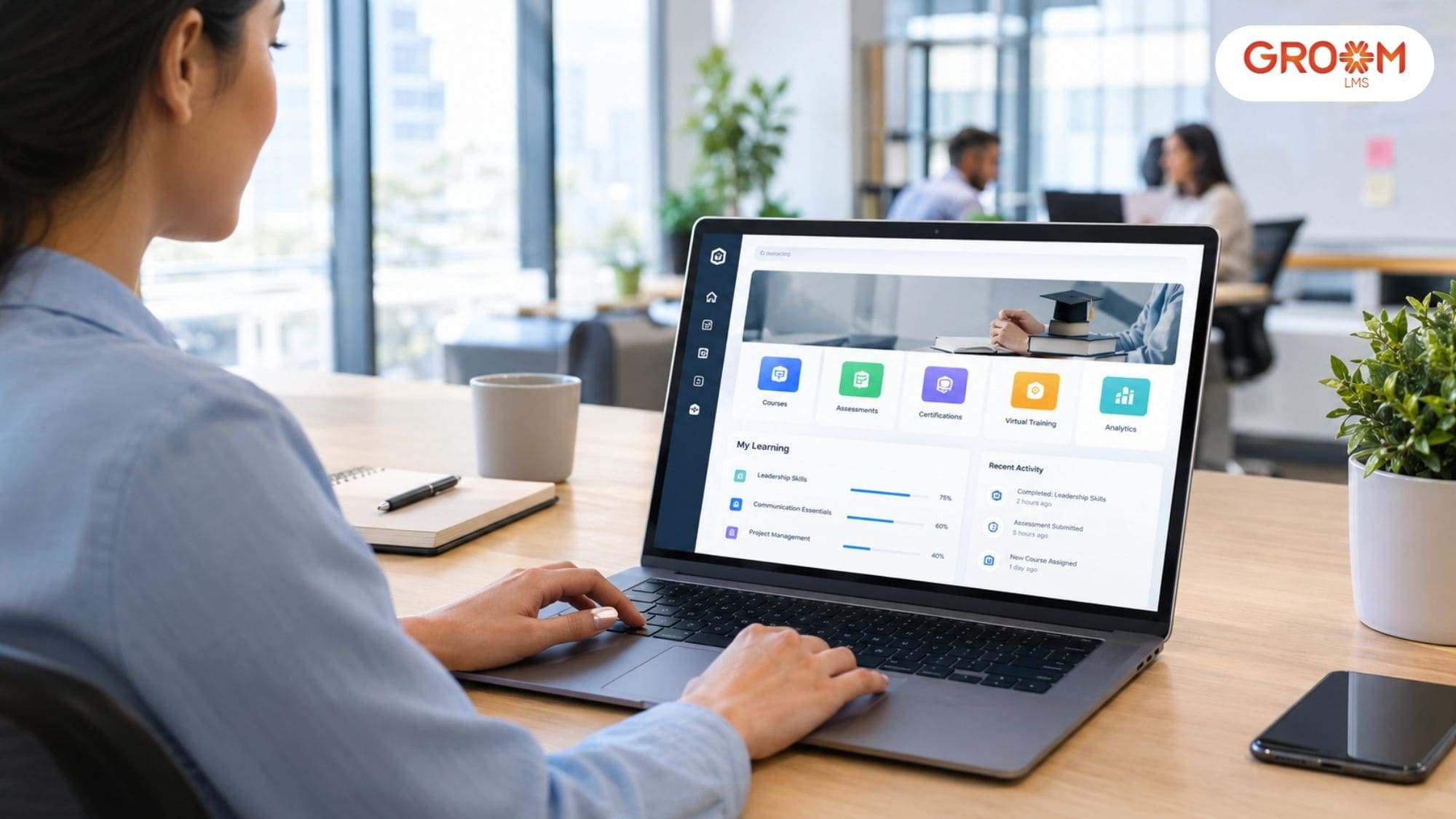
GroomLMS approaches this challenge by providing a scalable digital learning environment where organisations can create and manage training programmes independently. Its capabilities cover courses, assessments, certifications, virtual training, analytics, dashboards, and broader learning management needs.
As organisations increasingly connect learning with business skills and career development, the ability to manage learning efficiently becomes even more important. LinkedIn’s 2025 Workplace Learning Report found that 49% of surveyed L&D and talent development professionals said executives were concerned that employees lacked the skills needed to execute business strategy.
So, how can an LMS help organisations respond to this challenge?
What Are Enterprise Learning Management Systems?
Enterprise learning management systems are software platforms designed to manage learning and training across an organisation.
Unlike a basic training tool, an enterprise LMS typically needs to support different teams, learning programmes, administrators, reporting requirements, and organisational growth.
A well-designed system can help organisations:
- Create and organise online courses
- Assign training to employees
- Monitor learner progress
- Conduct assessments
- Manage certifications
- Deliver virtual training
- Analyse learning activity
- Maintain centralised training records
For example, an organisation onboarding 500 employees could use an LMS to assign the same foundational programme while allowing different departments to receive role-specific courses.
This centralised approach reduces manual coordination and gives L&D teams greater visibility into learning activity.
Why Enterprise Learning Is Becoming More Strategic
Employee learning is no longer limited to occasional workshops. Organisations increasingly use learning programmes to address skill gaps, support career development, and prepare employees for changing responsibilities.
LinkedIn’s 2025 Workplace Learning Report highlights skills development, career development, skills assessments, and learning engagement as important components of organisational adaptability.
As a result, L&D teams need more than a place to upload courses. They need systems that can support an ongoing learning process.
An enterprise LMS can help connect that process:
Identify a need → create or assign learning → deliver training → assess learners → track results → improve the programme.
That workflow becomes particularly useful when an organisation has multiple departments or locations.
How GroomLMS Supports Enterprise Learning
GroomLMS is designed to simplify the management of digital learning while supporting organisational growth.
Instead of relying heavily on technical teams for routine LMS administration, organisations can create a GroomLMS instance online and manage their learning environment independently.
This can be particularly useful for L&D and corporate training teams that need to move quickly.
For example, imagine an organisation launching a new product training programme.
The L&D team could create the learning environment, organise the course, assign the relevant training, monitor learner activity, conduct assessments, and review results from the same broader LMS environment.
The platform also allows organisations to upgrade or downgrade subscriptions as their requirements change. This gives businesses more flexibility as their learning needs evolve.
From Training Delivery to Learning Management
A major shift in enterprise learning is the move from simply delivering training to managing the complete learning journey.
Consider a new employee joining a company.
Instead of receiving a collection of documents and attending disconnected sessions, the organisation could structure the experience through an LMS:
- Assign onboarding content.
- Provide role-specific learning modules.
- Add assessments to check understanding.
- Track completion and performance.
- Provide certification where required.
- Use learning data to identify further development needs.
This creates a more structured employee training workflow.
It also gives L&D teams a clearer view of what has been completed and where additional support may be required.
Making Training Easier to Scale
Scaling training manually can become challenging as an organisation grows.
For instance, a company with 50 employees may manage training through spreadsheets and email. However, the same approach becomes harder when the workforce expands across departments, locations, or business units.
Enterprise learning management systems help centralise these processes.
GroomLMS supports scalable digital learning for organisations of different sizes. Its capabilities include course management, assessments, certifications, virtual training, analytics, and dashboards.
Therefore, an organisation can build its learning infrastructure around its current requirements while adapting it as those requirements change.
This scalability is especially relevant for enterprises managing onboarding, employee development, compliance training, and recurring learning programmes.
Reducing Continuous Technical Dependency
One common challenge with complex learning systems is dependence on technical teams for everyday changes.
L&D professionals may need to update courses, manage learners, modify training programmes, or review learning activity without waiting for IT support.
GroomLMS is positioned around independent LMS management, allowing organisations to manage their learning environment without continuous technical dependency.
That matters because training teams often work with changing business requirements.
For example, if a company introduces a new internal process, the L&D team may need to update training quickly. A more self-managed LMS environment can make such operational changes easier to handle.
Using Learning Data for Better Decisions
Training activity creates useful information.
Completion rates, assessment results, learner participation, and certification records can help L&D teams understand how programmes are performing.
However, data becomes valuable only when teams can use it to make decisions.
For example, if learners consistently perform poorly on one assessment, the L&D team could review that section of the course. Similarly, low completion rates may indicate that the programme needs a different format, schedule, or communication strategy.
GroomLMS provides analytics and dashboards that support the monitoring of digital learning activity.
Consequently, L&D teams can move beyond simply asking, “Did employees complete the course?”
They can begin asking better questions:
- Where are learners struggling?
- Which programmes are being completed?
- What learning needs further attention?
- Are training outcomes aligned with business requirements?
Building a More Flexible Enterprise Learning Workflow
The most effective LMS implementation does not begin with software. It begins with the learning problem.
Before launching a programme, organisations should define:
The business need: What problem should training solve?
The target learners: Who needs the training?
The learning outcome: What should employees know or do afterward?
The delivery method: Should learning be self-paced, virtual, instructor-led, or blended?
The measurement approach: How will completion, knowledge, or performance be evaluated?
The improvement cycle: How will learner data influence future training?
Once these questions are clear, an LMS can support the operational side of the programme.
This approach prevents organisations from treating an LMS as merely a digital storage system for courses.
Why GroomLMS Fits the Changing Enterprise Learning Model
Enterprise learning needs to balance structure with flexibility.
L&D teams need control over programmes, while employees need accessible learning experiences. At the same time, businesses need systems that can scale without creating unnecessary operational complexity.
GroomLMS brings these requirements together through a learning environment designed for independent management, digital course delivery, assessments, certifications, virtual training, analytics, and dashboards.
The platform is also recognised among the Top 10 LMS platforms in India by Siliconindia Magazine and is described as being trusted by more than 100 corporate customers globally.
More importantly, its value for an organisation depends on how effectively the platform is connected to actual learning goals.
The technology should support the strategy, rather than become the strategy itself.
Conclusion
Enterprise learning management systems can give organisations a central structure for delivering, managing, monitoring, and improving employee learning.
However, the real value comes from combining the right technology with clear learning objectives and practical workflows. L&D teams need to know what employees must learn, how learning will be delivered, and how results will be measured.
GroomLMS supports this process by providing a scalable environment for courses, assessments, certifications, virtual training, analytics, dashboards, and learning management. Its self-managed approach can also help organisations reduce continuous dependence on technical teams for routine LMS administration.
As organisations continue to focus on skills development and career growth, learning platforms need to support more than course delivery. They need to make learning easier to organise, monitor, adapt, and scale.
For businesses looking to build a structured digital learning environment, GroomLMS offers an approach that combines practical LMS management with scalable enterprise learning capabilities.
Simplify Enterprise Learning with GroomLMS
Simplify employee training, automate learning management, and scale your enterprise learning with GroomLMS.
Contact Us | Join GroomLMS | Chat on WhatsApp
Frequently Asked Questions (FAQs)
What are enterprise learning management systems?
Enterprise learning management systems are platforms that help organisations deliver, manage, track, and analyse employee training at scale.
How can an enterprise LMS improve employee training?
An enterprise LMS centralises courses, assessments, learner records, certifications, and progress tracking, making employee training easier to organise and monitor.
Can GroomLMS support online learning management?
Yes. GroomLMS supports digital courses, assessments, certifications, virtual training, analytics, dashboards, and other online learning management requirements.
How can an LMS automate training processes?
An LMS can reduce manual work by centralising training assignments, learner tracking, assessments, completion records, and reporting within one learning environment.
What organisations can use GroomLMS?
GroomLMS can support businesses and organisations of different sizes, including enterprises, startups, MSMEs, institutions, and organisations with structured employee learning requirements.