
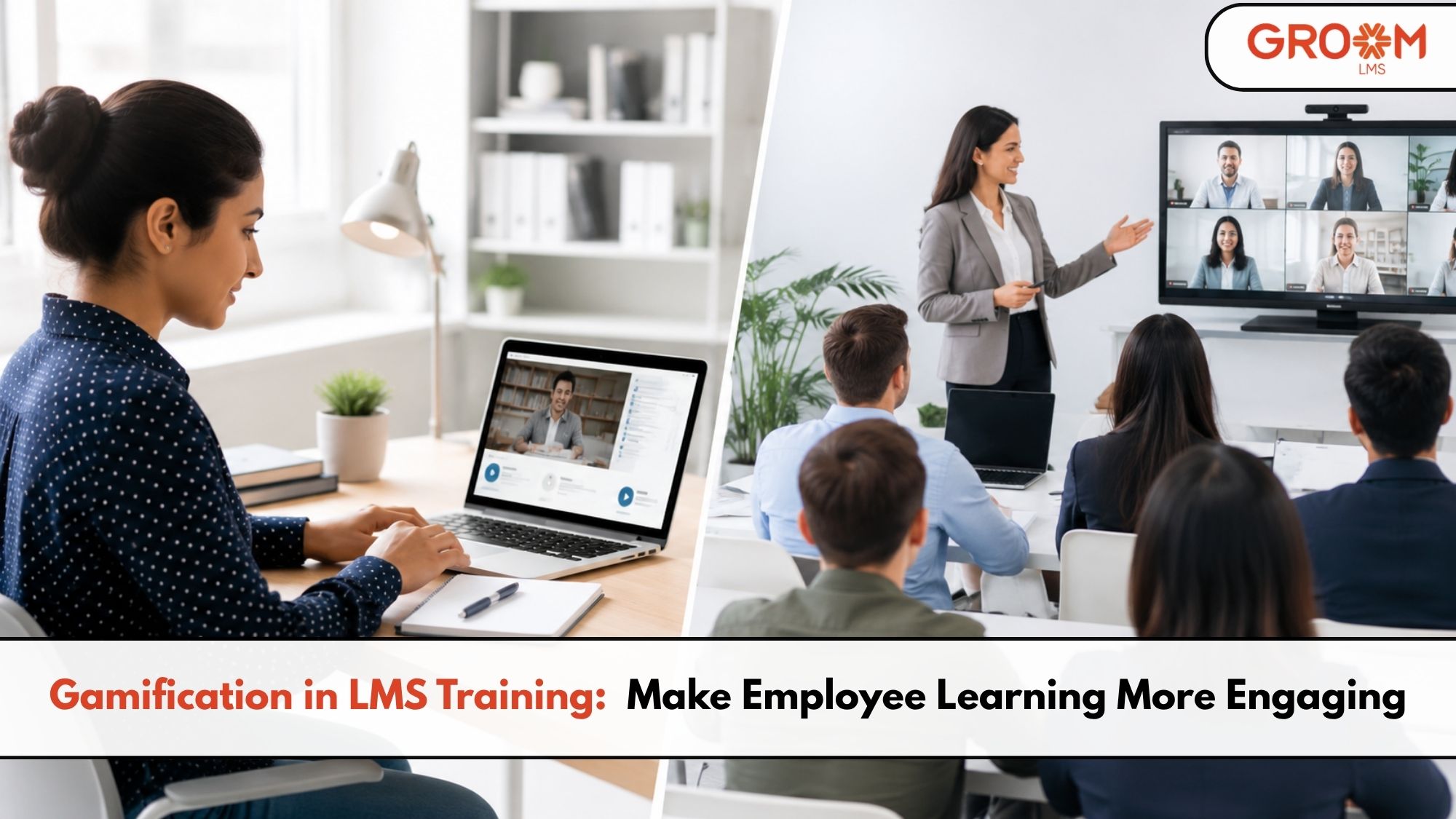
Employee training often sounds simple on paper. Create a course, assign it to employees, track completion, and move on.
In reality, keeping employees interested can be much harder. Long courses, repetitive assessments, and limited interaction can quickly turn learning into another task on the to-do list.
That is where gamification in LMS training can make a difference. By introducing elements such as points, badges, challenges, progress bars, and rewards, organizations can make learning more interactive and motivating.
However, gamification is not about turning every training program into a game. Instead, it uses selected game-based elements to encourage participation and reinforce learning.
For L&D teams, the right LMS can make this process much easier. GroomLMS enables organizations to create, manage, automate, and scale digital learning programs without depending on complicated systems or constant IT support.
So, how can businesses use gamification effectively? Let’s explore.
What Is Gamification in LMS Training?
Gamification in LMS training means using game-inspired elements within online learning to increase learner participation and motivation.
These elements can make routine activities feel more interactive while giving employees a clearer sense of progress.
Common gamification elements include:
- Points for completing learning activities
- Badges for reaching specific milestones
- Leaderboards for friendly competition
- Progress bars to show learning status
- Levels that represent increasing achievement
- Challenges that encourage active participation
- Rewards for completing courses or assessments
- Instant feedback after quizzes and activities
For example, an employee might earn points after completing a compliance module. After completing five modules, the employee could unlock a badge.
As a result, the learning journey becomes more visible and rewarding.
Why Employees Respond to Gamified Learning
Traditional training often focuses on delivering information. Gamified learning adds another layer by giving learners reasons to participate.
First, visible progress can create a sense of achievement. Employees can see what they have completed and what remains.
Second, small rewards can encourage learners to continue. A badge or milestone may seem simple, but it can provide useful recognition.
Third, interactive challenges can break up repetitive learning experiences. Consequently, employees may remain more attentive throughout a course.
Gamification can also support different workplace learning needs. For example, organizations can use it for:
- New employee onboarding
- Product training
- Sales enablement
- Compliance training
- Soft skills development
- Leadership programs
- Technical training
- Customer service training
The key is to connect each game element with a meaningful learning objective.
How Gamification Can Improve LMS Training
Gamification can support several parts of the employee learning experience.
1. Increases Learner Engagement
Employees are more likely to interact with training when the experience feels active.
Instead of simply watching videos and clicking Next, learners can complete challenges, earn points, and track their progress.
Therefore, gamification can turn passive course consumption into more active participation.
2. Encourages Course Completion
Starting a course is easy. Finishing it is another story.
Progress indicators, milestones, and achievement systems can encourage learners to continue toward completion.
For instance, a progress bar showing 80% completion gives employees a visible reminder that they are close to finishing.
3. Makes Assessments More Interactive
Quizzes do not always have to feel like formal tests.
LMS gamification can introduce timed challenges, points, levels, or achievement badges into assessments. This approach can make knowledge checks feel more engaging.
At the same time, organizations can still use assessments to measure actual knowledge and understanding.
4. Creates Friendly Competition
Leaderboards can encourage friendly competition between employees or teams.
However, competition should be used carefully. Not every learner enjoys public rankings.
For that reason, organizations can also use personal achievement systems. Learners can compete against their own previous performance rather than against colleagues.
5. Provides Immediate Feedback
Feedback helps learners understand how they are performing.
Gamified LMS activities can provide immediate responses after quizzes, challenges, and other activities.
Consequently, employees can identify gaps quickly and revisit learning material when necessary.
Practical Ways to Use Gamification in LMS Training
You do not need to redesign an entire learning program to introduce gamification.
Instead, start with a few simple elements that support your existing objectives.
Create Learning Challenges
Break larger courses into smaller challenges.
For example:
- Complete a short learning module.
- Take a knowledge check.
- Earn points for successful completion.
- Unlock the next challenge.
- Receive a completion badge.
This structure can make a lengthy learning journey feel more manageable.
Introduce Achievement Badges
Badges can recognize specific accomplishments.
Organizations could create badges such as:
- Compliance Champion
- Product Expert
- Customer Service Pro
- Leadership Learner
- Onboarding Complete
These badges can also help employees visualize their development.
Use Progress Tracking
Progress indicators provide learners with a clear destination.
For example, a training dashboard might show:
Course progress: 75%
Modules completed: 6 of 8
Assessment score: 88%
Next milestone: Final assessment
This simple visibility can encourage learners to keep moving.
Reward Consistent Participation
Gamification does not always need to reward high scores.
Organizations can also recognize consistent learning behavior.
For example, learners could earn points for completing weekly modules or maintaining a learning streak.
This approach encourages regular participation rather than one-time activity.
How GroomLMS Can Support Gamified Learning
A successful gamification strategy needs more than attractive rewards. L&D teams also need a learning platform that makes course management, assessments, tracking, and reporting easier.
GroomLMS provides scalable LMS capabilities for organizations that want to manage digital learning independently.
Teams can use an LMS environment to support activities such as:
- Digital course delivery
- Assessments and knowledge checks
- Certification management
- Virtual training
- Learning progress tracking
- Analytics and dashboards
- Automated training workflows
As a result, organizations can build structured learning experiences without creating unnecessary technical complexity.
Moreover, GroomLMS supports different organizational needs. A startup may begin with a small training program, while a larger enterprise may require broader learning management and reporting capabilities.
The platform can therefore support learning programs as they grow.
Best Practices for Gamification in LMS Training
Gamification works best when it supports learning instead of distracting from it.
Keep these principles in mind:
Start With the Learning Objective
Before choosing points or badges, define what employees need to learn or do.
The game element should reinforce that objective.
Keep Rewards Meaningful
Do not add badges simply because they look attractive.
Each reward should represent a meaningful achievement, milestone, or behavior.
Avoid Excessive Competition
Leaderboards can motivate some employees but discourage others.
Therefore, provide alternative forms of recognition when appropriate.
Keep Activities Simple
Learners should understand the rules immediately.
If an activity requires a long explanation, the gamification may be creating unnecessary complexity.
Measure More Than Completion
Course completion is useful, but it is not the entire picture.
Also monitor:
- Assessment performance
- Participation
- Learning progress
- Repeat attempts
- Certification rates
- Knowledge retention where measurable
This data can help L&D teams improve future training programs.
A Simple Gamified LMS Workflow
Organizations can start with a straightforward workflow:
- Identify the learning goal.
- Divide the training into manageable modules.
- Add interactive activities or assessments.
- Assign points or badges to meaningful achievements.
- Track learner progress.
- Provide feedback and recognition.
- Review learning data.
- Improve the program based on results.
This approach keeps gamification purposeful.
Instead of adding game elements everywhere, organizations can place them where they genuinely improve the learning experience.
Conclusion
Gamification in LMS training can make employee learning more engaging, interactive, and rewarding. When used thoughtfully, points, badges, challenges, progress tracking, and feedback can encourage learners to participate and complete their training.
However, gamification should never replace good instructional design. The strongest learning experiences combine clear objectives, useful content, meaningful practice, effective assessments, and the right level of motivation.
For organizations managing growing training needs, a flexible LMS can simplify this entire process. GroomLMS helps businesses create, manage, automate, and scale digital learning programs while reducing dependence on complicated systems.
Ultimately, the goal is not simply to make training more entertaining. It is to create learning experiences that employees want to complete and that organizations can measure, manage, and improve.
Transform Your Corporate Learning with GroomLMS
Discover how GroomLMS empowers your organization to streamline training, enhance learner engagement, and deliver impactful learning experiences with an AI-powered LMS built for growth.
Request a Demo | Schedule a Consultation | Chat with Our Team
Frequently Asked Questions (FAQs)
What is gamification in LMS training?
Gamification in LMS training uses game-based elements such as points, badges, challenges, progress bars, and rewards to make online employee learning more engaging.
How does gamification improve employee training?
Gamification can encourage participation, provide visible progress, make assessments more interactive, and motivate employees to complete learning activities.
Can an LMS automate employee training?
Yes. Modern LMS platforms can automate activities such as course assignments, learner notifications, assessments, progress tracking, certifications, and training reports.
What can organizations use online learning management systems for?
Organizations can use LMS platforms for onboarding, compliance training, employee development, product training, leadership programs, certifications, and virtual learning.
How can GroomLMS be used for corporate training?
GroomLMS can support digital courses, assessments, certifications, virtual training, learning management, progress tracking, analytics, and scalable employee training programs.