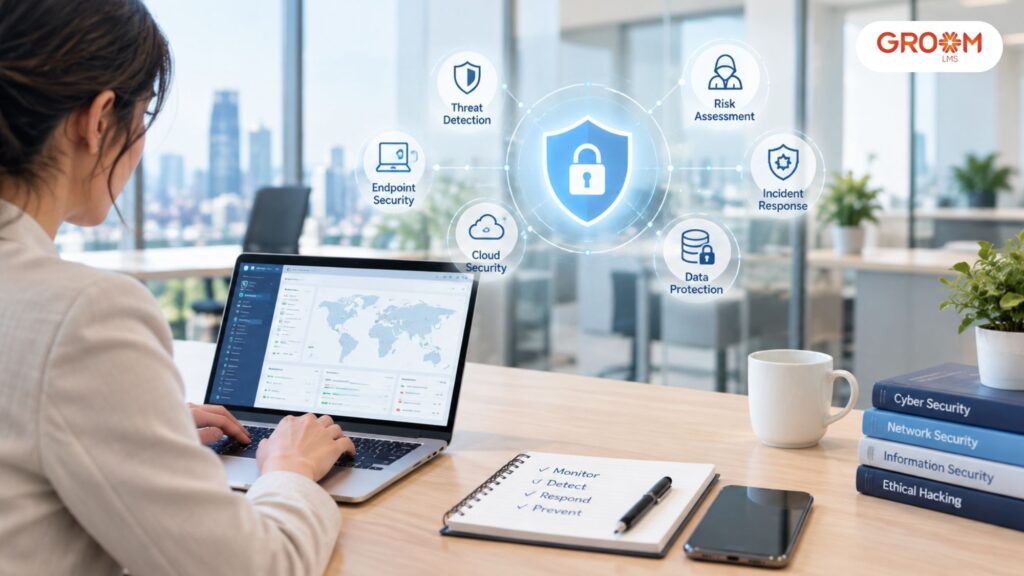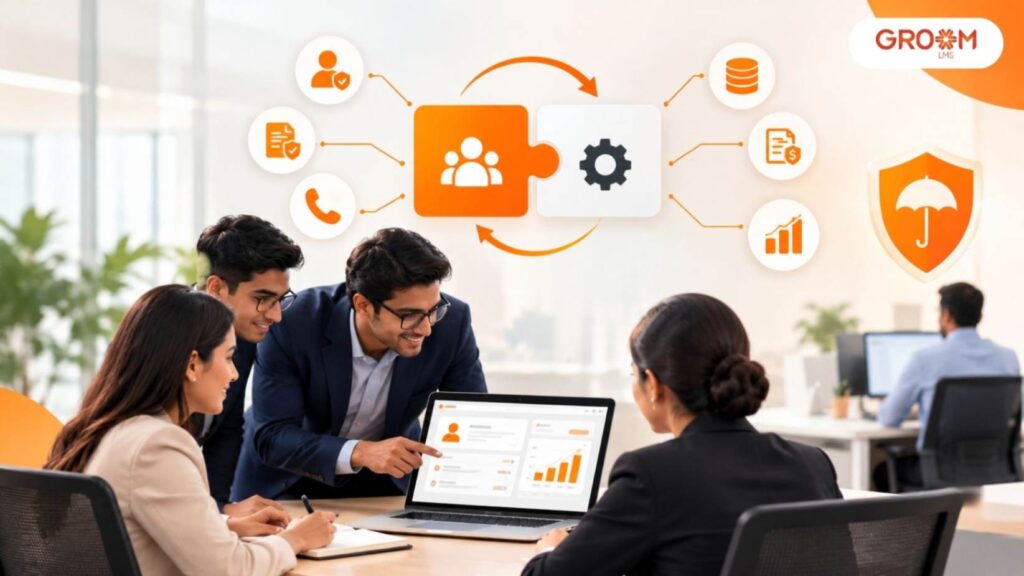
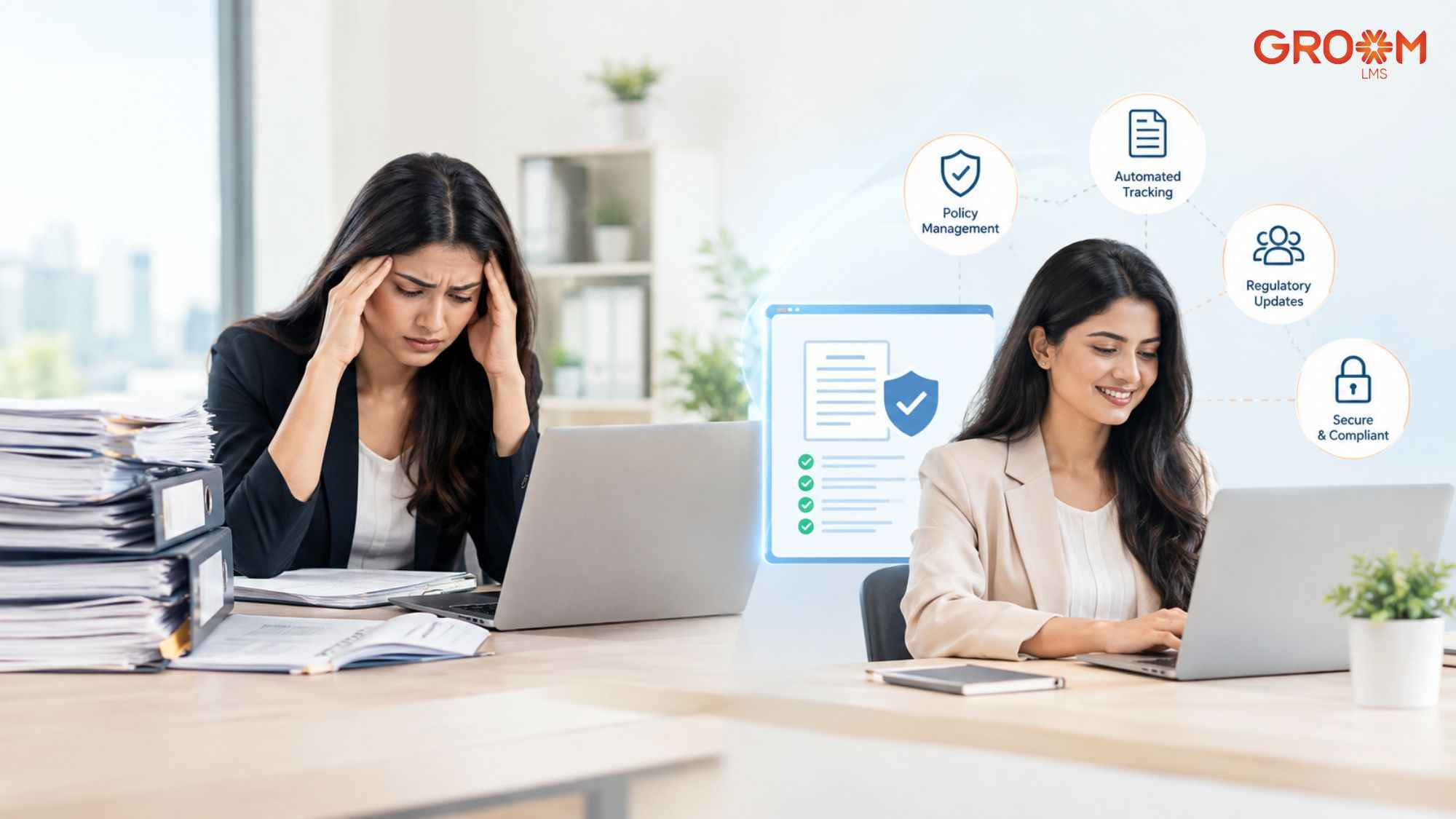
Managing compliance becomes harder when training records, employee progress, assessments, and certifications are spread across spreadsheets, emails, and separate systems. What starts as a simple process can quickly become difficult to monitor as the organisation grows.
HR, L&D, and compliance teams need to know which employees have completed required training, who is overdue, and where learning gaps exist. They also need reliable records when training needs to be reviewed.
This is where digital compliance solutions for businesses can make a practical difference. Instead of relying on disconnected processes, organisations can bring training, assessments, tracking, certifications, and reporting into a central digital environment.
GroomLMS supports this approach through digital course management, assessments, certifications, dashboards, analytics, and learning management capabilities. As a result, organisations can manage compliance learning more systematically while reducing unnecessary administrative work.
This guide explains the common challenges of compliance management, how digital solutions can address them, and what businesses should consider when choosing a platform.
Why Compliance Management Becomes Difficult as Businesses Grow
Compliance management is rarely limited to one training course.
Employees may need different training based on their roles, departments, locations, or responsibilities. Some programmes may also require periodic refreshers, assessments, or certifications.
Manual processes create additional work because teams have to repeatedly check records, send reminders, update spreadsheets, and prepare reports.
For example, imagine an organisation with several departments and hundreds of employees. The HR team may need to track:
- Who has been assigned each course
- Who has started training
- Who has completed it
- Assessment results
- Certification status
- Overdue training
- Refresher requirements
When this information sits in separate files, getting a complete picture becomes difficult.
Therefore, the problem is not simply the amount of training. It is the effort required to manage and monitor it consistently.
What Are Digital Compliance Solutions for Businesses?
Digital compliance solutions for businesses are technology-based systems that help organisations manage compliance-related activities through a centralised digital environment.
Depending on the solution, this may include:
- Digital compliance courses
- Employee training assignments
- Assessments and knowledge checks
- Completion tracking
- Certification management
- Automated notifications
- Dashboards and analytics
- Compliance reports
- Learning records
The goal is to replace fragmented administrative processes with a structured workflow.
For example, an organisation can assign a compliance course to a specific employee group, set a completion requirement, monitor progress, assess knowledge, and review the resulting training data from one system.
This approach also makes it easier to scale training as the workforce changes.
Common Compliance Management Problems Businesses Face
Before choosing a digital solution, it helps to identify the actual problems that need to be solved.
Manual Training Tracking
Spreadsheets can be useful for simple record keeping. However, they become harder to maintain when training involves multiple departments, recurring courses, and changing employee groups.
Manual updates can also create inconsistencies between different records.
Missed Training and Reminders
Employees may overlook training emails or forget deadlines. Meanwhile, administrators have to repeatedly identify overdue learners and follow up with them.
A structured digital workflow can reduce this repetitive work.
Limited Visibility
Compliance teams need more than a list of completed courses.
They may need to understand completion patterns, assessment performance, certification status, and department-level gaps.
Without central reporting, gathering this information can take considerable time.
Difficulty Scaling
A process that works for 50 employees may become difficult to manage for 1,000 employees.
As employee numbers increase, businesses need systems that can handle larger learner groups without creating the same increase in administrative workload.
How Digital Solutions Simplify Compliance Training
Digital compliance management works best when the entire training cycle is connected.
A typical workflow can follow these steps:
- Identify training requirements
Determine which employees need specific compliance courses based on their roles and responsibilities. - Create or upload learning content
Organise policies, procedures, videos, scenarios, assessments, and other learning resources into structured courses. - Assign training
Deliver the appropriate courses to selected employees or groups. - Set deadlines and reminders
Give employees clear completion timelines and use notifications to support timely participation. - Monitor progress
Review course completion, learner activity, and assessment performance. - Manage certifications
Maintain relevant certification records and identify training that requires renewal. - Generate reports
Use dashboards and reports to understand compliance status and identify gaps.
This connected workflow reduces the need to move information between different systems.
Why Training Automation Matters
Automation can remove many repetitive administrative tasks from compliance management.
For example, instead of manually sending the same reminder to every employee, a digital learning platform can support automated notifications based on course assignments and deadlines.
Similarly, organisations can use structured workflows for assessments, completion tracking, certifications, and reporting.
However, automation should not mean removing human oversight. Compliance content still needs to be accurate, relevant, and reviewed when policies or requirements change.
NIST’s guidance on cybersecurity and privacy learning programmes recommends a lifecycle approach that includes planning, implementation, evaluation, and ongoing improvement. It also highlights the value of metrics for improving learning programmes over time.
Therefore, automation should support the overall compliance strategy rather than operate as an isolated feature.
Features to Look for in a Digital Compliance Solution
Not every platform will support the same compliance workflows. Businesses should therefore evaluate features according to their actual requirements.
Centralised Course Management
The platform should allow teams to organise and manage compliance learning from one environment.
This reduces the need to maintain separate course files and disconnected records.
Employee Progress Tracking
Administrators should be able to see whether employees have started, completed, or fallen behind on assigned training.
This visibility helps teams identify gaps earlier.
Assessments and Knowledge Checks
Compliance training should not always end when an employee reaches the final slide.
Assessments can help organisations evaluate whether learners understand important concepts and procedures.
GroomLMS supports digital assessments alongside course management, certifications, analytics, and dashboards.
Reporting and Analytics
Reporting helps transform training data into useful information.
GroomLMS’s Advanced Reporting & Analytics capabilities include customisable reports and dashboards, real-time analytics, skill and competency tracking, and compliance and audit reports.
These capabilities can help HR, L&D, and compliance teams review training activity without relying entirely on manual data collection.
Certifications and Records
Where training programmes involve certificates, organisations should have a structured way to manage completion and certification information.
This becomes especially useful when employees need recurring or role-specific training.
Certain regulatory requirements may also specify what training records organisations must maintain. For example, OSHA regulations for certain maritime workplaces specify records such as employee name, trainer name, type of training, and training dates. Requirements vary by regulation and jurisdiction, so businesses should verify the rules that apply to them.
How to Choose the Right Digital Compliance Solution
Choosing a platform should start with the organisation’s workflow rather than a long feature checklist.
Ask these questions before making a decision:
Can the system support different employee groups?
Compliance requirements often vary between departments and job roles. Check whether the platform can support role-based training assignments.
Can employees and administrators use it easily?
A complicated interface can create problems for both learners and training managers.
Look for simple course administration, clear learner navigation, and accessible reporting.
Can the system scale?
Consider future requirements, not just the current workforce.
The platform should be able to support additional employees, courses, assessments, and training programmes as the organisation grows.
Can it reduce technical dependency?
L&D and HR teams should be able to manage routine learning activities without requiring technical assistance for every small change.
Does it provide useful reporting?
Reports should answer practical questions, such as who completed training, where gaps exist, and which programmes require attention.
How GroomLMS Supports Digital Compliance Management
GroomLMS provides a centralised environment to create, manage, deliver, and monitor digital learning programmes.
For compliance training, organisations can manage courses, assessments, certifications, virtual training, dashboards, analytics, and learner progress from one platform.
GroomLMS also allows businesses to create and manage their LMS environment independently, reducing continuous technical dependency. Its scalable setup can support changing training needs as organisations grow.
How to Build a More Manageable Compliance Training Process
Technology works best when the compliance process is clearly structured. Start by mapping requirements to employees, defining learning objectives, and setting completion and assessment criteria.
Then assign training through the LMS, monitor progress, and review reports regularly.
The process becomes a continuous cycle:
Identify → Train → Assess → Track → Report → Improve
This approach makes compliance training easier to manage and maintain over time. GroomLMS supports this process through structured courses, assessments, progress tracking, certifications, and reporting.
Conclusion
Compliance management becomes difficult when training, records, reminders, and reporting depend on disconnected manual processes. As organisations grow, these challenges can consume valuable time and make it harder to identify training gaps.
Digital compliance solutions for businesses provide a more structured approach. By bringing course delivery, employee tracking, assessments, certifications, automation, and reporting into one environment, organisations can create a clearer compliance training workflow.
However, the right solution should do more than automate tasks. It should be easy for teams to manage, flexible enough to support different learner groups, and scalable as training requirements change.
GroomLMS brings these capabilities together through a centralised learning environment that supports digital courses, assessments, certifications, dashboards, analytics, and training management.
For HR, L&D, and compliance teams, the objective is simple: make compliance training easier to deliver, easier to monitor, and easier to improve.
Simplify Compliance Management with GroomLMS
Manage digital training, track employee progress, streamline compliance activities, and keep your learning programmes organised with GroomLMS.
Contact Us | Join GroomLMS | Chat on WhatsApp
Frequently Asked Questions (FAQs)
What are digital compliance solutions for businesses?
Digital compliance solutions help businesses manage compliance-related training, employee progress, assessments, certifications, reminders, and reporting through digital platforms.
How does an LMS help with employee compliance training?
An LMS can centralize training, automate course assignments, track completion, manage assessments, and provide reports. This makes compliance training easier to administer.
Can online learning management systems automate compliance training?
Yes. An online learning management system can automate recurring assignments, reminders, notifications, progress tracking, and other routine training tasks.
What types of compliance training can businesses manage with an LMS?
Businesses can manage training related to workplace policies, safety, data security, onboarding, ethics, regulatory requirements, and role-specific compliance needs.
How can GroomLMS support compliance training?
GroomLMS supports digital learning through courses, assessments, certifications, virtual training, dashboards, analytics, and scalable LMS capabilities. It also supports end-to-end e-learning content development when organizations need additional assistance.