Your training is ready. The content is approved, learners are waiting, and the launch date is getting closer.
There’s just one tiny problem: IT.
“Can you set up the course?”, “Can you give these employees access?”, “Can you make that change?”
And suddenly, launching one training program feels like opening a support-ticket marathon.
For L&D teams, the real challenge is often not creating great training. It is getting that training live without depending on technical teams for every routine task. Course uploads, learner access, assessments, updates, and progress tracking can quickly turn a simple learning initiative into an administrative headache.
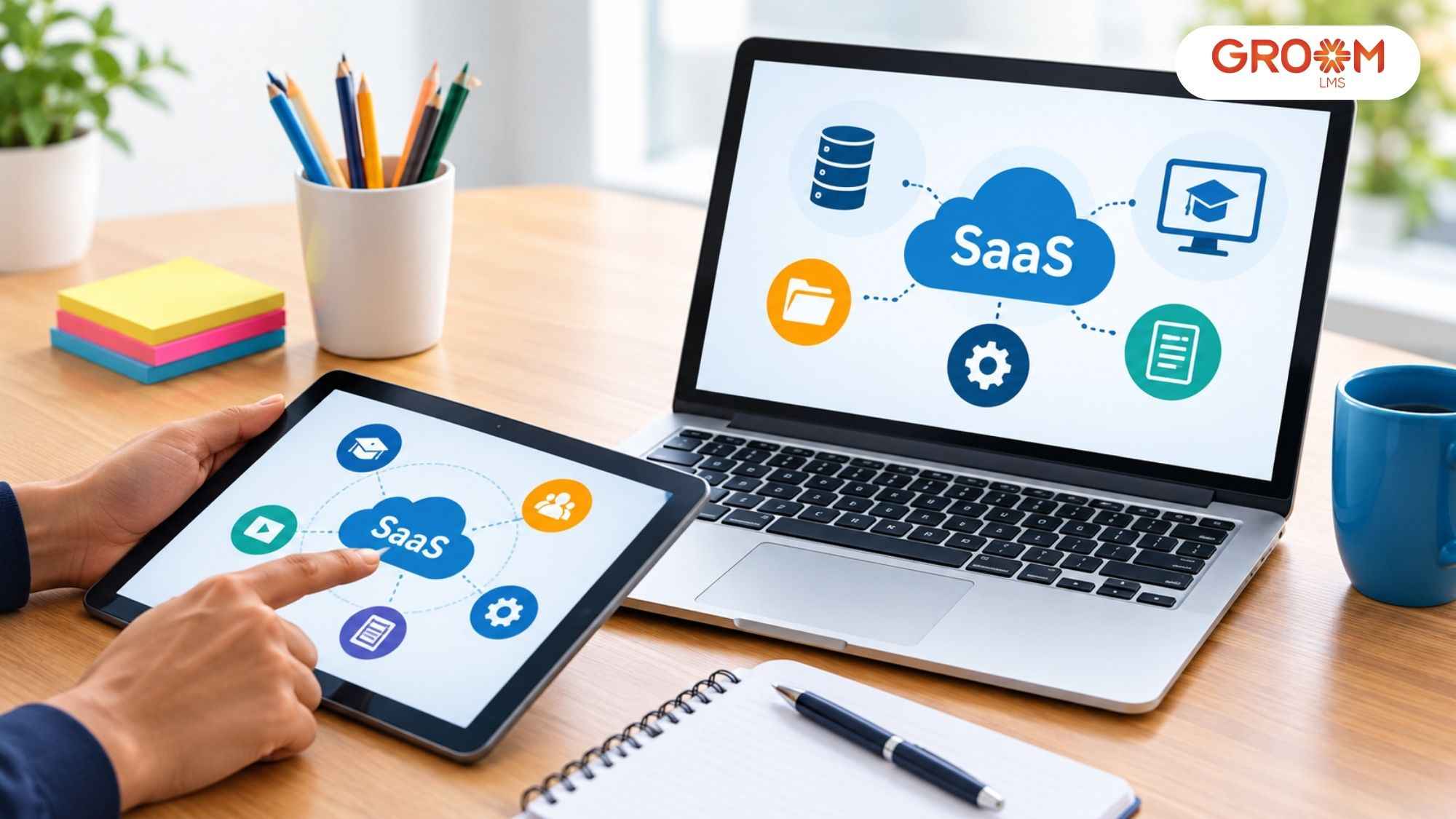
That is where a SaaS LMS can change the workflow. Instead of managing complicated infrastructure, L&D teams can work through a centralized, cloud-based learning environment designed for everyday training needs.
GroomLMS helps organizations create and manage their learning environment online, giving L&D teams more control over courses, learners, assessments, and training activities.
Because your training launch should involve more “Ready, set, learn” and fewer “Please raise a ticket.”
Why IT Dependency Can Slow Down Corporate Training
Corporate training often involves more moving parts than employees see.
An L&D team may need to upload a course, create learner groups, assign training, configure assessments, monitor progress, and prepare reports. When every step requires technical assistance, even routine changes can become delayed.
For example, an HR team may want to launch onboarding for a new batch of employees. If the learning platform requires IT intervention for user access, course configuration, or basic updates, the launch can lose momentum.
The same issue appears when training needs to change.
A compliance course may require an updated document. A product training module may need new information. An assessment may need a few questions replaced.
When L&D teams cannot make these changes independently, training becomes dependent on another department’s availability.
That creates three common problems:
- Training launches take longer.
- L&D teams spend more time on administration.
- Employees may wait longer for access to required learning.
The goal should not be to eliminate IT from the learning ecosystem. Instead, the goal is to reduce unnecessary technical dependency.
What Is a SaaS LMS?
A SaaS LMS is a Learning Management System delivered as Software as a Service.
Instead of installing and maintaining the platform on an organization’s own infrastructure, the learning environment is accessed online. The provider manages the underlying platform, while the organization uses the LMS to create, deliver, manage, and monitor training.
For L&D teams, this can simplify everyday training operations.
A SaaS LMS can bring activities such as these into one environment:
- Course delivery
- Learner management
- Assessments
- Certifications
- Training assignments
- Progress tracking
- Reporting and analytics
The practical advantage is accessibility. L&D professionals can manage learning activities without having to handle the technical infrastructure behind the platform.
That makes SaaS LMS platforms particularly useful for organizations that want to expand training without creating additional technical complexity.
How a SaaS LMS Makes Corporate Training Easier
The value of a SaaS LMS is not simply that training happens online. Its real value comes from reducing friction around the training process.
Faster Course Deployment
When the learning environment is already available online, L&D teams do not have to start every training initiative with infrastructure setup.
They can focus on preparing the learning experience, adding content, assigning learners, and monitoring results.
This is especially useful when organizations need to launch frequent onboarding, compliance, product, or skill-development programs.
Less Dependence on IT for Routine Tasks
L&D teams often understand the training requirement better than anyone else.
They know which employees need a course, when it should be completed, and what assessment is appropriate. A self-managed LMS allows them to handle many routine learning activities directly.
Instead of asking IT to make every small adjustment, L&D can manage the learning environment themselves.
This does not remove technical support when it is genuinely needed. It simply prevents routine learning administration from becoming an IT bottleneck.
Easier Learner Management
Managing employees through spreadsheets can quickly become difficult as training programs grow.
A SaaS LMS can centralize learners, courses, assignments, assessments, and completion information.
For example, an L&D manager could create separate learning paths for new employees, managers, sales teams, and technical staff.
Each group can receive relevant training without forcing everyone through the same learning journey.
Better Training Visibility
Training is difficult to improve when nobody knows what is happening.
A centralized LMS can provide visibility into learner progress, course completion, assessment performance, and other training information.
This gives L&D teams a clearer picture of questions such as:
- Who has completed the training?
- Which learners are falling behind?
- How are employees performing in assessments?
- Which courses require attention?
Instead of collecting information manually from different sources, teams can use centralized reports and dashboards to support their decisions.
SaaS LMS vs. Traditional Training Management
The difference becomes clearer when you compare the workflows.
With a heavily IT-dependent setup, an L&D manager may need to submit a request, wait for configuration, test the change, and then coordinate learner access.
With a SaaS LMS, many routine activities can be handled directly within the learning platform.
| Training Activity | IT-Dependent Approach | SaaS LMS Approach |
|---|---|---|
| Course updates | May require technical support | Managed through the LMS |
| Learner assignment | May involve multiple teams | Managed centrally |
| Progress tracking | Manual reports may be required | Available through LMS reporting |
| Training expansion | Can require additional setup | Platform can scale with needs |
| Routine administration | Often creates support requests | L&D can manage many tasks directly |
The point is not that every traditional system is difficult or that every SaaS platform works identically.
Rather, organizations should evaluate how much time their current learning system requires for routine activities.
If L&D spends more time managing the platform than improving learning, it may be time to rethink the setup.
Where a SaaS LMS Can Help L&D Teams
A SaaS LMS can support several common corporate learning scenarios.
Employee Onboarding
New employees need information quickly. An LMS can organize onboarding into a structured learning path containing company information, policies, role-specific training, assessments, and other resources.
This creates a consistent experience for employees joining from different locations.
Compliance Training
Compliance programs often involve deadlines, assessments, and completion tracking.
A centralized LMS can help L&D teams assign required learning, monitor completion, and maintain training records more efficiently.
Upskilling and Reskilling
Employee development is rarely a one-time event.
Organizations can use an LMS to create ongoing learning journeys around leadership, communication, technology, customer service, or role-specific skills.
Because courses can be managed digitally, learning can continue beyond scheduled classroom sessions.
Distributed and Hybrid Teams
Employees may work from different offices, cities, or locations.
A SaaS LMS gives learners a common digital environment for accessing assigned training. This can help organizations maintain consistency while giving employees more flexibility around when and where they learn.
How to Choose the Right SaaS LMS
Moving to a SaaS LMS should solve problems, not create new ones.
Before choosing a platform, L&D teams should consider several practical questions.
Can L&D Manage It Independently?
Check whether your team can create courses, assign learners, manage assessments, and monitor progress without requiring technical assistance for every task.
Is It Scalable?
Your learning requirements may change as your organization grows.
Look for a platform that can support additional learners, courses, departments, and training programs without forcing you into a completely different system.
Does It Provide Useful Reporting?
More data does not automatically mean better reporting.
Look for dashboards and reports that help answer real business questions about completion, performance, learner progress, and training effectiveness.
Is the Learner Experience Simple?
An LMS can have many features, but employees still need to understand how to use it.
A clear interface and straightforward navigation can reduce unnecessary friction for learners.
Can It Adapt to Different Training Needs?
Corporate learning rarely follows one format.
Your LMS may need to support courses, assessments, certifications, virtual training, and different learning paths. Choose a platform that fits the way your organization actually trains people.
How GroomLMS Helps Reduce Training Complexity
GroomLMS is designed to make learning and development easy, accessible, interactive, and cost-effective.
For organizations looking to reduce technical dependency, one practical advantage is the ability to create a GroomLMS instance online within seconds. Organizations can then manage their learning environment independently rather than relying on continuous technical support.
The platform supports course creation, assessments, certifications, virtual training, analytics, and dashboards. These capabilities give L&D teams a centralized environment for managing different parts of employee learning.
GroomLMS also supports organizations as their requirements change. Subscriptions can be upgraded or downgraded as needs evolve, making the learning environment more adaptable.
For an L&D team, the larger benefit is control.
Instead of treating every training initiative as a technical project, teams can focus more of their time on designing useful learning experiences, supporting employees, and measuring outcomes.
How to Make the Switch Without Disrupting Training
Moving to a new learning system does not have to mean changing everything at once.
A practical approach is to start small.
Identify your biggest training bottleneck.
Is it course delivery, learner management, reporting, or IT dependency?
Select one training program as a pilot.
Onboarding is often a useful starting point because it involves repeatable learning activities.
Organize your existing content.
Remove outdated material and group the remaining content into clear learning paths.
Set measurable learning outcomes.
Decide what learners should know or do after completing the training.
Monitor the pilot.
Review completion, assessment results, learner feedback, and administrative effort.
Expand gradually.
Once the workflow works, apply the same approach to other employee training programs.
This approach allows L&D teams to improve the process without turning LMS implementation into another overwhelming project.
Conclusion
Corporate training should not get stuck in a queue because someone needs to configure a system.
When L&D teams depend heavily on IT for routine learning activities, even simple training initiatives can become slower and harder to manage. That can affect onboarding, compliance training, employee development, and the overall learning experience.
A SaaS LMS offers a more practical approach by providing an online learning environment that organizations can access, manage, and scale without maintaining the underlying infrastructure themselves.
For L&D teams, the goal is not simply to adopt another piece of technology. It is to create a training workflow that is easier to operate and easier for employees to use.
GroomLMS supports this approach by bringing course management, assessments, certifications, virtual training, analytics, and dashboards into one learning environment. Its self-managed setup also helps organizations reduce unnecessary technical dependency.
When the technology becomes easier to manage, L&D teams can spend more time doing what they were hired to do: building better learning experiences and helping employees grow.
Stop Letting IT Delays Slow Down Your Training
With GroomLMS, your L&D team can manage courses, learners, assessments, and training analytics from one easy-to-use LMS, without relying on IT for every routine task.
Contact Us | Join GroomLMS | Chat on WhatsApp
Frequently Asked Questions (FAQs)
What is a SaaS LMS?
A SaaS LMS is a cloud-based Learning Management System delivered as a service. Organizations access it online without managing the underlying software infrastructure themselves.
How does a SaaS LMS reduce IT dependency?
A SaaS LMS allows L&D teams to manage many routine activities online, such as course delivery, learner assignments, assessments, and progress tracking, reducing the need for technical support.
Is a SaaS LMS suitable for employee training?
Yes. A SaaS LMS can support onboarding, compliance training, upskilling, reskilling, assessments, certifications, and continuous employee development.
Can a SaaS LMS scale with an organization?
Yes. SaaS LMS platforms can support changing training requirements as organizations add learners, courses, departments, and new learning programs.
How can GroomLMS support corporate training?
GroomLMS provides tools for course creation, assessments, certifications, virtual training, analytics, dashboards, and centralized learning management, while allowing organizations to manage their learning environment independently.