
“Can AI do everything for us now?”
Not quite. And honestly, your LMS probably does not want that job either.
AI is changing how organisations create, deliver, personalise, and manage learning. Yet adding AI to a training programme is not simply about using a chatbot or generating a few quiz questions. The real value comes from connecting intelligent technology with a structured learning environment.
That is where the conversation around GroomLMS and AI becomes interesting.
For L&D teams, HR professionals, and corporate training managers, an LMS provides the foundation for organising courses, assessments, learners, progress, and reports. AI can then support selected parts of that learning ecosystem, helping teams reduce repetitive work and make learning experiences more responsive.
However, AI should not replace instructional thinking or human oversight. UNESCO recommends a human-centred approach to AI in education, with attention to privacy, ethics, appropriate use, and pedagogical value.
So, how can organisations bring GroomLMS and AI together in a practical way? Let’s explore it.
Why AI Is Becoming Part of Corporate Learning
Corporate learning generates a lot of information.
There are courses to manage, employees to enrol, assessments to review, completion records to monitor, and training requirements to update. When these activities are handled manually, L&D teams can spend more time managing processes than improving learning.
AI can support this environment by helping organisations work with learning data and content more efficiently.
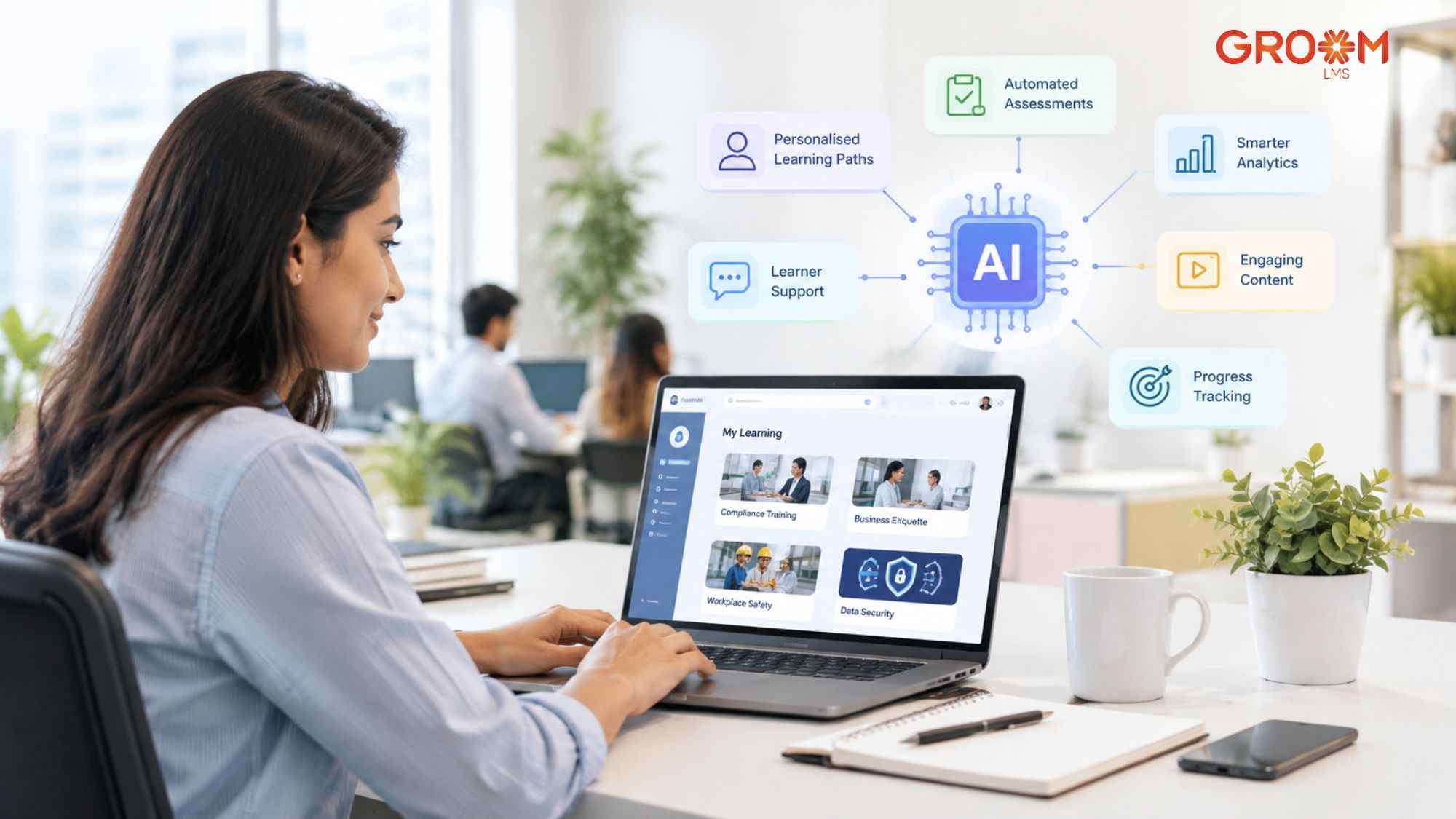
Depending on the technology and use case, AI can support areas such as:
- Personalised learning recommendations
- Automated content assistance
- Question and assessment generation
- Learner support
- Training data analysis
- Feedback and performance insights
- Intelligent proctoring
- Administrative automation
The important point is that AI works best when it has a clear learning environment around it.
An LMS provides that structure.
Instead of treating AI as a standalone tool, organisations can consider how it fits into their existing learning workflow.
What GroomLMS and AI Can Bring to Corporate Training
GroomLMS provides a central environment for creating and managing digital learning. Its platform supports courses, assessments, certifications, reporting, analytics, virtual training, and learner management.
AI can complement these capabilities by supporting specific activities within the learning process.
For example, imagine an organisation onboarding 300 employees.
The L&D team needs to provide introductory training, assign assessments, monitor completion, and identify employees who require additional support.
The LMS manages the learning structure.
AI can assist with selected tasks, such as generating draft assessment questions, identifying learning patterns, or supporting personalised learning recommendations.
The result is not “AI replaces the L&D team.”
Instead, it is:
Human expertise + LMS structure + AI assistance
That combination can make training operations more manageable while keeping people responsible for important learning decisions.
How AI Can Improve the Employee Learning Experience
Employees do not all learn in exactly the same way.
One employee may complete a course quickly. Another may need additional examples. Someone else may struggle with a particular assessment topic.
AI can help organisations move towards more responsive learning experiences.
Personalised learning support
AI can analyse learning information and help identify patterns in learner activity.
For instance, employees struggling with a specific topic could receive additional resources or be directed towards relevant learning content.
Personalisation does not necessarily mean creating a completely different course for every employee. It can simply mean making learning pathways more relevant.
Faster learner assistance
Employees often have questions while completing online training.
AI-based assistants can potentially provide immediate responses to common questions, while more complex issues can still be handled by trainers or subject-matter experts.
This can reduce unnecessary waiting and help learners stay engaged.
More relevant assessments
AI can assist instructional designers in creating question variations based on defined learning objectives.
However, generated questions should always be reviewed by a qualified person. AI can produce content quickly, but speed does not automatically guarantee accuracy.
That human review is especially important for compliance, safety, technical, and regulated training.
Where AI Can Reduce the L&D Team’s Workload
One of the biggest opportunities for AI is not replacing people. It is reducing repetitive work.
Consider a training manager preparing a new employee course.
The workflow might involve:
- Reviewing the learning objectives.
- Creating course content.
- Developing assessment questions.
- Organising learning activities.
- Assigning employees.
- Tracking completion.
- Reviewing assessment results.
- Preparing reports.
AI can assist with selected content and analysis tasks, while the LMS provides the operational structure.
GroomLMS supports course creation, assessments, certifications, reporting, analytics, and digital learning management. Its website also lists AI-based proctoring as an enterprise capability.
This creates opportunities to reduce repetitive administrative effort without removing human control from the learning process.
AI Should Support Learning, Not Replace Human Judgement
This is where organisations need to slow down before they speed up.
AI can generate content, identify patterns, and automate certain tasks. However, it can also produce inaccurate or inappropriate information.
UNESCO highlights the importance of human agency, data privacy, ethical considerations, and pedagogical suitability when AI is used in education and learning.
For corporate training, this means organisations should establish clear boundaries.
Before using AI, ask:
- Is the AI output accurate?
- Does it support the learning objective?
- Is sensitive learner data being handled appropriately?
- Does a subject-matter expert need to review the output?
- Could the AI recommendation disadvantage certain learners?
- Is the use of AI actually improving the learning experience?
These questions help keep technology focused on the learner rather than the technology itself.
A Practical GroomLMS and AI Workflow
Organisations do not need to transform their entire learning strategy overnight.
A practical approach can start with a simple workflow.
1. Define the learning objective
First, decide what employees need to know or do after training.
AI should support a defined learning goal, not become the goal itself.
2. Create and organise the learning content
Use the LMS to structure courses, learning activities, assessments, and resources.
GroomLMS provides tools for creating and delivering digital courses within a central learning environment.
3. Identify suitable AI use cases
Look for repetitive or data-heavy tasks where AI can provide genuine value.
For example, assessment drafting, learner support, content recommendations, or selected analysis activities may be suitable.
4. Add human review
Review AI-generated content before using it with employees.
This is especially important when training involves regulations, company policies, safety procedures, or sensitive information.
5. Monitor learner activity
Use LMS reporting and analytics to understand course completion, assessments, and learner performance.
6. Improve the programme
Use the information collected from training to identify gaps and improve future learning experiences.
This creates a continuous cycle:
Plan → Create → Deliver → Analyse → Improve
AI can support parts of this cycle, while the LMS provides the structure that keeps everything organised.
Why a Centralised LMS Still Matters in an AI-Driven Learning Environment
It may seem that AI tools could eventually handle everything independently.
But organisations still need a reliable place to manage learning.
A centralised LMS helps bring together courses, learners, assessments, certifications, progress information, and reporting.
GroomLMS is designed to support organisations across different sizes and training requirements. Its platform allows organisations to create an LMS instance online and manage their learning environment without continuous technical dependency.
That structure becomes even more useful when AI tools are introduced.
Instead of having learning information scattered across separate applications, teams can establish a central learning workflow and introduce AI where it adds practical value.
The goal is not to use AI everywhere.
The goal is to use it where it makes learning or learning management better.
Common Mistakes to Avoid When Using AI for Learning
AI adoption can become complicated when organisations focus on technology before defining the problem.
Avoid these common mistakes:
Using AI without a learning objective:
Technology should support what employees need to learn, not determine the training strategy.
Publishing AI-generated content without review:
Human validation remains essential for accuracy, context, tone, and relevance.
Ignoring privacy considerations:
Organisations should understand what learner or company information is being processed and how it is protected.
Automating everything:
Some learning decisions require human judgement, especially when they involve performance, compliance, or employee development.
Choosing tools without considering the wider LMS environment:
AI works better when it fits into an organised learning workflow rather than becoming another disconnected platform.
How GroomLMS Can Support the AI-Enabled Learning Journey
GroomLMS provides the foundation organisations need to manage digital learning through courses, assessments, certifications, dashboards, analytics, and learner tracking.
For organisations exploring AI, this creates a practical starting point.
Teams can structure their learning programmes in an LMS and then identify where AI can support content development, learner engagement, assessment, analysis, or selected automation.
GroomLMS also supports different training scenarios, including employee development, onboarding, compliance training, and role-based learning paths.
This flexibility matters because AI should be introduced according to the organisation’s learning needs.
A startup may need simple automation. An enterprise may require advanced reporting, integrations, or AI-supported assessment processes. The underlying principle remains the same: technology should serve the learning strategy.
Conclusion
The conversation around GroomLMS and AI is not really about choosing between people and technology.
It is about creating a learning environment where both can do what they do best.
An LMS provides structure. It organises courses, learners, assessments, certifications, progress, and reporting. AI can then support selected activities that benefit from automation, personalisation, content assistance, or data analysis.
However, effective AI adoption requires more than adding intelligent tools. Organisations need clear learning objectives, responsible data practices, human review, and a practical implementation strategy. UNESCO’s guidance similarly emphasises human-centred and responsible use of AI in education.
GroomLMS gives organisations a centralised environment for managing digital learning and training programmes. When AI is introduced thoughtfully, it can complement that environment and help L&D teams spend less time on repetitive tasks and more time improving learning.
The future of corporate learning does not have to be human versus AI.
It can be human-led learning, supported by intelligent technology.
Power Up Corporate Learning with GroomLMS and AI
Bring smarter technology into your training strategy with GroomLMS and AI. Create engaging learning experiences, support personalised training, simplify assessments, and gain better visibility into learner progress through a centralised LMS environment.
Contact Us | Join GroomLMS | Chat on WhatsApp
Frequently Asked Questions(FAQs)
What is an AI-powered LMS?
An AI-powered LMS combines learning management capabilities with artificial intelligence. It can support personalization, automation, recommendations, analytics, and smarter learning experiences.
How can AI improve employee training?
AI can help personalize learning, identify knowledge gaps, automate repetitive training tasks, recommend relevant content, and analyze learner performance.
Can GroomLMS support AI-powered learning?
GroomLMS provides a scalable digital learning environment with courses, assessments, workflows, analytics, certifications, virtual training, and other capabilities that support modern and increasingly intelligent learning strategies.
How does AI help L&D managers?
AI can reduce repetitive administrative work and provide useful insights from learning data. This allows L&D managers to spend more time on strategy, employee development, and improving learning outcomes.
Will AI replace human trainers?
No. AI can automate repetitive processes and support data-driven decisions. Trainers remain essential for mentorship, empathy, judgment, coaching, creativity, and human connection.