Training is an investment, not just an expense.
However, many organizations still struggle to prove whether their training programs deliver enough business value. They spend money on instructors, venues, content, technology, and employee time. Yet, they may not have clear data showing what they gained in return.
This makes corporate training ROI a major priority for HR and L&D teams.
At the same time, training programs are becoming more complex. Organizations need to train remote employees, onboard new hires, meet compliance requirements, develop leadership skills, and support continuous learning.
Managing all these activities manually can increase costs and administrative workloads.
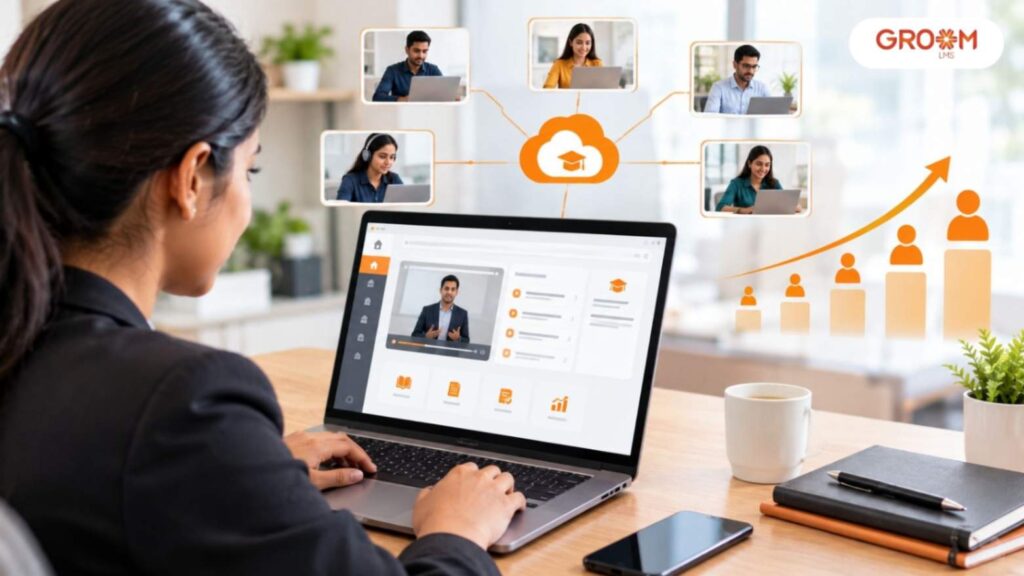
A scalable Learning Management System (LMS) can change this equation. Instead of treating an LMS as simply a course-delivery platform, organizations can use it to automate training, track performance, improve learner engagement, and scale learning programs.
GroomLMS helps organizations create and manage digital learning programs while reducing unnecessary technical dependency.
So, how can a scalable LMS improve training ROI?
Let’s explore the key factors.
What Does Corporate Training ROI Really Mean?
Corporate training ROI measures the value an organization receives from its training investment.
A simple ROI calculation can compare the financial benefits generated by training against the cost of delivering it.
Training ROI = (Training Benefits − Training Costs) ÷ Training Costs × 100
However, training value is not always measured through direct revenue.
Organizations can also evaluate:
- Employee productivity
- Employee performance
- Training completion
- Knowledge retention
- Compliance rates
- Employee onboarding time
- Error reduction
- Customer satisfaction
- Employee retention
- Time saved by automation
Therefore, a good LMS should help organizations collect useful learning data and connect training activities with business outcomes.
Why Is Corporate Training ROI Difficult to Improve?
Many organizations face similar challenges.
Manual Training Administration
Training teams may spend hours assigning courses, sending reminders, updating records, and creating reports.
As the workforce grows, these tasks become increasingly difficult.
Limited Training Visibility
Without centralized reporting, managers may not know:
- Who completed training
- Who needs additional support
- Which courses perform well
- Where knowledge gaps exist
- How employees perform in assessments
This makes it harder to improve future programs.
High Delivery Costs
Traditional classroom training can involve:
- Travel expenses
- Venue costs
- Printed materials
- Instructor fees
- Employee downtime
Digital learning can reduce many of these expenses while making training easier to scale.
Dependence on IT Teams
If L&D teams need technical assistance for routine changes, training programs can become slower and less flexible.
A self-service LMS can reduce this dependency.
7 Ways a Scalable LMS Can Improve Corporate Training ROI
1. Reduce Repetitive Administrative Work
Automation is one of the simplest ways to improve training efficiency.
A modern LMS can automate activities such as:
- Course enrollment
- Training assignments
- Notifications
- Reminders
- Assessments
- Progress tracking
- Certification workflows
- Reporting
For example, imagine an organization onboarding 200 employees.
Without automation, the training team may manually assign courses and track completion.
With an LMS, administrators can create an onboarding learning path once and assign it automatically.
As a result, the team saves time and can focus on higher-value L&D activities.
2. Scale Training Without Scaling Costs
Training costs often increase as organizations grow.
However, digital learning allows organizations to reuse content across larger groups.
For example, a company can create one product training program and provide it to employees across multiple locations.
The same content can support:
- New employees
- Existing employees
- Sales teams
- Customer support teams
- Channel partners
Therefore, organizations can reach more learners without repeating the entire training process.
3. Improve Employee Learning Engagement
Training only creates value when employees actually engage with it.
Long and repetitive learning programs may struggle to hold attention.
A scalable LMS can support more engaging learning formats, including:
- Interactive courses
- Videos
- Assessments
- Quizzes
- Microlearning
- Virtual training
- Certifications
Organizations can also organize content into structured learning paths.
This makes the learning journey easier to follow.
4. Use Learning Analytics for Better Decisions
You cannot improve what you cannot measure.
Learning analytics gives HR and L&D teams visibility into training performance.
Useful metrics may include:
- Course completion rates
- Assessment scores
- Learner participation
- Certification status
- Training hours
- Course engagement
- Department-level performance
Suppose a company notices that employees consistently perform poorly on one assessment.
The L&D team can investigate the content and identify where learners struggle.
Then, they can update the course accordingly.
This creates a continuous improvement cycle.
5. Reduce Employee Downtime
Traditional training often requires employees to attend sessions at specific times.
That can affect productivity.
Online learning offers greater flexibility.
Employees can access appropriate learning materials based on their schedules and roles.
For example, a short compliance module can replace a lengthy classroom session.
As a result, organizations can balance employee development with daily business responsibilities.
6. Standardize Training Across Locations
Large organizations often operate across multiple branches, cities, or countries.
This can create inconsistent training experiences.
A centralized LMS can help organizations deliver standardized learning content across locations.
For example, every new employee can receive the same:
- Company introduction
- Policy training
- Compliance courses
- Role-specific training
- Assessment
- Certification
At the same time, organizations can customize learning paths for specific departments.
This creates consistency without removing flexibility.
7. Reduce Long-Term Training Costs
A scalable LMS can help organizations reduce several recurring expenses.
These may include:
- Physical training materials
- Venue costs
- Travel expenses
- Manual reporting
- Administrative effort
- Repeated instructor sessions
Moreover, digital content can often be reused and updated when requirements change.
This can make training programs more sustainable over time.
How to Measure Training ROI with an LMS
Simply implementing an LMS does not automatically improve ROI.
Organizations need a measurement strategy.
Start by defining the training objective.
For example:
Goal: Reduce customer-support errors.
Then identify the relevant metrics:
- Error rate before training
- Error rate after training
- Assessment scores
- Course completion
- Customer complaints
Next, compare the results with training costs.
This approach helps connect learning activity with business performance.
Use a Simple Training ROI Framework
Follow these steps:
Step 1: Define the Business Goal
Decide what the training should improve.
Step 2: Establish a Baseline
Measure current performance before training.
Step 3: Deliver the Learning Program
Use courses, assessments, activities, and learning paths.
Step 4: Track Learning Performance
Monitor completion, engagement, and assessment results.
Step 5: Measure Business Outcomes
Compare performance after training.
Step 6: Calculate ROI
Compare measurable benefits against training costs.
This framework helps transform training from an administrative function into a measurable business activity.
How GroomLMS Supports Scalable Corporate Training
GroomLMS is designed to make learning and development easier, accessible, interactive, and cost-effective.
Organizations can create a GroomLMS instance online within seconds. They can also manage their platform independently without continuous technical dependency.
This is especially useful for L&D teams that need to launch or update training programs quickly.
GroomLMS supports capabilities such as:
- Digital course development
- Assessments
- Certifications
- Virtual training
- Learning management
- Automated workflows
- Analytics and dashboards
- Content localization
- Scalable learning programs
For example, an organization can create a role-based employee training program.
New employees can receive onboarding content automatically. They can then complete assessments and required certifications.
Meanwhile, managers can monitor progress through centralized reports.
This creates a more structured process while reducing manual administration.
Example: Improving Training ROI with a Scalable LMS
Consider a company with 1,000 employees across several locations.
Previously, the company conducted classroom-based compliance training.
The process involved:
- Scheduling multiple sessions
- Booking training rooms
- Coordinating instructors
- Tracking attendance
- Sending reminders
- Preparing manual reports
The organization then moves the program to an LMS.
Now, the company can:
- Create one standardized course
- Assign training to employees
- Automate reminders
- Deliver assessments
- Track completion
- Generate reports
- Manage certifications
The organization may therefore reduce administrative effort and improve training visibility.
More importantly, the L&D team can spend more time improving the learning experience.
What Should You Look for in a Scalable LMS?
Before selecting an LMS, evaluate more than its feature list.
Look for a platform that offers:
- Easy administration
- Scalable infrastructure
- Automation capabilities
- Learning analytics
- Assessment tools
- Certification management
- Mobile accessibility
- Content management
- Customizable learning paths
- Secure data management
- Reliable reporting
- Minimal technical dependency
Most importantly, the platform should support your current needs while allowing your training programs to grow.
Start Measuring Training as a Business Investment
Improving corporate training ROI requires more than reducing costs.
Organizations should also improve learning quality, employee performance, operational efficiency, and measurable outcomes.
A scalable LMS can support this process by bringing training activities into one centralized environment.
Automation reduces repetitive work.
Analytics improves visibility.
Digital learning reduces delivery limitations.
Personalized learning improves relevance.
Scalability allows organizations to reach more employees without constantly rebuilding their training infrastructure.
Therefore, the right LMS can become an important part of a long-term learning strategy.
Conclusion
Maximizing corporate training ROI requires organizations to connect learning investments with measurable outcomes.
A scalable LMS can help achieve this by reducing administrative work, automating training workflows, improving accessibility, and providing useful learning analytics.
However, organizations should first define what success means for their training programs. Completion rates alone may not tell the complete story. Employee performance, productivity, compliance, knowledge retention, and cost savings can provide deeper insights.
GroomLMS supports organizations with scalable digital learning capabilities, assessments, certifications, automation, analytics, and self-service platform management.
By simplifying training operations, organizations can build learning programs that are easier to manage, measure, and scale.
Transform Your Corporate Learning with GroomLMS
Discover how GroomLMS empowers your organization to streamline training, enhance learner engagement, and deliver impactful learning experiences with an AI-powered LMS built for growth.
Request a Personalized Demo | Schedule a Consultation | Chat with Our Team
Frequently Asked Questions(FAQs)
What is corporate training ROI?
Corporate training ROI measures the value generated by employee training compared with the cost of delivering that training. It can include financial and non-financial outcomes.
How can an LMS improve corporate training ROI?
An LMS can improve training ROI by reducing administrative work, automating processes, supporting scalable learning, and providing data to measure training performance.
Can an LMS reduce employee training costs?
Yes. Digital learning can reduce costs associated with travel, physical materials, venues, repeated training sessions, and manual administration.
How does training automation improve ROI?
Training automation reduces repetitive administrative work. Teams can automate enrollment, reminders, assessments, progress tracking, and certification workflows.
What LMS metrics should companies track?
Organizations can track completion rates, assessment scores, engagement, certification status, training hours, learner progress, and relevant business performance indicators.