
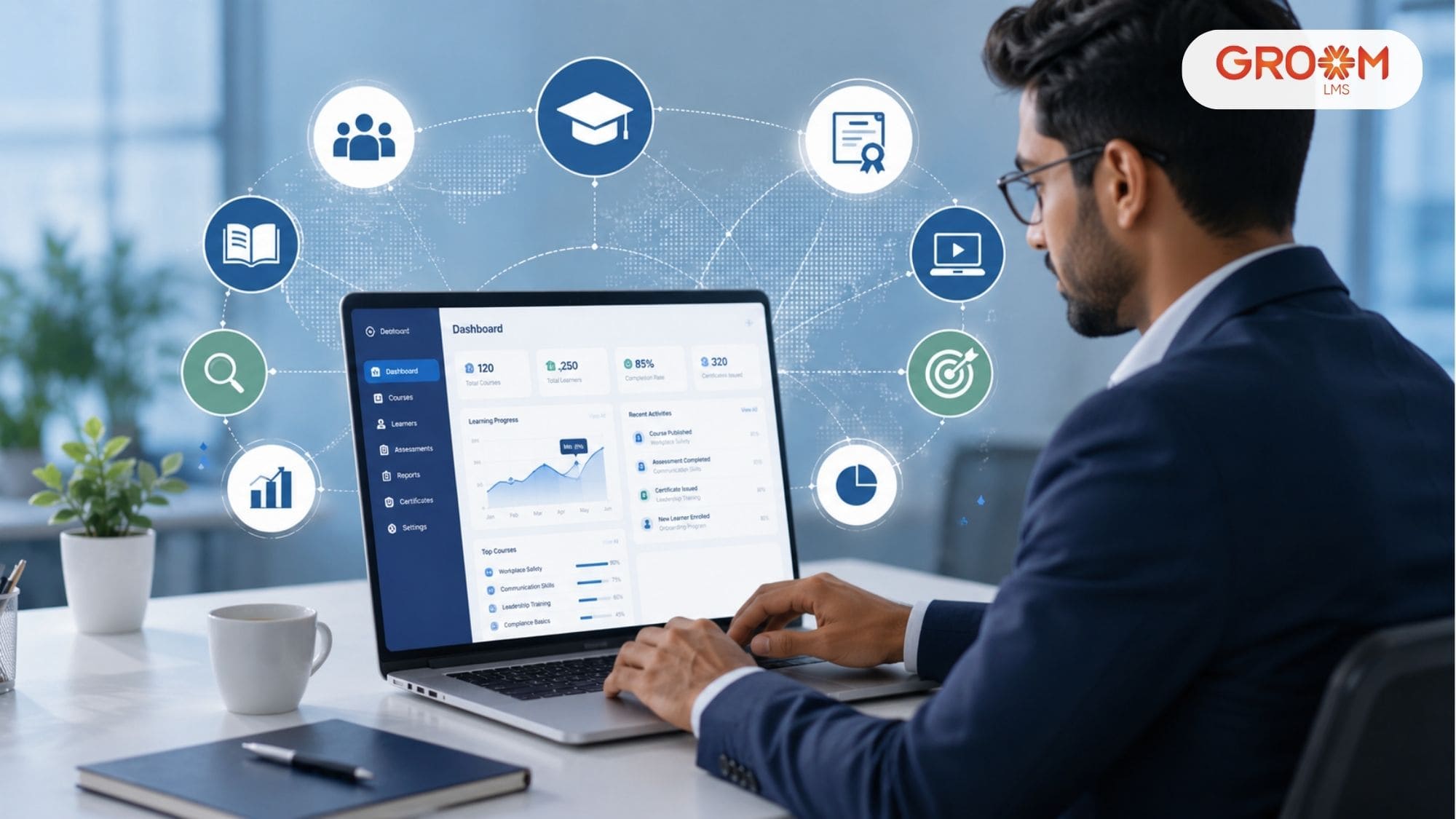
Choosing an LMS can look simple until you start comparing platforms. One system may offer strong course management, another may focus on analytics, while another may promise easier administration. The real challenge is finding a platform that fits your organisation’s actual learning needs.
For L&D teams, HR professionals, and corporate training managers, the right LMS should do more than host online courses. It should help organise learning, assign training, track progress, manage assessments, and scale programmes without creating unnecessary technical work.
GroomLMS provides a digital learning environment designed to help organisations manage courses, assessments, certifications, virtual training, analytics, and other learning activities from one platform. This makes it relevant for organisations evaluating their options when looking for the best online learning management system in India.
Before choosing an LMS, however, it is important to look beyond feature lists. Usability, scalability, automation, reporting, support, and long-term requirements should all be part of the evaluation.
What Is an Online Learning Management System?
An online learning management system is software used to create, deliver, manage, and track digital learning programmes.
An LMS typically brings courses, learners, assessments, progress records, and reporting into one environment. It can support employee onboarding, compliance training, professional development, product training, and other learning programmes.
For example, an organisation onboarding new employees could use an LMS to:
- Assign introductory courses
- Provide learning materials
- Conduct assessments
- Track completion
- Issue certificates
- Monitor learner performance
Instead of managing these activities through spreadsheets, emails, and separate systems, an LMS provides a central learning environment.
That centralisation becomes increasingly useful as the number of learners and courses increases.
Why Choosing the Right LMS Matters
Not every organisation needs the same learning platform.
A startup may need a simple system for onboarding and employee development. An enterprise may require multiple courses, assessments, certifications, reporting, virtual training, and different learning programmes for different teams.
The best online learning management system in India for one organisation may therefore be completely different from the right choice for another.
Before comparing platforms, identify:
- Who will use the LMS?
- What types of training will you deliver?
- How many learners do you expect?
- What learning activities need to be tracked?
- How much administrative work should be automated?
- What reports will managers and L&D teams need?
- How might your training requirements change as the organisation grows?
This approach helps you evaluate an LMS against actual business requirements instead of choosing based only on a long feature list.
Key Features to Look for in an Online Learning Management System
Once your requirements are clear, evaluate the platform across several practical areas.
1. Easy Course Management
Course creation and administration should not become a technical project every time you launch training.
Look for an LMS that makes it easy to organise courses, upload learning content, manage learners, and update training materials.
This is particularly useful for L&D teams that need to launch training programmes regularly.
2. Assessments and Certifications
Learning should not end when an employee finishes a course.
Assessments can help organisations check understanding, while certificates can document successful completion where appropriate.
Therefore, consider whether the LMS supports quizzes, assessments, completion tracking, and certification workflows.
3. Learning Analytics and Reporting
Training data becomes more useful when it can support decisions.
An LMS should help administrators understand information such as course completion, assessment performance, learner progress, and participation.
For example, if a large group of employees repeatedly struggles with one assessment, the L&D team can review the learning content and identify where additional support may be needed.
Reporting is also important when organisations need evidence of completed training.
4. Automation
Manual follow-ups can consume considerable administrative time.
A suitable LMS should help automate repetitive activities such as assigning training, tracking completion, sending reminders, and maintaining learning records where supported.
This allows training teams to spend less time chasing updates and more time improving learning experiences.
5. Scalability
Your LMS should be able to grow with your organisation.
Consider whether the platform can support increasing numbers of learners, courses, categories, and training programmes without making administration unnecessarily complicated.
Scalability also matters for organisations that may start with employee training and later expand into customer, partner, or other learning programmes.
6. Integration and Content Compatibility
Your existing learning content and technology ecosystem matter when choosing an LMS.
If your organisation already uses digital learning packages, check whether the LMS supports relevant standards such as SCORM and xAPI. Also, consider whether it can integrate with the tools and systems your teams already use.
Good integration can reduce duplicate work and make it easier to manage learner data, training content, and reporting from connected systems.
For example, SCORM support can be important when working with SCORM-based e-learning courses. GroomLMS supports digital learning requirements while also considering SCORM and xAPI compatibility, helping organisations manage learning content within a connected LMS environment. This can make it easier to build a more consistent online learning ecosystem as training needs grow.
7. User Experience
An LMS can have many features and still be difficult to use.
Consider the experience of both administrators and learners.
Administrators should be able to manage training without excessive technical dependency. At the same time, employees should be able to find courses, understand what they need to complete, and access learning without unnecessary complexity.
A simpler experience can make implementation easier across different employee groups.
How to Compare LMS Platforms Before Making a Decision
Rather than comparing platforms feature by feature without context, create a simple evaluation process.
Step 1: Define Your Learning Goals
Start with the outcomes you want from the LMS.
For example, your goals may include improving onboarding, standardising employee training, supporting compliance, or developing specific workplace skills.
Step 2: Identify Your Learners
Consider employee roles, departments, locations, experience levels, and expected learner numbers.
Different learner groups may require different courses or learning paths.
Step 3: List Your Essential Features
Separate features into two groups: essential and useful.
Your essentials might include:
- Course management
- Assessments
- Certifications
- Learner tracking
- Reporting
- Automation
- Virtual training
- Scalability
This prevents attractive but unnecessary features from distracting you during evaluation.
Step 4: Test the Administrative Experience
Do not evaluate an LMS only from the learner’s perspective.
Ask how easily your L&D team can create courses, assign learners, update content, generate reports, and manage the learning environment.
Training Industry also recommends starting LMS selection by defining the organisation’s learning strategy and goals.
Step 5: Consider Future Requirements
Finally, think beyond your first training programme.
Will you need more learners? More courses? Certifications? Different departments? New training formats?
A platform that can adapt to changing requirements can reduce the need for another technology transition later.
How GroomLMS Supports Online Learning Management
GroomLMS is designed to make learning and development easier to manage through a central digital learning environment.
Organisations can create a GroomLMS instance online and manage their learning environment independently. The platform supports capabilities such as course creation, assessments, certifications, virtual training, analytics, dashboards, and digital learning management.
This can be useful for organisations that want to reduce continuous technical dependency while maintaining control over their learning programmes.
GroomLMS can also support organisations of different sizes as their training requirements evolve. Its broader use cases include employee development, onboarding, compliance training, and other structured learning programmes.
For smaller organisations, choosing an LMS that is practical to maintain is particularly important. GroomLMS also discusses LMS considerations for Indian SMEs, including usability, scalability, and reducing dependence on manual training processes.
The goal is not simply to put courses online. It is to create a manageable system where learning can be organised, delivered, monitored, and improved.
Common Mistakes to Avoid When Choosing an LMS
Even a feature-rich platform may not be the right fit if the selection process starts from the wrong place.
Avoid choosing an LMS only because it has the largest number of features. More features do not automatically mean better learning management.
Also avoid ignoring administrator experience. If every small change requires technical assistance, the platform may create more work instead of reducing it.
Another common mistake is overlooking scalability. Your initial requirements may be small, but your learning programme can expand quickly.
Finally, do not skip practical testing. Whenever possible, involve both administrators and representative learners before making the final decision.
How to Know If an LMS Is the Right Fit
The right LMS should connect technology with your actual learning strategy.
Ask yourself:
- Can our team manage it comfortably?
- Can employees use it without unnecessary friction?
- Does it support our current training formats?
- Can we track meaningful learning data?
- Can we automate repetitive administrative tasks?
- Can the platform scale with our organisation?
- Does it support our future learning requirements?
If the answers align with your needs, you have a stronger basis for making your decision.
The best online learning management system in India is not necessarily the platform with the longest feature list. It is the platform that fits your learners, learning goals, administrative requirements, and growth plans.
Conclusion
Choosing the best online learning management system in India requires more than comparing software features. Organisations need to consider how the platform will support real learning programmes, administrators, employees, and future growth.
Start by defining your training goals and learners. Then evaluate course management, assessments, certifications, reporting, automation, usability, content compatibility, and scalability. Most importantly, consider how much effort your L&D team will need to manage the platform after implementation.
A well-chosen LMS can bring learning activities into one organised environment and make training easier to deliver, monitor, and improve. It can also reduce repetitive administrative work and give teams clearer visibility into learning progress.
GroomLMS provides a scalable digital learning environment with capabilities for courses, assessments, certifications, virtual training, analytics, and dashboards. For organisations looking to simplify online learning management while retaining greater control over their training environment, it can be considered as part of the evaluation process.
Ultimately, the right platform should make learning management more practical, not more complicated.
Choose the Right LMS with GroomLMS
Simplify online learning, manage training efficiently, and scale your learning programmes with GroomLMS.
Contact Us | Join GroomLMS | Chat on WhatsApp
Frequently Asked Questions (FAQs)
What is an online learning management system?
An online learning management system is software used to deliver, organise, track, and manage digital learning programmes, including employee training and assessments.
What features should an LMS have?
Important features can include course management, assessments, certifications, learner tracking, reporting, automation, analytics, content compatibility, and scalability.
How can an LMS improve employee training?
An LMS centralises training and can help organisations assign courses, monitor progress, deliver assessments, manage certifications, and analyse learning activity.
Can an LMS automate training management?
Yes. Depending on the platform, an LMS can automate activities such as course assignments, reminders, completion tracking, assessments, and reporting.
Is GroomLMS suitable for different types of organisations?
GroomLMS supports scalable digital learning for organisations of different sizes and can be used for areas such as employee training, onboarding, compliance, assessments, certifications, and virtual learning.