
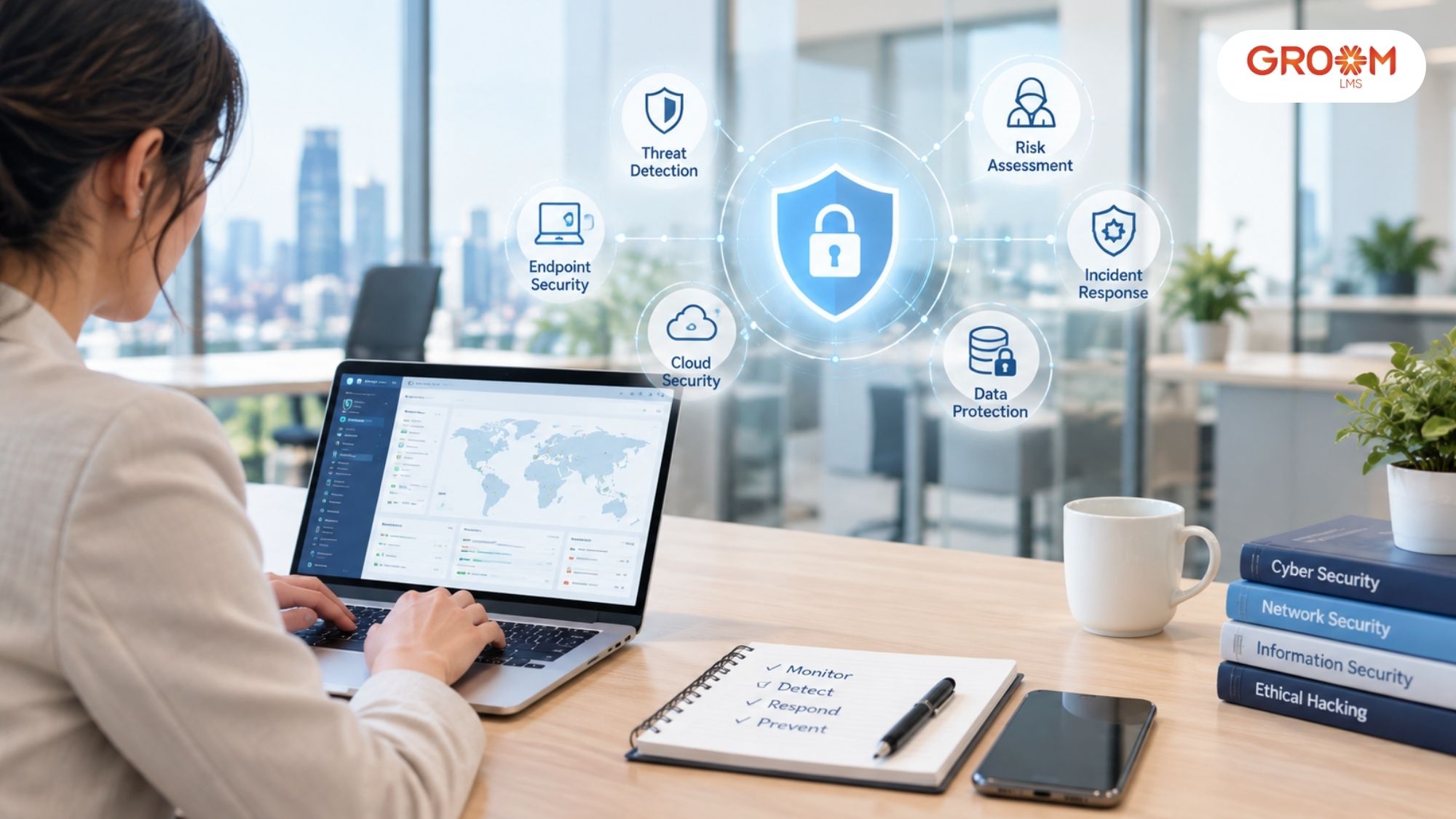
Cybersecurity threats often begin with simple mistakes, such as clicking suspicious links, using weak passwords, or sharing sensitive information. Without proper training, employees may unknowingly expose business systems and data to attackers.
The best cybersecurity awareness programs help employees recognise threats, follow safe practices, and report suspicious activity. However, one-time training is rarely enough to build lasting security habits. Businesses need regular learning, practical examples, and assessments to reinforce awareness.
With GroomLMS, organisations can organise digital training, assess employee understanding, and monitor learning progress. A structured approach helps businesses strengthen security awareness while keeping training manageable and consistent.
Why Cybersecurity Awareness Training Matters for Businesses
Cybersecurity incidents do not always begin with sophisticated technical attacks. Sometimes, an employee clicks an unfamiliar link, shares a verification code, or approves an unexpected login request.
Awareness training helps employees recognise these situations before they become serious problems. It also gives them clear instructions for responding when something appears suspicious.
The Cybersecurity and Infrastructure Security Agency (CISA) recommends practical security habits, including recognising phishing attempts, using strong passwords, enabling multifactor authentication, and installing software updates.
For businesses, these habits support a broader security strategy. Technical controls remain essential, but employees need to understand how their everyday decisions affect organisational security.
The best cybersecurity awareness programs address risks employees actually encounter. For example, a finance employee may need guidance on fraudulent payment requests, while a remote employee may need training on public Wi-Fi and device security.
When training reflects real responsibilities, employees can apply what they learn more confidently. This makes cybersecurity awareness relevant to daily work rather than just another mandatory course.
What Makes the Best Cybersecurity Awareness Programs Effective?
A strong awareness programme combines relevant content, regular practice, clear reporting procedures, and measurable outcomes. It should help employees understand both the threats they face and the actions they can take.
The best cybersecurity awareness programs typically include the following elements.
- Phishing awareness: Teach employees to identify suspicious links, unexpected attachments, impersonation attempts, and urgent requests for confidential information.
- Password and account security: Explain password managers, unique passwords, multifactor authentication, and safe account recovery practices.
- Data protection: Show employees how to handle sensitive documents, share files securely, and avoid exposing confidential information.
- Device and remote-work security: Cover screen locking, software updates, approved applications, and safe connections when working remotely.
- Incident reporting: Explain how to report suspicious messages, lost devices, accidental disclosures, and unusual account activity.
- Role-specific scenarios: Provide examples that reflect the responsibilities and risks associated with different departments.
Content should also be accessible to employees with different levels of technical knowledge. Use plain language, short demonstrations, practical examples, and assessments that check understanding.
The NIST Cybersecurity Framework provides a useful reference for understanding cybersecurity as an ongoing organisational risk-management activity. Awareness training should support this wider effort rather than operate independently.
How to Build a Cybersecurity Awareness Training Programme
Businesses do not need to launch a large training initiative immediately. A structured rollout can help teams identify priorities, deliver relevant learning, and improve the programme over time.
1. Identify the most relevant security risks
Start by reviewing common threats, previous incidents, internal security policies, and employee responsibilities. Consult IT and security teams to determine which behaviours require the most attention.
For example, if employees regularly receive suspicious messages impersonating senior leaders, prioritise phishing recognition and verification procedures.
2. Set clear learning objectives
Define what employees should know or do after training. Instead of setting a vague objective such as understanding cybersecurity, establish specific outcomes.
Employees should be able to identify warning signs in suspicious emails, explain how to report incidents, and demonstrate safe handling of confidential information.
Clear objectives make it easier to select content and evaluate whether training has worked.
3. Deliver short, practical learning modules
Divide the programme into manageable topics. A module might explain phishing indicators, present an example message, and ask employees to identify suspicious elements.
Other modules can cover password security, social engineering, device protection, and data handling. Use scenarios that resemble the decisions employees make during normal work.
The best cybersecurity awareness programs make learning practical without overwhelming employees with technical terminology.
4. Reinforce learning throughout the year
Schedule regular refreshers rather than relying entirely on annual training. Use short quizzes, scenario-based exercises, policy reminders, and updates about emerging threats.
Reinforcement should be proportionate to the risk and employee workload. Repeating identical material is less useful than revisiting important concepts through different situations.
5. Evaluate and improve the programme
Review assessment results, participation, employee feedback, and reporting behaviour. Identify topics that repeatedly cause confusion and revise the relevant content.
If employees struggle to recognise fraudulent login requests, provide clearer examples and additional practice. Then evaluate whether understanding improves in subsequent assessments.
This cycle helps the programme respond to actual learning needs rather than following a fixed schedule without reviewing results.
Use an LMS to Manage Cybersecurity Awareness Training
As organisations grow, managing cybersecurity training through spreadsheets, email reminders, and separate files becomes difficult. Training administrators may struggle to identify who completed each module, which employees need refreshers, and where knowledge gaps remain.
A learning management system can centralise course delivery, assessments, assignments, and progress monitoring.
For HR and L&D teams, this provides a more organised way to coordinate awareness training across departments, locations, and employee groups. IT security managers can work with training administrators to ensure that learning materials reflect current policies and known risks.
When evaluating the best cybersecurity awareness programs, consider whether the supporting platform can:
- Assign training to relevant employee groups.
- Deliver digital courses and knowledge assessments.
- Track participation and completion status.
- Provide reports that help identify learning gaps.
- Support updates to content as organisational risks change.
- Scale training without creating excessive administrative work.
GroomLMS offers a digital learning environment where organisations can manage courses, assessments, certifications, and learner progress. Its dashboards and reporting capabilities can help administrators monitor training activities and identify areas requiring attention.
Before selecting a platform, confirm that its available features meet your reporting, access-control, and organisational requirements. A straightforward system that teams can manage consistently is often more practical than a complicated setup that requires continuous technical assistance.
Measure the Results of Cybersecurity Awareness Programs
Course completion alone does not prove that employees can recognise or respond to security threats. Businesses should measure learning outcomes and relevant behaviour wherever practical.
Start with a small set of indicators that connect directly to programme objectives.
Knowledge assessment results: Compare quiz performance across topics and training cycles to identify recurring misunderstandings.
Phishing simulation outcomes: Where simulations are appropriate and approved, review interaction patterns and whether employees report suspicious messages. Interpret results carefully because simulations cannot represent every real-world threat.
Incident reporting: Monitor whether employees use approved reporting channels and whether suspicious activity reaches the right team promptly.
Training completion: Track overdue assignments and identify departments that may need additional support.
Employee feedback: Ask whether the material was understandable, relevant, and easy to apply.
Avoid using a single metric to judge success. For example, an increase in reported suspicious emails may indicate that employees are becoming more aware, not that attacks are necessarily increasing.
The best cybersecurity awareness programs use several indicators together and interpret them alongside the organisation’s wider security information. Establish a baseline, review trends, and adjust training based on evidence rather than assumptions.
Common Mistakes Businesses Should Avoid
Even well-intentioned awareness initiatives can lose effectiveness when training becomes repetitive, overly technical, or disconnected from daily work.
Avoid these common mistakes:
- Relying on annual training alone: Long gaps between sessions can make important practices easier to forget.
- Using generic examples: Content that ignores employees’ actual responsibilities may feel irrelevant and fail to address their risks.
- Focusing only on completion: Employees may finish a course without understanding how to apply its lessons.
- Creating a blame-based culture: Employees may hesitate to report mistakes if they fear punishment for raising concerns.
- Ignoring content updates: Outdated examples and policies can leave employees unprepared for current threats.
Instead, encourage employees to report suspicious activity promptly and make reporting procedures easy to find. Review training whenever policies, working practices, or identified risks change.
The best cybersecurity awareness programs combine consistent learning with a workplace culture that treats security as a shared responsibility.
Conclusion
The best cybersecurity awareness programs help employees recognise threats, protect sensitive information, and respond appropriately to suspicious activity. Regular training, realistic scenarios, and clear reporting procedures make security practices easier to apply at work.
Businesses should focus on relevant learning objectives, measure employee understanding, and update training as risks evolve. An LMS can simplify course delivery, assessments, and progress tracking without adding unnecessary administrative work.
GroomLMS helps organisations manage digital learning and monitor training progress through a central platform. By combining structured awareness training with consistent reinforcement, businesses can encourage safer employee behaviour and build a stronger security-conscious workplace.
Strengthen Employee Security Awareness with GroomLMS
Discover how GroomLMS empowers your organization to streamline training, enhance learner engagement, and deliver impactful learning experiences with an AI-powered LMS built for growth.
Contact Us | Join GroomLMS | Chat on WhatsApp
Frequently Asked Questions (FAQs)
How often should businesses conduct cybersecurity awareness training?
Businesses should provide initial training during onboarding, followed by regular refreshers and targeted sessions when risks or policies change. Frequency should reflect organisational needs and the sensitivity of employees’ responsibilities.
Who should participate in cybersecurity awareness programs?
All employees should receive relevant baseline training, including managers and executives. Additional modules can address the specific risks faced by IT teams, finance staff, customer service representatives, and other roles.
How can small businesses deliver cybersecurity awareness training with limited resources?
Small businesses can begin with short digital modules, practical examples, simple assessments, and existing security guidance. An LMS can help organise assignments and track progress without relying entirely on manual administration.
What is the difference between cybersecurity awareness and cybersecurity training?
Cybersecurity awareness helps employees recognise threats and understand safe practices. Cybersecurity training develops more specific knowledge and skills, such as responding to incidents or performing security-related tasks.
How can an LMS support the best cybersecurity awareness programs?
An LMS can organise courses, distribute learning materials, administer assessments, and track completion. The best cybersecurity awareness programs use these capabilities alongside practical exercises, clear reporting procedures, and regular evaluation to improve employee security behaviour.