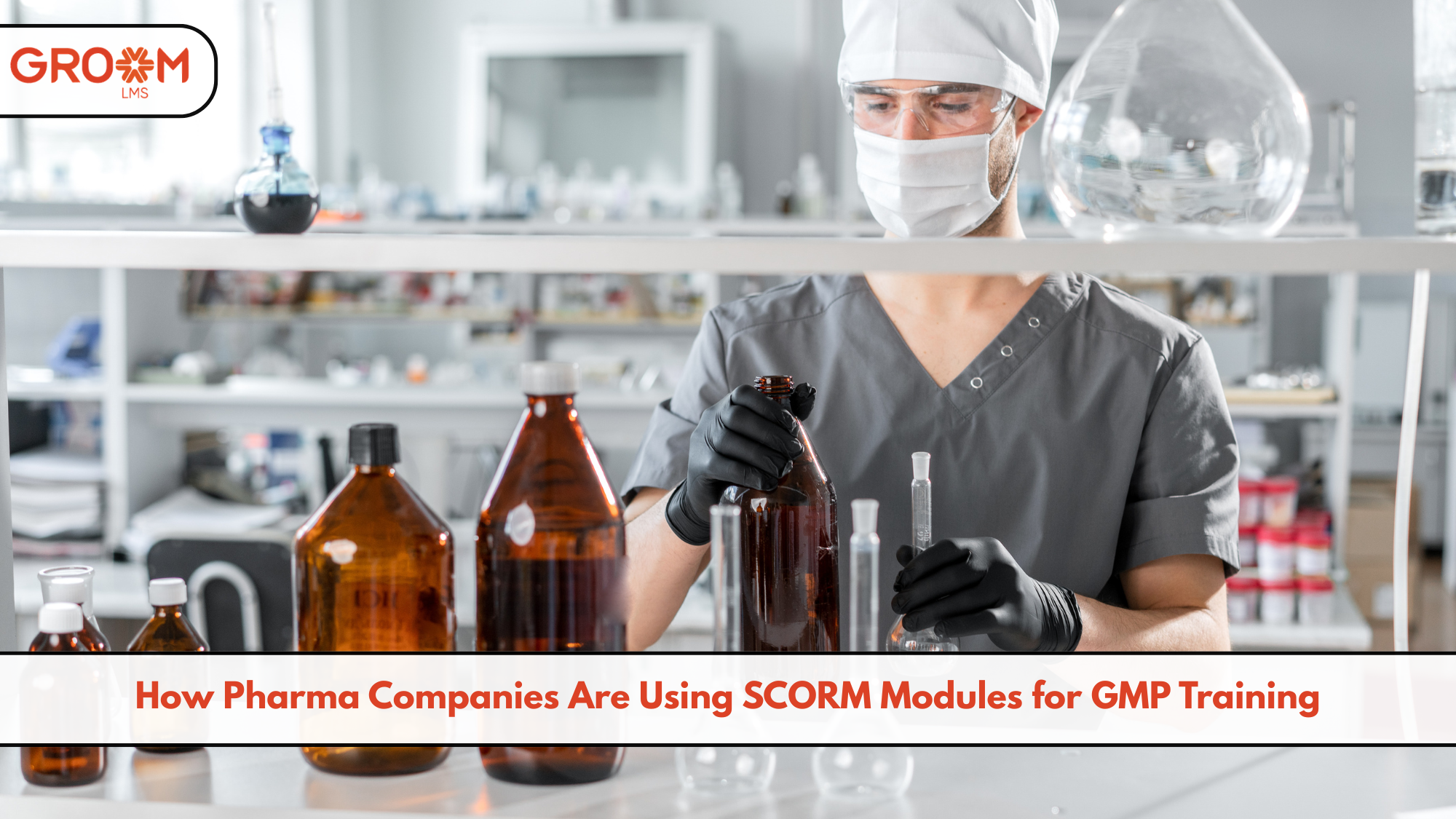
In pharmaceutical manufacturing, training is not simply another HR activity. It directly supports product quality, employee performance, and regulatory readiness.
Yet, GMP training can become difficult to manage as pharmaceutical companies grow. New employees join regularly. SOPs change. Refresher training becomes necessary. Different teams need different learning paths. Meanwhile, L&D and quality teams still need reliable training records.
That is where SCORM modules for GMP training can make a practical difference.
SCORM allows digital learning content to communicate with an LMS. As a result, organizations can deliver structured courses while tracking learner progress, completion, scores, and other training data.
For pharma companies, this creates a more organized approach to compliance-focused learning.
With GroomLMS, organizations can create, manage, automate, and scale digital training without depending on complex IT processes. This makes it easier for L&D teams to manage GMP learning across departments, locations, and employee groups.
Let’s explore how pharmaceutical companies can use SCORM-based learning to build a simpler and more scalable GMP training system.
Why GMP Training Matters in Pharmaceutical Companies
Good Manufacturing Practice helps pharmaceutical companies maintain consistent processes and protect product quality.
Therefore, employees need training that matches their roles and responsibilities.
GMP training may cover areas such as:
- Good Manufacturing Practices
- Standard Operating Procedures
- Data integrity
- Hygiene and sanitation
- Documentation practices
- Quality management
- Manufacturing processes
- Equipment handling
- Safety procedures
- Deviation and corrective action processes
- Change control
- Contamination prevention
Importantly, training should not stop after onboarding.
Employees may need continuing training when procedures change or when their responsibilities evolve. Regulatory expectations also emphasize appropriate and ongoing personnel training.
For example, FDA requirements under 21 CFR 211.25 address training related to an employee’s specific functions and applicable CGMP requirements.
Consequently, pharma companies need a training system that can support both initial and ongoing learning.
What Are SCORM Modules?
SCORM stands for Sharable Content Object Reference Model.
It is a set of technical standards that allows e-learning content to communicate with compatible learning management systems.
In simple terms, a SCORM module is a packaged digital learning course that can be uploaded to an LMS.
Once uploaded, the LMS can receive information from the course, depending on how the module is designed.
This can include:
- Course completion
- Learner progress
- Assessment scores
- Quiz interactions
- Time spent learning
- Pass or fail status
Therefore, SCORM creates a useful connection between the learning content and the LMS.
For GMP training, this connection can help organizations move beyond simply distributing training documents.
How Pharma Companies Use SCORM Modules for GMP Training
Pharmaceutical companies can use SCORM modules across different stages of employee training.
1. New Employee GMP Onboarding
New employees often need to understand GMP principles before working independently.
Instead of conducting every introductory session manually, companies can provide structured SCORM courses through an LMS.
For example, a new manufacturing employee might complete:
- Introduction to GMP
- Personal hygiene and gowning
- Documentation practices
- Data integrity
- Manufacturing SOPs
- Final assessment
The LMS can then record the learner’s progress and completion.
This creates a consistent onboarding experience for employees across different teams.
2. Role-Based GMP Training
Not every employee needs identical training.
A production operator may require different learning from someone working in quality assurance.
Therefore, pharma companies can create role-specific learning paths.
For example:
Production employees may receive training on manufacturing procedures, equipment, hygiene, and contamination control.
Quality teams may receive additional training on documentation, deviations, CAPA, audits, and quality systems.
Warehouse employees may focus on storage, handling, labeling, and material management.
With SCORM-based courses inside an LMS, these learning programs can be organized according to employee roles.
3. SOP Training
Standard Operating Procedures are central to pharmaceutical operations.
However, simply uploading an SOP document does not guarantee that employees understand it.
Instead, organizations can convert important procedures into interactive digital learning.
A typical SOP training module could include:
- Procedure overview
- Step-by-step explanations
- Visual demonstrations
- Knowledge checks
- Scenario-based questions
- Final assessment
Afterward, the LMS can capture the learner’s completion and assessment results.
This makes SOP training more engaging and easier to monitor.
4. Refresher GMP Training
GMP knowledge can fade when employees do not regularly revisit important procedures.
Therefore, pharmaceutical companies can use SCORM modules for recurring refresher training.
For example, an organization might assign short modules covering:
- Data integrity
- Hygiene
- Documentation
- Contamination control
- Updated SOPs
Instead of repeating long classroom sessions, teams can deliver focused digital learning.
This approach also makes refresher training easier to distribute across multiple locations.
How SCORM Helps Track GMP Training
One of the biggest challenges in compliance training is knowing who completed what.
A spreadsheet may work for a small team. However, managing hundreds or thousands of employees can quickly become difficult.
SCORM-enabled LMS platforms can provide centralized training information.
Depending on the course configuration, training teams can monitor:
- Completion status
- Assessment scores
- Learner progress
- Training time
- Course attempts
- Assessment interactions
- Success status
SCORM supports data such as completion status, progress, scores, interactions, and session time.
As a result, L&D teams can spend less time manually checking individual records.
Instead, they can use dashboards and reports to identify incomplete training and follow up with relevant employees.
A Simple SCORM-Based GMP Training Workflow
A well-designed GMP learning process does not need to be complicated.
A pharmaceutical organization can follow this workflow:
Step 1: Identify Training Requirements
Start by mapping training requirements to employee roles.
Consider:
- Job responsibilities
- GMP requirements
- SOPs
- Previous training
- Refresher requirements
- Knowledge gaps
Step 2: Create or Convert Learning Content
Transform important training material into interactive digital modules.
Use videos, animations, scenarios, knowledge checks, and assessments where appropriate.
Step 3: Package Content as SCORM
The completed course can be published as a SCORM package.
This allows compatible LMS platforms to launch and track the learning content.
Step 4: Upload the Module to the LMS
Training administrators can upload the SCORM package and configure the course.
They can then define completion rules, passing scores, and learner access.
Step 5: Assign Training
Courses can be assigned according to employee roles, departments, locations, or training requirements.
Step 6: Monitor Progress
Training managers can review learner activity through dashboards and reports.
Incomplete training can then be identified quickly.
Step 7: Evaluate and Update
Training teams should periodically review course effectiveness.
When an SOP or process changes, the relevant learning content can also be updated.
This creates a continuous training cycle instead of a one-time learning event.
What Makes SCORM Useful for Pharma Training?
SCORM is particularly useful when organizations need structured digital learning that works consistently with an LMS.
Its practical benefits include:
- Standardized course delivery
- Centralized training management
- Easier learner tracking
- Assessment tracking
- Reusable learning content
- Structured completion records
- Easier deployment across locations
- Better visibility for L&D teams
However, SCORM itself does not make a training program compliant.
The quality of the content, training process, assessments, records, and organizational controls still matters.
That distinction is important.
A technically trackable course is only one part of an effective GMP training system.
How GroomLMS Can Simplify SCORM-Based GMP Training
Managing digital GMP training becomes much easier when the LMS reduces unnecessary administrative work.
GroomLMS enables organizations to create, manage, and scale learning programs through a centralized digital environment.
For pharmaceutical L&D teams, this can support workflows such as:
- Uploading and managing digital courses
- Delivering SCORM-based learning
- Creating assessments
- Tracking learner progress
- Managing certifications
- Monitoring training completion
- Using dashboards and reports
- Supporting virtual training
- Scaling learning across teams
This is especially useful for organizations that want more independence from IT teams.
Instead of relying on technical teams for every training update, L&D administrators can manage many day-to-day learning activities directly.
For example, when a new GMP module is ready, the training team can add it to the LMS, assign it to the relevant employees, monitor completion, and review results.
As a result, training becomes a repeatable operational process rather than a collection of disconnected activities.
Best Practices for Using SCORM Modules for GMP Training
SCORM works best when the learning strategy behind it is well designed.
Keep these practices in mind:
Keep Modules Focused
Avoid putting an entire GMP curriculum into one long course.
Instead, divide learning into shorter modules based on topics or roles.
Use Assessments Strategically
Add knowledge checks where they help measure understanding.
For important topics, use scenario-based questions rather than simple recall questions.
Connect Training With Job Roles
Employees should receive training that relates to their actual responsibilities.
This makes learning more relevant and practical.
Track More Than Completion
Completion alone does not always demonstrate understanding.
Where appropriate, monitor assessment scores, attempts, progress, and other available learning data.
Update Content When Procedures Change
Outdated training can create confusion.
Therefore, establish a process for reviewing and updating modules when relevant SOPs or processes change.
Make Learning Easy to Access
Employees may work across manufacturing floors, offices, laboratories, warehouses, and multiple locations.
A convenient digital learning environment can make training easier to complete consistently.
The Future of Digital GMP Training
Pharmaceutical training is becoming increasingly digital.
However, the goal should not simply be to replace classroom sessions with online courses.
Instead, companies should build learning systems that are easier to manage, measure, update, and scale.
SCORM modules for GMP training provide one practical way to connect structured digital content with LMS-based tracking.
At the same time, organizations can strengthen their training strategy with assessments, dashboards, role-based learning, certifications, and automated workflows.
For growing pharmaceutical companies, this combination can reduce administrative complexity while giving L&D teams greater visibility into training activity.
The result is a more organized learning environment that can support employees throughout their training journey.
Conclusion
Pharmaceutical companies need GMP training that is consistent, accessible, trackable, and easy to update. However, managing these requirements manually can become increasingly difficult as organizations expand.
SCORM modules for GMP training provide a structured approach to digital learning. They allow training content to communicate with an LMS and can support tracking of completion, progress, scores, and other learning data.
More importantly, SCORM can become part of a broader training strategy. Companies can combine role-based learning, SOP training, assessments, refresher courses, certifications, and reporting within one learning environment.
GroomLMS helps organizations simplify this process by bringing digital course delivery, assessments, certifications, dashboards, and learning management into a centralized platform.
Therefore, pharmaceutical L&D teams can spend less time managing fragmented training processes and more time improving learning outcomes.
The goal is simple: make GMP training easier to deliver, easier to monitor, and easier to scale.
Transform Your Corporate Learning with GroomLMS
Discover how GroomLMS empowers your organization to streamline training, enhance learner engagement, and deliver impactful learning experiences with an AI-powered LMS built for growth.
Request a Demo | Schedule a Consultation | Chat with Our Team
Frequently Asked Questions (FAQs)
What is SCORM in an LMS?
SCORM is a technical standard that allows e-learning content to communicate with a compatible LMS. It can support tracking of completion, progress, scores, and learner interactions.
How can SCORM modules support GMP training?
SCORM modules can deliver structured GMP courses through an LMS while allowing organizations to track learner progress, assessments, and completion.
Can pharmaceutical companies use an LMS for employee training?
Yes. Pharmaceutical companies can use an LMS to manage onboarding, GMP training, SOP learning, refresher training, assessments, certifications, and other employee learning programs.
How does training automation help pharma companies?
Training automation can reduce manual administrative work by helping organizations assign courses, monitor progress, send reminders, and manage learning activities through a centralized system.
Can GroomLMS support SCORM-based training?
GroomLMS is designed to help organizations manage digital learning programs, including course delivery, assessments, certifications, reporting, and scalable employee training workflows.