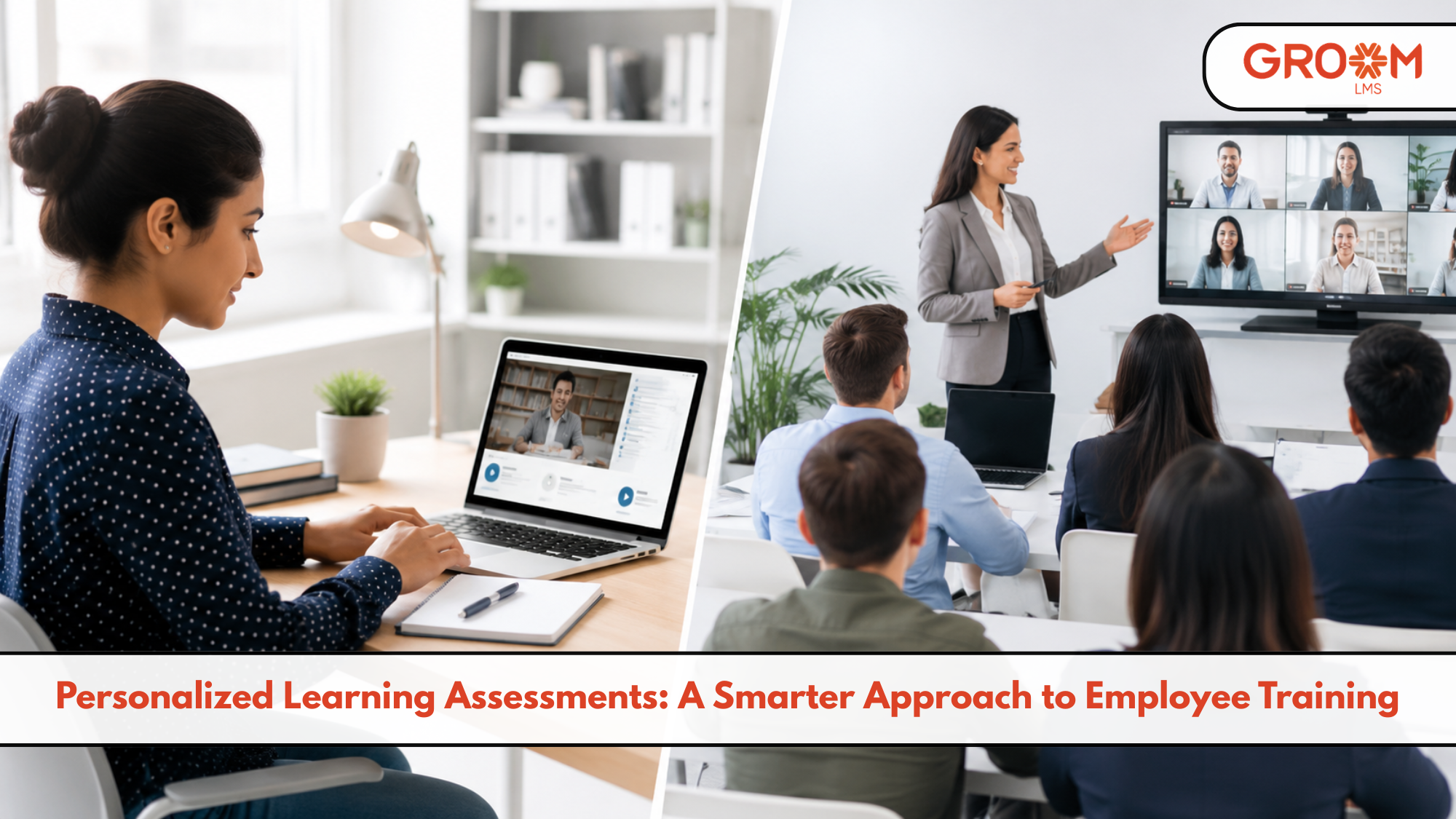
Training does not work equally well for everyone. Some employees need foundational concepts, while others are ready for advanced challenges. Yet, many organizations still give every learner the same quiz, the same content, and the same learning path.
That approach can make training feel repetitive for experienced employees and overwhelming for beginners. As a result, learners may lose interest, while L&D teams struggle to identify actual skill gaps.
Personalized learning assessments offer a better approach. Instead of treating every learner the same, they use learner performance and knowledge levels to create a more relevant assessment experience.
For example, an employee who performs well on a topic can move toward advanced questions. Meanwhile, someone who struggles can receive additional learning support.
With the right LMS, organizations can also manage assessments, track performance, identify gaps, and automate follow-up learning. GroomLMS helps organizations bring these activities into a centralized digital learning environment.
So, how do personalized assessments work, and how can L&D teams use them effectively? Let’s explore.
What Are Personalized Learning Assessments?
Personalized learning assessments are evaluations designed around an individual learner’s knowledge, skills, performance, or learning needs.
Traditional assessments usually give every learner the same questions. Personalized assessments can adjust the experience based on learner data.
For example, an assessment may consider:
- Previous assessment scores
- Course completion history
- Skill levels
- Question responses
- Learning progress
- Areas of difficulty
- Training requirements
- Job role or learning objectives
Therefore, learners receive a more relevant assessment experience.
Instead of simply asking, “Did the employee complete the course?”, organizations can ask a more useful question:
“Does the employee understand what they need to apply on the job?”
That shift can make training more meaningful and measurable.
Why Traditional Training Assessments Often Fall Short
A standard quiz is easy to create. However, it may not provide enough information about individual learner needs.
Consider a sales team completing product training.
One employee may already understand the product features. Another may struggle with basic product knowledge. A third employee may understand the features but struggle to apply them during customer conversations.
Giving all three employees the same ten questions provides limited insight.
Personalized learning assessments can help L&D teams identify these differences.
Common problems with one-size-fits-all assessments
Organizations often face issues such as:
- Repetitive questions for experienced learners
- Insufficient support for struggling learners
- Limited insight into individual skill gaps
- Manual assessment tracking
- Delayed feedback
- Difficulty creating targeted learning paths
- Poor connection between assessment results and training activities
Consequently, assessment becomes a final checkpoint instead of an active part of learning.
A personalized approach can turn assessment into a continuous feedback mechanism.
How Do Personalized Learning Assessments Work?
The process does not need to be complicated.
A well-designed personalized assessment can follow a simple workflow.
Step 1: Identify the learning objective
First, define what the learner should know or do after training.
For example, a cybersecurity course may require employees to identify phishing attempts.
The assessment should then measure that specific capability.
Step 2: Establish learner levels
Next, divide learners into relevant skill levels.
These could include:
- Beginner
- Intermediate
- Advanced
Alternatively, organizations can use job roles, departments, or specific competencies.
Step 3: Create question groups
Develop questions that test different levels of understanding.
For instance:
- Basic questions test knowledge.
- Intermediate questions test application.
- Advanced questions test decision-making.
This approach gives the assessment more depth.
Step 4: Use learner responses
Assessment results can reveal where a learner performs well and where they need support.
A learner who answers foundational questions correctly may receive more challenging content.
On the other hand, someone who struggles may need additional explanations or practice.
Step 5: Provide targeted feedback
Finally, connect results with useful feedback.
Instead of simply showing “Incorrect,” provide guidance such as:
“You may want to review the section on customer objection handling before attempting the advanced assessment.”
That small change can make feedback more actionable.
Benefits of Personalized Learning Assessments
Personalization can improve both learner experience and training management.
Better identification of skill gaps
Personalized assessments help organizations understand where learners need support.
Instead of relying only on course completion rates, L&D teams can examine individual performance.
This creates a clearer picture of actual learning outcomes.
More relevant learning experiences
Learners do not all start from the same point.
Therefore, assessments that account for individual performance can reduce unnecessary repetition.
At the same time, they can provide additional support where needed.
Faster learning progression
Employees who already understand a topic may not need to spend excessive time reviewing basic material.
Instead, they can move toward more advanced activities.
As a result, training can become more efficient.
Better learner engagement
Relevant questions tend to feel more meaningful.
When learners see that training reflects their knowledge level and role, they may become more involved in the process.
Furthermore, immediate feedback can encourage learners to keep improving.
More useful training data
Personalized assessments can generate valuable learner data.
L&D teams can use that information to identify:
- Common knowledge gaps
- High-performing learners
- Difficult topics
- Training completion patterns
- Department-level learning needs
- Areas requiring additional training
Consequently, training decisions can rely more on evidence and less on assumptions.
Personalized Assessments in Different Training Scenarios
Personalized learning assessments can support many types of employee training.
Compliance training
Employees can take assessments based on their understanding of policies and procedures.
Learners who struggle with a topic can receive additional training before completing the final assessment.
Product training
Sales and customer-facing teams can be assessed on product knowledge, features, use cases, and customer scenarios.
Advanced employees can tackle scenario-based questions rather than repeating basic product information.
Onboarding
New employees often have different levels of previous experience.
A personalized assessment can identify what each employee already knows.
Then, the organization can focus onboarding content on areas that require attention.
Skill development
Organizations can assess competencies before and after training.
This makes it easier to compare performance and identify progress.
For example, an employee may begin with basic communication skills and later complete advanced scenario-based assessments.
How an LMS Can Automate Personalized Assessments
Managing personalized assessments manually can quickly become difficult.
Imagine an L&D team managing hundreds of employees across multiple departments. Tracking individual scores, assigning follow-up courses, and monitoring progress through spreadsheets creates unnecessary administrative work.
An LMS can simplify this process.
Key LMS capabilities to look for
When selecting an LMS, consider features such as:
- Online assessments
- Question banks
- Automated scoring
- Learner progress tracking
- Performance reports
- Course prerequisites
- Certifications
- Automated notifications
- Dashboards and analytics
- Role-based learning
- Learning path management
Together, these capabilities can reduce repetitive administrative tasks.
Moreover, they allow L&D teams to spend more time improving learning content and less time managing spreadsheets.
How GroomLMS Supports Personalized Training
Personalized learning assessments work best when assessment data connects with the wider learning experience.
GroomLMS provides organizations with a centralized environment for managing digital learning, assessments, learner progress, certifications, and training activities.
For example, an organization can structure training around different learner requirements and use assessment results to understand performance.
L&D teams can then use these insights to improve future learning programs.
GroomLMS can also support broader training workflows, including:
- Digital course management
- Online assessments
- Learner tracking
- Certification management
- Virtual training
- Reporting and dashboards
- Scalable employee training
The advantage is not simply having more features. Instead, the goal is to create a smoother training workflow that organizations can manage without unnecessary technical complexity.
Best Practices for Creating Personalized Assessments
Personalization does not mean making every assessment completely different.
Instead, focus on making assessments more relevant and useful.
Start with clear learning objectives
Every question should connect to something the learner needs to understand or perform.
Avoid adding questions simply because they are easy to create.
Use different question difficulties
Include a mixture of basic, intermediate, and advanced questions.
This helps identify different levels of understanding.
Add scenario-based questions
Real-world scenarios can reveal whether employees know how to apply information.
For example:
“What should an employee do after receiving a suspicious email containing an unknown attachment?”
This can provide more meaningful insight than a simple definition-based question.
Give useful feedback
Feedback should explain what the learner should review or practice.
Therefore, avoid relying only on “Correct” or “Incorrect.”
Review assessment data regularly
Assessment data becomes valuable when organizations actually use it.
Review results to identify recurring knowledge gaps and improve training content.
A Simple Personalized Assessment Workflow
Organizations can start without creating a complicated system.
A practical workflow could look like this:
- Define the training objective.
- Assess the learner’s starting knowledge.
- Assign appropriate learning content.
- Conduct a formative assessment.
- Identify performance gaps.
- Recommend additional learning where necessary.
- Conduct a final assessment.
- Track progress and results.
- Review the data for future training improvements.
This creates a continuous learning cycle instead of treating assessment as the final step.
What Should You Look for in an LMS?
If personalized assessments are part of your training strategy, evaluate the LMS carefully.
Ask these questions before making a decision:
- Can the platform create different assessment types?
- Can administrators track individual learner performance?
- Can the system provide useful reports?
- Can assessments connect with courses?
- Can the platform automate repetitive training tasks?
- Can the system scale as learner numbers increase?
- Can L&D teams manage the platform without constant IT support?
The answers can help you determine whether the platform fits your organization’s training model.
Conclusion
Personalized learning assessments can make employee training more relevant, measurable, and effective. Instead of giving every learner an identical experience, organizations can use performance data to understand individual strengths and learning gaps.
As a result, learners can receive more targeted support, while L&D teams gain better visibility into training outcomes.
However, personalization does not have to mean creating hundreds of completely different courses. A smarter approach combines well-designed assessments, learner data, targeted feedback, and automated learning workflows.
That is where an LMS becomes particularly valuable. A centralized platform can help organizations manage assessments, courses, learner progress, reporting, and certifications from one environment.
GroomLMS supports organizations looking to simplify these processes and scale digital employee training without unnecessary technical complexity.
Ultimately, personalized learning assessments should answer more than whether someone passed a quiz. They should help organizations understand what learners know, where they struggle, and what they need to learn next.
Transform Your Corporate Learning with GroomLMS
Discover how GroomLMS empowers your organization to streamline training, enhance learner engagement, and deliver impactful learning experiences with an AI-powered LMS built for growth.
Request a Demo | Schedule a Consultation | Chat with Our Team
Frequently Asked Questions (FAQs)
What are personalized learning assessments?
Personalized learning assessments evaluate learners based on their knowledge, performance, skills, or learning requirements. They can provide more relevant questions and feedback.
How do personalized assessments improve employee training?
They help identify individual skill gaps and provide more targeted learning experiences. Therefore, employees can focus more on areas that require improvement.
Can an LMS automate personalized assessments?
Yes. Depending on the platform, an LMS can automate assessments, scoring, progress tracking, reporting, and other training activities.
What types of questions can personalized assessments include?
They can include multiple-choice questions, scenario-based questions, knowledge checks, skill assessments, and other question formats supported by the LMS.
How can GroomLMS support personalized employee training?
GroomLMS provides tools for digital course management, assessments, learner tracking, certifications, virtual training, reporting, and scalable online learning management.