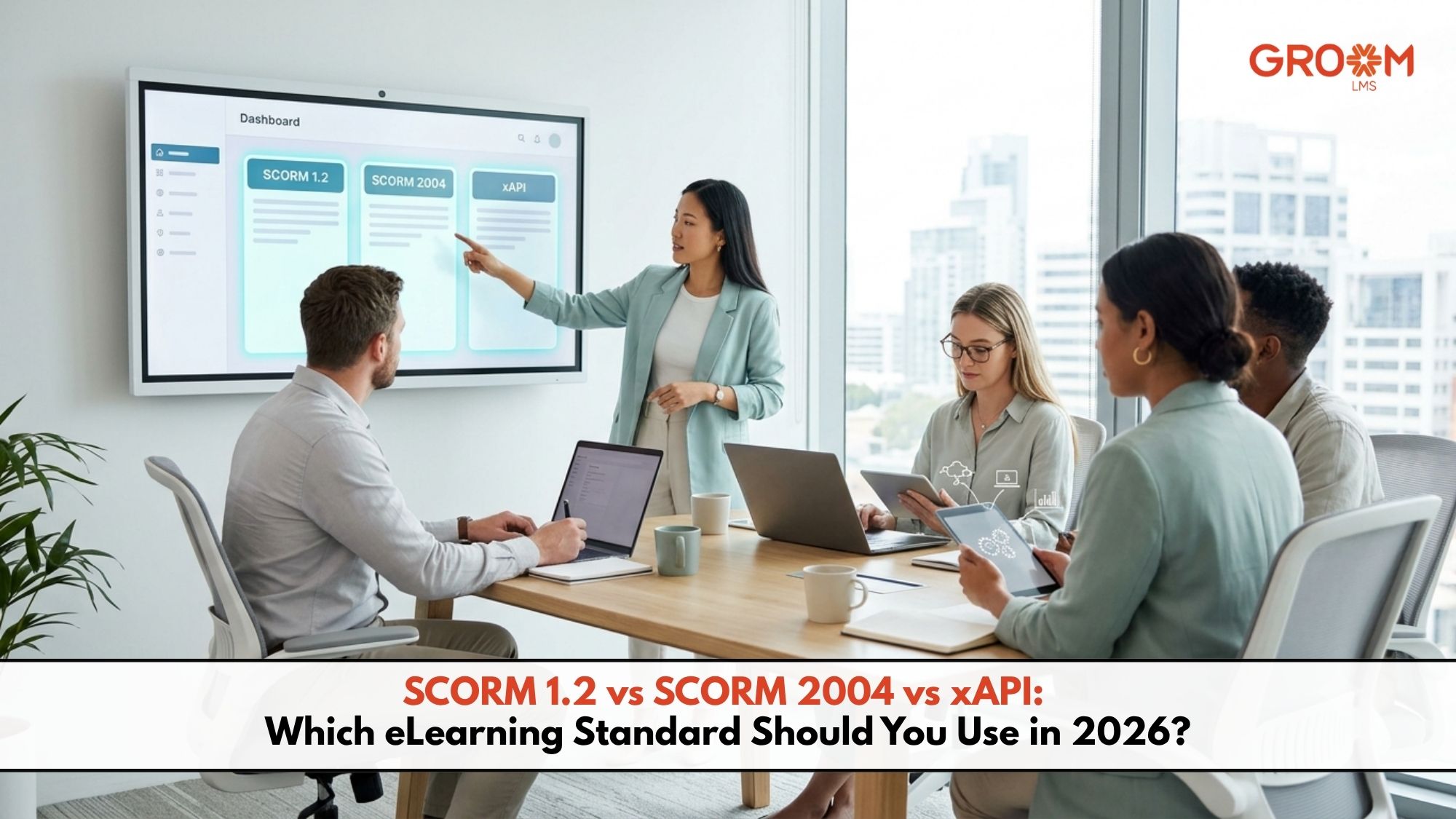
Choosing an eLearning standard can feel more complicated than choosing the course itself. You may see SCORM 1.2, SCORM 2004, xAPI, and newer learning technologies during the selection process. However, each option solves a different problem.
For L&D teams, the decision matters because the right standard affects course compatibility, learner tracking, reporting, and future scalability.
SCORM remains widely used for traditional online courses. Meanwhile, xAPI offers broader tracking across different learning experiences. Therefore, the best choice depends on what you need to track and how your learning ecosystem works.
In this guide, we compare SCORM 1.2 vs SCORM 2004 vs xAPI in practical terms. You will learn what each standard does, where it works best, and what limitations you should consider.
For organizations that want to launch and manage digital learning without constant technical support, platforms such as GroomLMS can also simplify course delivery, assessments, tracking, and administration.
What Are SCORM and xAPI?
Before comparing the three options, it helps to understand what these standards actually do.
SCORM stands for Sharable Content Object Reference Model. It was created to improve interoperability between eLearning content and LMS platforms. SCORM allows compatible learning content to communicate with an LMS and report information such as completion and scores.
xAPI, or Experience API, takes a broader approach. It allows learning experiences to generate structured statements about what a learner did. These experiences can happen inside or outside a traditional LMS.
In simple terms:
- SCORM focuses strongly on LMS-based online courses.
- SCORM 2004 adds more advanced sequencing capabilities.
- xAPI supports a wider range of learning experiences and data.
That difference becomes important when organizations plan for modern learning ecosystems.
SCORM 1.2: The Widely Supported Option
SCORM 1.2 is one of the most widely supported eLearning standards.
It was released in 2001 and remains common across commercial authoring tools and LMS platforms. It can capture information such as completion, scores, duration, and selected interaction data.
When should you use SCORM 1.2?
SCORM 1.2 works well when your organization needs:
- Standard online courses
- Basic completion tracking
- Quiz and assessment scores
- Course progress tracking
- Broad LMS compatibility
- Existing SCORM-based course libraries
For example, imagine an organization has 200 compliance courses created in SCORM 1.2.
Moving everything to another standard may create unnecessary costs. If the existing courses work correctly, continuing with SCORM 1.2 can be practical.
Limitations of SCORM 1.2
However, SCORM 1.2 has limitations.
Its tracking capabilities are relatively limited compared with modern learning data approaches. It also does not provide the advanced sequencing capabilities introduced with SCORM 2004.
Therefore, it is best suited to straightforward LMS-based learning rather than complex learning ecosystems.
SCORM 2004: Better Sequencing and Control
SCORM 2004 builds on the SCORM framework while introducing more advanced capabilities.
One of its biggest advantages is sequencing. SCORM 2004 allows course designers to define rules around the order in which learning objects are delivered. It can also support prerequisites and remediation based on learner performance.
When should you use SCORM 2004?
SCORM 2004 can be useful when you need:
- Complex course structures
- Learning paths
- Prerequisites
- Conditional progression
- Remediation
- More controlled learner navigation
- Advanced LMS-based training
Consider a compliance program with four modules.
A learner may need to complete Module 1 before accessing Module 2. If they fail an assessment, the system may require additional learning before they continue.
SCORM 2004 can support this type of structured learning flow.
SCORM 2004 editions matter
There is also an important detail to remember.
SCORM 2004 has multiple editions. ADL identifies SCORM 2004 3rd Edition and 4th Edition among the supported versions, while older editions have different levels of support.
Therefore, always check which SCORM 2004 edition your LMS supports before publishing content.
xAPI: Tracking Learning Beyond the LMS
xAPI takes a different approach.
Instead of focusing mainly on communication between an online course and an LMS, xAPI can capture learning experiences across different environments.
For example, learning could happen through:
- Mobile applications
- Simulations
- Virtual training
- Websites
- Offline activities
- Performance-support tools
- Digital resources
- Traditional eLearning
The data can then be stored and retrieved through an appropriate Learning Record Store, or LRS.
The IEEE xAPI working group describes xAPI as a standard for interoperable storage and retrieval of learning experience data.
When should you use xAPI?
xAPI becomes especially valuable when your organization wants broader learning analytics.
For example, suppose employees complete an online course, attend a workshop, use a simulation, and practice a skill through a mobile application.
Tracking only the online course gives you an incomplete picture.
With xAPI, these different experiences can potentially become part of a broader learning data ecosystem.
What makes xAPI different?
The biggest difference is flexibility.
SCORM typically revolves around the course and LMS relationship. xAPI can capture experiences from multiple sources.
However, that flexibility also introduces more technical considerations.
You may need an LRS, integrations, appropriate data structures, and a clear analytics strategy. Therefore, xAPI should not be selected simply because it is newer.
SCORM 1.2 vs SCORM 2004 vs xAPI: Key Differences
The easiest way to understand the options is to compare their practical use cases.
| Feature | SCORM 1.2 | SCORM 2004 | xAPI |
|---|---|---|---|
| LMS course tracking | Excellent | Excellent | Possible |
| Basic completion tracking | Yes | Yes | Yes |
| Score tracking | Yes | Yes | Yes |
| Advanced sequencing | Limited | Stronger | Depends on implementation |
| Learning outside LMS | Limited | Limited | Strong |
| Cross-platform experiences | Limited | Limited | Strong |
| Broad legacy compatibility | Very strong | Strong | Depends on LMS/LRS |
| Complex learning analytics | Limited | Limited | Stronger |
| Requires LRS | No | No | Commonly used |
| Best for | Traditional courses | Structured learning paths | Modern learning ecosystems |
The important point is that there is no universal winner.
The right standard depends on your content, LMS, reporting requirements, and future learning strategy.
Which eLearning Standard Should You Choose in 2026?
Your decision should begin with your actual training requirements.
Choose SCORM 1.2 if compatibility matters most
SCORM 1.2 remains a sensible option when you have an existing library of SCORM courses.
Choose it when:
- Your courses are relatively simple.
- Your LMS already supports SCORM 1.2.
- You mainly need completion and score tracking.
- You work with multiple content vendors.
- Maximum legacy compatibility is important.
For many organizations, reliability can matter more than adopting the newest technology.
Choose SCORM 2004 for structured learning paths
SCORM 2004 is a stronger option when course sequencing matters.
Choose it when:
- Learners must follow specific module sequences.
- Prerequisites are important.
- You need controlled navigation.
- Remediation is part of the training strategy.
- Your LMS fully supports the required SCORM 2004 edition.
However, test the actual content and LMS combination before deployment.
Choose xAPI for broader learning analytics
xAPI makes more sense when learning happens across multiple environments.
Choose it when:
- Learning extends beyond the LMS.
- You need richer experience data.
- Mobile and simulation-based learning matter.
- You want to connect multiple learning systems.
- Advanced learning analytics are a priority.
Still, plan the technical architecture before implementation.
How Should L&D Teams Make the Decision?
Instead of asking, “Which standard is newest?”, ask five practical questions.
Where does learning happen?
If almost everything happens inside your LMS, SCORM may be sufficient.
If learning happens across apps, simulations, workshops, and other systems, xAPI may offer greater flexibility.
What information do you need?
Basic completion and scores require less complexity.
However, detailed learning experience data may require xAPI.
What does your LMS support?
Never assume compatibility.
Before purchasing or developing content, verify:
- SCORM 1.2 support
- SCORM 2004 edition support
- xAPI support
- LRS integration
- Reporting capabilities
- Content import requirements
What content already exists?
Your existing content library should influence your decision.
If hundreds of courses already use SCORM 1.2, migration may not provide enough value to justify the cost.
What will your learning ecosystem look like?
Think beyond today’s training requirements.
If your organization plans to introduce mobile learning, simulations, performance support, or richer learning analytics, broader data capabilities may become increasingly useful.
A Practical Decision Framework
Use this quick framework before selecting an eLearning standard:
Need simple LMS-based courses?
Start with SCORM 1.2.
Need structured sequencing and prerequisites?
Consider SCORM 2004.
Need to track learning across multiple environments?
Consider xAPI.
Already have a large SCORM library?
Prioritize compatibility before migration.
Planning a data-rich learning ecosystem?
Evaluate xAPI and LRS requirements.
This approach keeps the decision connected to business needs instead of technology trends.
How GroomLMS Can Simplify eLearning Management
Selecting an eLearning standard is only one part of the process.
L&D teams also need to upload courses, manage learners, automate training, monitor progress, conduct assessments, and review results.
That is where a capable LMS becomes important.
GroomLMS is designed to help organizations create and manage digital learning programs without depending on complicated technical processes for everyday administration.
Depending on the organization’s requirements, an LMS can support activities such as:
- Course management
- Learner enrollment
- Assessments
- Certifications
- Progress tracking
- Reporting and dashboards
- Virtual training
- Digital learning delivery
The goal is simple: reduce administrative complexity so L&D teams can focus more on learning outcomes.
At the same time, organizations should verify the exact standards and integrations supported by their selected LMS before purchasing or publishing content.
Common Mistakes to Avoid When Choosing an eLearning Standard
Choosing a standard only because it is popular can create problems later.
Avoid these mistakes:
- Selecting a standard without checking LMS compatibility
- Assuming every SCORM 2004 edition works identically
- Migrating existing content without a clear business reason
- Choosing xAPI without planning data architecture
- Ignoring reporting requirements
- Focusing on technology instead of learner needs
- Testing content only after a large-scale rollout
Instead, run a small pilot.
Upload representative courses, test learner tracking, check assessment data, and review reports. Then scale the solution once the workflow works reliably.
The Bottom Line: Which Standard Wins in 2026?
There is no single winner in the SCORM 1.2 vs SCORM 2004 vs xAPI comparison.
SCORM 1.2 remains useful because of its widespread compatibility and straightforward tracking. SCORM 2004 adds stronger sequencing and structured learning capabilities. Meanwhile, xAPI offers a broader approach to capturing learning experiences across different environments.
Therefore, choose based on your learning ecosystem rather than the age of the technology.
If your organization needs dependable LMS-based course delivery, SCORM may still be the right answer. If you need advanced sequencing, SCORM 2004 deserves consideration. If your strategy includes multiple learning environments and richer data, xAPI may provide a better foundation.
Most importantly, make sure your LMS, content, reporting requirements, and future plans work together.
GroomLMS can help organizations manage digital learning through a scalable LMS environment, giving L&D teams a more streamlined way to deliver, manage, and monitortraining programs.
Conclusion
The right eLearning standard can make training easier to deliver, track, and scale. However, the best choice depends on what your organization actually needs.
SCORM 1.2 remains a practical choice for traditional LMS-based courses and broad compatibility. SCORM 2004 works well when structured sequencing, prerequisites, and controlled learning paths matter. On the other hand, xAPI becomes valuable when learning extends beyond the LMS and organizations need richer experience data.
So, when comparing SCORM 1.2 vs SCORM 2004 vs xAPI, do not simply choose the newest option. Instead, evaluate your existing content, LMS capabilities, learner journey, reporting needs, and future plans.
A scalable learning platform should also make everyday administration easier. GroomLMS helps organizations manage digital courses, assessments, learners, certifications, and training workflows through a centralized learning environment.
Ultimately, the right standard is the one that supports your learning goals without creating unnecessary complexity.
Choose the Right E-Learning Standard with GroomLMS
Make your e-learning content easier to deliver, track, and manage with GroomLMS. Support SCORM-based courses, monitor learner progress, add assessments and certifications, and manage digital training from one centralized platform.
Contact Us | Join GroomLMS | Chat on WhatsApp
Frequently Asked Questions (FAQs)
What is the difference between SCORM 1.2 and SCORM 2004?
SCORM 2004 provides more advanced sequencing and navigation capabilities than SCORM 1.2. SCORM 1.2 remains popular because of its broad compatibility and straightforward tracking.
Is SCORM still relevant for employee training in 2026?
Yes. SCORM remains relevant, particularly for organizations using traditional LMS-based courses and existing SCORM content libraries. However, newer learning ecosystems may also benefit from xAPI.
Is xAPI better than SCORM?
Not necessarily. xAPI and SCORM solve different problems. SCORM works well for structured LMS-based courses, while xAPI can track learning experiences across a broader range of environments.
Can an LMS support both SCORM and xAPI?
Yes, depending on the LMS and its integrations. Organizations should verify the specific SCORM versions, xAPI capabilities, and LRS integrations supported before implementation.
How can GroomLMS support online employee training?
GroomLMS can help organizations manage digital courses, learners, assessments, certifications, virtual training, progress tracking, and reporting through a centralized learning platform.