
“If one compliance course fits everyone, it probably fits no one particularly well.”
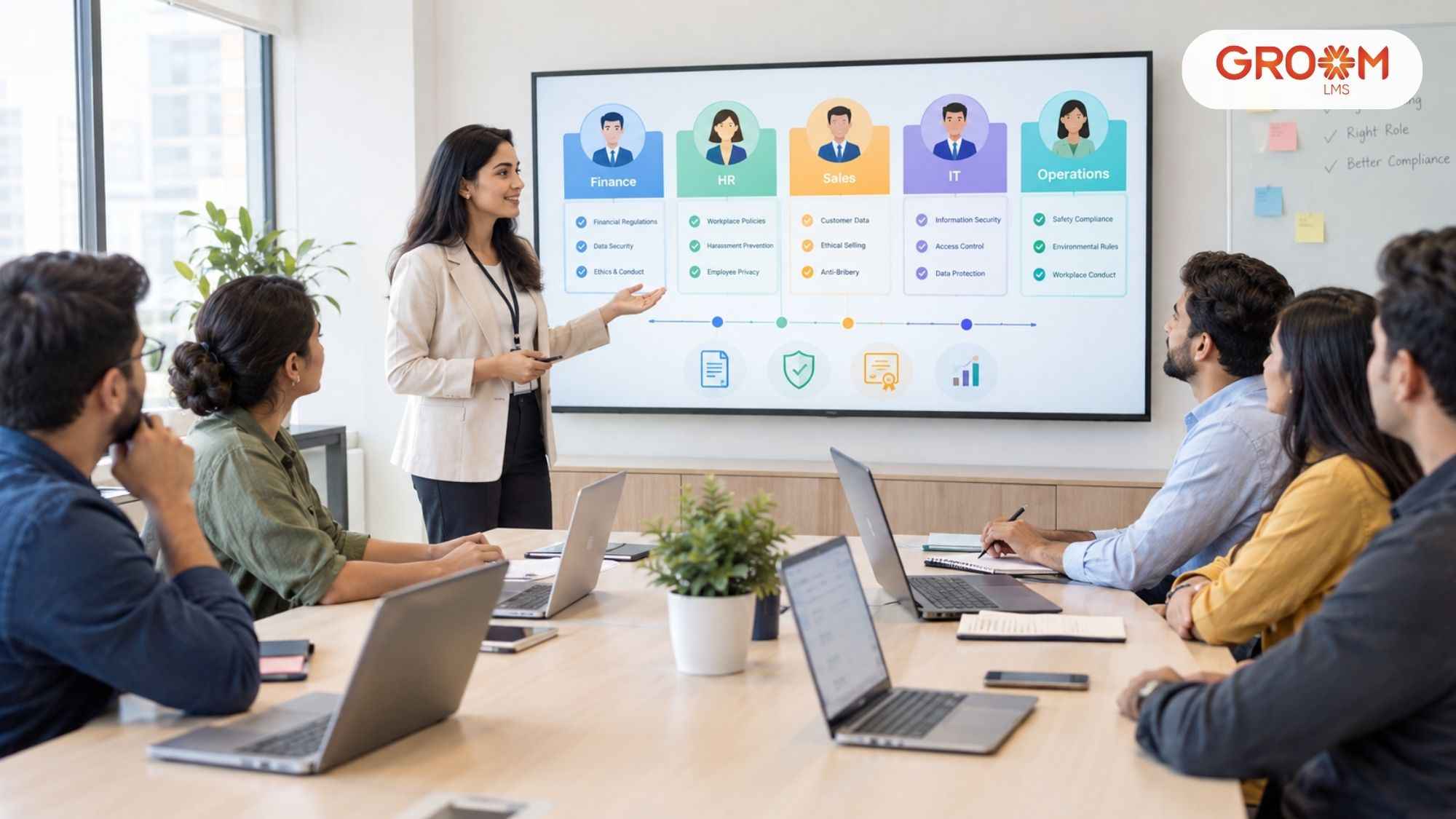
That is the problem with one-size-fits-all compliance training. A finance employee, sales executive, HR professional, and IT specialist may all work in the same organisation, but their compliance responsibilities can be very different.
Yet, many businesses still give every employee the same course, the same examples, and the same assessment. The result? Employees sit through information they may never use while missing guidance that actually matters to their roles.
Customized compliance training takes a different approach. It aligns learning with employee responsibilities, business risks, industry requirements, and real workplace situations.
With GroomLMS, organisations can create, manage, and track structured digital learning programmes using courses, assessments, certifications, dashboards, and analytics. This makes it easier to deliver relevant compliance learning without turning training management into another full-time job.
Why One-Size-Fits-All Compliance Training Does Not Always Work
A single compliance course may seem easier to create and manage. However, it can create problems when employees have different responsibilities.
For example, consider a company with HR, finance, IT, sales, and operations teams. Each group interacts with different processes, information, customers, and risks.
A generic course may cover basic policies, but it may not explain what those policies mean in each employee’s actual work.
This can lead to:
- Too much irrelevant information
- Limited engagement with the content
- Confusion about role-specific responsibilities
- Difficulty applying policies to real situations
- Repeated training that adds little value
NIST guidance on cybersecurity and privacy learning programmes also highlights the importance of role-based training and tailoring learning to different employee audiences.
The goal is not to create completely different training for every employee. Instead, organisations can create a common foundation and then add relevant learning based on role and risk.
What Is Customized Compliance Training?
Customized compliance training is learning designed around an organisation’s specific requirements, employee roles, industry, policies, and compliance risks.
Instead of asking, “What compliance course should everyone complete?”, businesses can ask:
“What does this employee need to know to perform their role responsibly?”
For example:
A sales employee may need training on ethical sales practices and customer data.
An HR professional may need training related to workplace conduct, employee privacy, and internal policies.
An IT employee may require deeper training on information security and access controls.
A manager may need additional learning on reporting, escalation, and compliance responsibilities.
This creates a more relevant learning experience without removing the organisation’s core compliance requirements.
Signs Your Compliance Training Is Too Generic
Not every organisation needs completely customised training. However, certain signs suggest that a standard approach may no longer be enough.
Employees receive information they rarely use
If large portions of a course do not relate to an employee’s work, learners may struggle to see its relevance.
Different roles face different compliance risks
Employees who handle financial data, customer information, physical equipment, or sensitive systems may require different guidance.
Employees struggle with practical situations
Knowing a policy is different from knowing how to apply it.
Scenario-based questions can help employees understand what to do when facing a real workplace situation.
Training completion is high but understanding is unclear
Completion data tells you whether someone finished a course. It does not always show whether they understood or can apply the content.
Assessments and practical knowledge checks can provide additional insight.
How to Build Customized Compliance Training
A customised programme does not have to become complicated. A clear process can make development easier.
1. Map compliance requirements to roles
Start by identifying which employees need which training.
Create a simple matrix based on:
- Job role
- Department
- Regulatory requirements
- Business responsibilities
- Risk exposure
- Required certifications
This prevents employees from receiving unnecessary courses.
2. Define common and role-specific content
Some compliance topics apply to everyone. These can form the core of the programme.
Then add role-specific modules where necessary.
For example, everyone may complete a general data protection module, while employees who handle sensitive customer information receive an additional module.
3. Use realistic workplace scenarios
Employees often learn better when they can connect policies to situations they may actually encounter.
Instead of simply explaining an anti-bribery policy, present a scenario involving a supplier offering an inappropriate benefit.
Ask the learner what action they should take and explain why.
GroomLMS also highlights practical scenarios, interactive activities, assessments, and feedback as useful elements of effective compliance training modules.
4. Add assessments based on the learning objective
Assessment questions should test the behaviour or knowledge the employee actually needs.
For example, a cybersecurity course might ask learners to identify the correct response to a suspicious email rather than simply recall a definition.
5. Assign learning through an LMS
Once training paths are defined, an LMS can help assign courses based on employee requirements.
This reduces the need to manually send training instructions to different groups.
How an LMS Makes Customized Compliance Training Easier
Creating different learning paths can become difficult when everything is managed manually.
An LMS provides a central environment where organisations can organise courses, assign learning, track progress, manage assessments, and review reports.
For example, an L&D team could create separate learning paths for:
- New employees
- Managers
- Finance teams
- Sales teams
- IT and security teams
Employees can then receive the training relevant to their responsibilities.
Automation can also help with reminders, recurring training, assessments, and completion tracking. This allows teams to spend less time checking spreadsheets and more time improving the learning programme.
How to Keep Customized Compliance Training Manageable
Customisation should solve complexity, not create more of it.
A practical approach is to build training in layers.
Start with mandatory organisation-wide learning. Then add role-specific modules where the requirements differ.
For example:
Core training: Code of conduct, workplace ethics, general compliance policies
Role-specific training: Data handling for customer-facing teams, financial compliance for finance teams, security training for IT teams
Advanced training: Manager responsibilities, specialist regulations, or higher-risk activities
This structure keeps the programme organised while still giving employees relevant learning.
NIST’s current guidance also supports a lifecycle approach where learning programmes are evaluated and updated as organisational needs change.
How GroomLMS Supports Customized Compliance Training
GroomLMS provides a centralised environment for creating, delivering, and monitoring digital learning programmes.
For compliance programmes, organisations can manage courses, assessments, certifications, dashboards, analytics, and learner progress within one learning environment. Its compliance solution also supports personalised learning, scenario-based exercises, automated reminders, tracking, and reporting.
This can help organisations create structured learning paths for different employee groups without managing every training activity separately.
GroomLMS also allows organisations to create an LMS instance online and manage their learning environment independently, which can reduce continuous technical dependency.
For organisations with changing requirements, a scalable LMS can make it easier to add new courses, update learning paths, and expand training programmes as needs evolve.
How to Measure Whether Customized Compliance Training Works
Customisation should be measured by more than course completion.
Track indicators such as:
- Course completion rates
- Assessment performance
- Certification status
- Overdue training
- Learner feedback
- Knowledge gaps
- Repeat training requirements
For example, if employees consistently perform poorly on one scenario-based assessment, the issue may not simply be learner performance. The training itself may need clearer explanations or better examples.
Regular reporting can therefore help L&D and compliance teams improve the programme over time.
Best Practices for Customized Compliance Training
Keep the process practical and focused.
First, avoid creating unnecessary courses. Customise learning only where employee responsibilities or risks genuinely differ.
Next, use short modules instead of forcing every topic into one large course. This makes it easier to update individual sections when requirements change.
Also, connect training to real workplace decisions. Employees should understand not only what the policy says, but what they should do when the policy applies.
Finally, review training regularly. Regulations, internal policies, systems, and employee responsibilities can change. Your learning programme should change with them.
Conclusion
One-size-fits-all compliance training may simplify course creation, but it does not always address the different responsibilities employees have. When learners receive information that does not relate to their roles, training can become less relevant and harder to apply.
Customized compliance training provides a more structured alternative. By mapping requirements to roles, using realistic scenarios, creating relevant learning paths, and assessing practical understanding, organisations can make compliance learning more meaningful.
An LMS can make this approach easier to manage by bringing courses, assignments, assessments, certifications, tracking, and reporting into one environment.
GroomLMS supports these requirements through its digital learning and compliance capabilities, helping organisations create and manage structured training programmes as their needs change. The objective is not to make compliance training more complicated. It is to make the right training available to the right employees at the right time.
Simplify Customized Compliance Training with GroomLMS
Create relevant compliance learning, manage role-based training, track employee progress, and streamline compliance management with GroomLMS.
Contact Us | Join GroomLMS | Chat on WhatsApp
Frequently Asked Questions (FAQs)
What is customized compliance training?
Customized compliance training delivers learning content based on employees’ roles, departments, responsibilities, or industry requirements, making training more relevant and effective.
Why is one-size-fits-all compliance training ineffective?
Generic compliance training often includes irrelevant information, leading to lower engagement, reduced knowledge retention, and limited real-world application.
How does an LMS improve compliance training?
An LMS automates course assignments, tracks learner progress, manages certifications, provides reports, and simplifies updates whenever compliance requirements change.
Can GroomLMS support role-based compliance training?
Yes. GroomLMS allows organizations to create role-specific learning paths, automate enrollments, monitor completion, and manage compliance training from one centralized platform.
Which organizations benefit from customized compliance training?
Businesses, healthcare providers, educational institutions, financial organizations, manufacturing companies, and government agencies all benefit from customized compliance training tailored to their workforce.