Every brokerage business depends on accurate data, quick decision-making, and efficient communication. Whether managing customer relationships, policy renewals, property listings, financial records, or regulatory compliance, brokers already rely on CRM and ERP systems every day.
However, many organizations face another challenge. Employee training often exists separately from these business systems. Staff must switch between multiple platforms, managers manually track learning progress, and important updates take longer to reach employees.
As businesses grow, this disconnected approach creates unnecessary delays and administrative work.
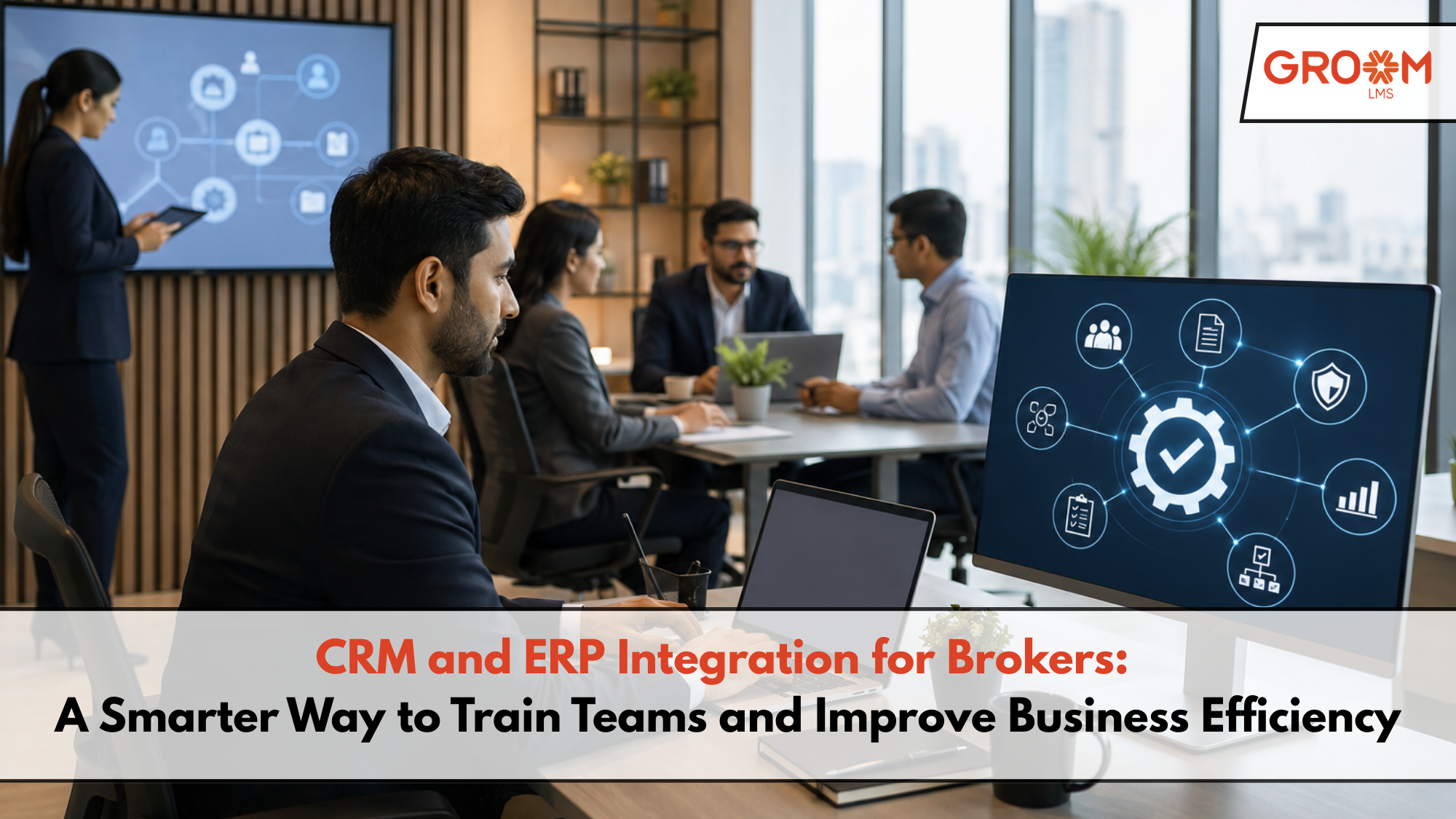
This is where CRM and ERP integration for brokers becomes valuable. When your learning platform connects with your existing business systems, employee development becomes faster, more organized, and easier to manage.
GroomLMS helps organizations simplify learning by providing a scalable Learning Management System that enables businesses to create, manage, automate, and monitor training programs without requiring continuous technical support. Instead of adding another complicated tool, it becomes part of your digital ecosystem.
Why CRM and ERP Integration Matters for Brokers
CRM systems manage customer interactions, while ERP systems handle business operations such as finance, inventory, compliance, reporting, and resource management.
Training, however, directly influences how effectively employees use these systems.
When learning remains disconnected, businesses often experience:
- Duplicate employee records
- Manual course assignments
- Delayed onboarding
- Inconsistent compliance training
- Difficulty measuring employee performance
- Higher administrative workload
Integrating your LMS with CRM and ERP systems eliminates these inefficiencies.
As a result, businesses spend less time managing training and more time serving clients.
Common Challenges Brokers Face Without System Integration
Many brokerage firms still manage employee learning manually. This approach creates avoidable operational issues.
Some common problems include:
Repetitive Administrative Tasks
HR teams repeatedly update employee information across multiple systems.
Delayed Onboarding
New employees often wait several days before receiving required learning materials.
Compliance Risks
Financial services, insurance, and real estate industries frequently update regulations. Employees may miss mandatory training if records are not synchronized.
Poor Reporting
Managers struggle to understand whether training improves employee performance because business data and learning data remain separate.
Limited Scalability
As organizations expand, manual learning management becomes increasingly difficult.
Benefits of CRM and ERP Integration for Brokers
Connecting your LMS with existing business software offers advantages across departments.
1. Faster Employee Onboarding
New employees can automatically receive training based on their department, role, or location.
For example:
- Insurance advisors receive compliance modules.
- Sales teams receive product training.
- Branch managers receive leadership courses.
This automation saves time while ensuring consistency.
2. Centralized Employee Information
Instead of updating employee records in multiple systems, integration synchronizes important information such as:
- Employee profiles
- Departments
- Job roles
- Branch locations
- Reporting structures
Consequently, administrators spend less time maintaining records.
3. Automated Learning Assignments
Automation reduces manual work significantly.
Organizations can automatically assign:
- Compliance courses
- Product certification
- Refresher programs
- Annual assessments
- Leadership development
Employees receive relevant learning without waiting for HR intervention.
4. Better Compliance Management
Brokerage industries operate under strict regulatory requirements.
Integrated systems help organizations:
- Track mandatory certifications
- Schedule recurring compliance courses
- Monitor completion status
- Generate audit-ready reports
Therefore, businesses remain prepared for internal and external audits.
5. Improved Business Insights
When learning data connects with operational systems, managers gain deeper visibility into workforce performance.
They can measure:
- Course completion rates
- Assessment scores
- Certification status
- Employee readiness
- Department-wise learning progress
These insights support better business decisions.
How CRM and ERP Integration Works
Although every organization has different software, the workflow generally follows a simple process.
Step 1: Employee Information Sync
Employee details flow automatically from CRM or ERP systems into the LMS.
Step 2: Training Assignment
The LMS assigns courses based on predefined business rules.
Step 3: Learning Completion
Employees complete training through an easy-to-use online platform.
Step 4: Progress Tracking
Managers monitor learning progress through dashboards and reports.
Step 5: Performance Reporting
Training records become available alongside operational data for better decision-making.
This connected workflow minimizes manual effort while improving learning efficiency.
Practical Example
Imagine an insurance brokerage hiring 50 new advisors.
Without integration:
- HR creates accounts manually.
- Training links are emailed individually.
- Managers follow up manually.
- Reports are prepared separately.
With integrated systems:
- Employee records sync automatically.
- Training begins immediately.
- Compliance courses are assigned instantly.
- Managers track progress through dashboards.
- Certification reports remain updated automatically.
The difference is substantial, especially as the organization grows.
Key Features to Look for in an Integrated LMS
Not every LMS supports seamless business integration.
Before choosing a platform, look for features such as:
- Easy user management
- Automated course enrollment
- Learning paths
- Certification management
- Assessment tools
- Progress dashboards
- Reporting and analytics
- Secure data management
- Scalable architecture
- API integration capabilities
These features reduce operational complexity while supporting long-term growth.
How GroomLMS Supports Integrated Learning
Modern organizations need more than course hosting. They require a learning platform that fits naturally into existing business processes.
GroomLMS provides organizations with a flexible learning environment that supports digital transformation through:
- Easy learning program creation
- Automated learner management
- Interactive assessments
- Certification management
- Scalable learning infrastructure
- Analytics and reporting
- Secure digital workflows
- End-to-end e-learning content services
Because businesses can independently manage their learning ecosystem, they reduce dependence on IT teams while improving operational efficiency.
Additionally, GroomLMS supports organizations with instructional design, multimedia development, assessments, content localization, and complete e-learning execution. This enables businesses to deliver engaging learning experiences without building everything internally.
Best Practices for Successful CRM and ERP Integration
Technology alone does not guarantee success.
Consider these best practices:
Define Clear Learning Goals
Identify what employees should achieve through training.
Automate Repetitive Processes
Reduce manual tasks wherever possible.
Keep Learning Relevant
Assign courses based on employee roles rather than generic programs.
Monitor Performance Regularly
Review dashboards to identify learning gaps.
Update Content Frequently
Ensure compliance, product knowledge, and operational procedures remain current.
Choose a Scalable Platform
Select an LMS that grows alongside your business.
Following these practices helps organizations maximize their investment in digital learning.
Why Integration Is Becoming a Business Necessity
Digital transformation continues to reshape brokerage operations.
Customers expect faster service.
Employees expect flexible learning.
Managers expect real-time reporting.
Disconnected systems can slow every part of the business.
By integrating CRM, ERP, and learning management, organizations create a connected environment where information flows smoothly, employees stay informed, and business operations become more efficient.
Rather than managing separate platforms, teams work within a unified digital ecosystem.
Conclusion
CRM and ERP integration for brokers is no longer just a technology upgrade. It is a practical strategy for improving employee training, reducing manual work, strengthening compliance, and supporting business growth.
When learning connects seamlessly with everyday business operations, organizations spend less time managing systems and more time developing skilled, confident teams.
GroomLMS simplifies this journey by helping organizations independently create, manage, automate, and scale learning programs without unnecessary complexity. As businesses continue embracing digital transformation, an integrated learning platform can become a valuable part of long-term operational success.
CTA – Request a Demo
Explore GroomLMS Today
Whether you’re training employees, partners, or customers, GroomLMS helps you deliver learning that drives results.
Request a demo, sign up to experience the platform, or contact us to find the right solution for your organization.
Frequently Asked Questions (FAQs)
What is CRM and ERP integration for brokers?
CRM and ERP integration for brokers connects customer management, business operations, and learning systems to streamline employee training, automate workflows, and improve operational efficiency.
Why should brokerage firms integrate their LMS with CRM and ERP systems?
Integration reduces manual administration, automates course assignments, improves compliance tracking, accelerates onboarding, and provides better reporting across the organization.
Can GroomLMS support employee onboarding and compliance training?
Yes. GroomLMS enables organizations to automate onboarding, assign role-based learning paths, manage certifications, deliver assessments, and monitor compliance training through a centralized platform.
What are the main benefits of an integrated Learning Management System?
An integrated LMS improves training efficiency, reduces repetitive tasks, enhances reporting, supports compliance, increases employee engagement, and helps organizations scale learning programs more effectively.
Is GroomLMS suitable for growing businesses?
Yes. GroomLMS is designed for organizations of all sizes and offers scalable learning management, digital course delivery, assessments, certifications, analytics, and end-to-end e-learning support.