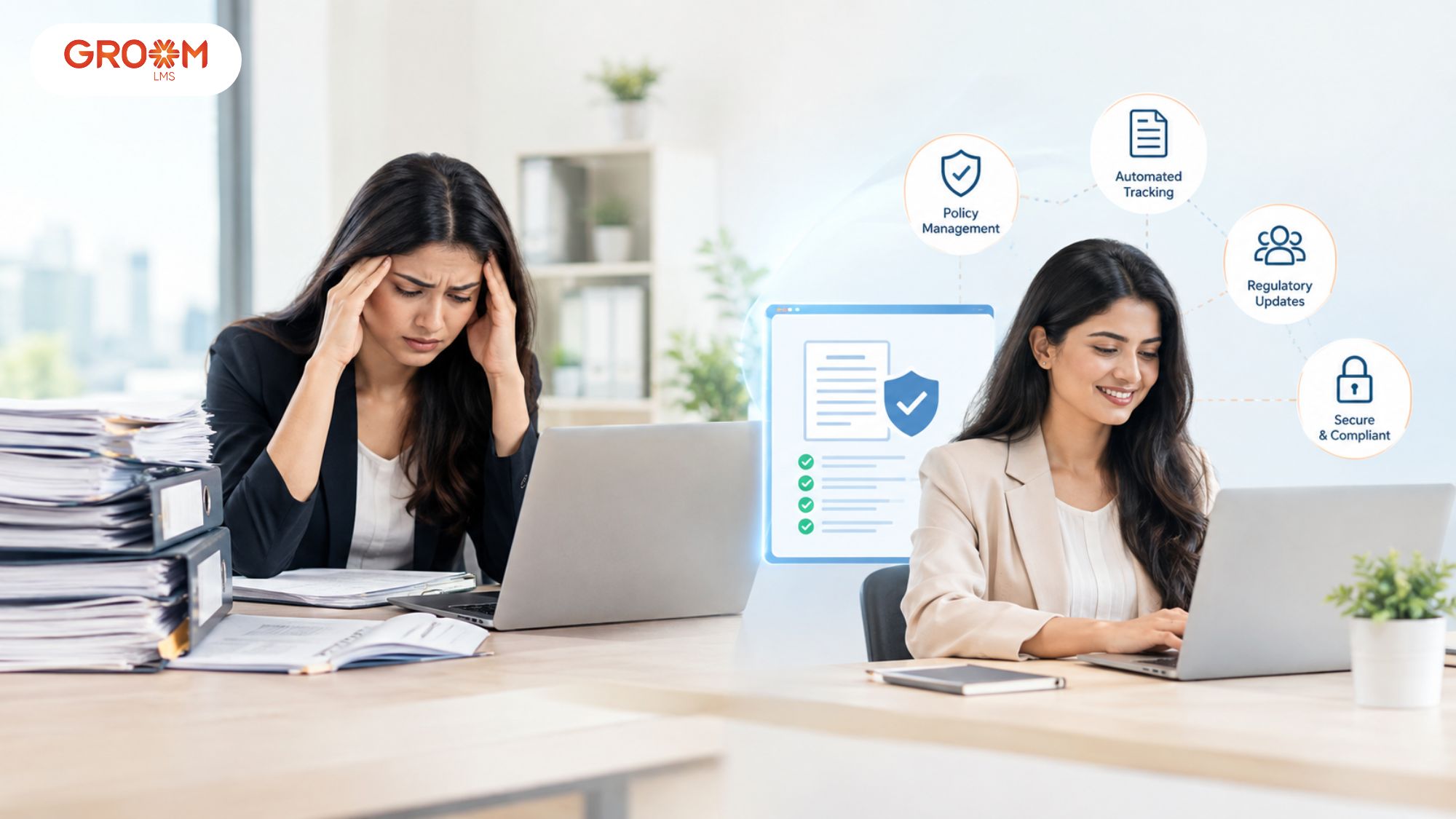
Planning employee training can become complicated when teams depend on classroom sessions, printed materials, manual attendance, and repeated presentations. These methods can work well for certain learning activities. However, managing them across departments, locations, and growing teams often requires significant coordination.
This raises an important question for HR professionals and corporate training managers: should organisations continue with traditional training or move towards a Learning Management System (LMS)?
Understanding LMS vs traditional training methods helps businesses compare how both approaches deliver learning, manage employees, measure progress, and support development. Traditional training often depends on face-to-face instruction, while an LMS provides a digital environment for organising and delivering learning programmes.
Neither approach suits every situation. Some skills require practical demonstrations and direct interaction. Others can be taught effectively through digital courses, assessments, and virtual learning.
GroomLMS helps organisations manage digital learning programmes through a simplified platform. By understanding the differences between both approaches, businesses can choose a training model that matches their workforce, learning objectives, and operational needs.
What Are Traditional Training Methods?
Traditional training methods involve delivering employee education through instructor-led sessions, workshops, classroom teaching, printed materials, and face-to-face demonstrations.
In this approach, trainers generally organise sessions at specific times and locations. Employees attend the training, interact with instructors, complete activities, and receive guidance.
Common traditional corporate training methods include:
- Classroom-based employee training.
- Instructor-led workshops and seminars.
- Printed manuals and training handbooks.
- Face-to-face demonstrations.
- Group discussions and role-playing exercises.
- On-the-job training and mentoring.
These methods offer direct interaction. Employees can ask questions immediately, participate in discussions, and receive personal feedback.
For example, a company introducing new customer service procedures might organise a workshop. Trainers can demonstrate customer interactions, conduct role-playing exercises, and correct mistakes.
However, traditional training can become difficult to coordinate when employees work across different locations or shifts. Repeating sessions, maintaining attendance records, and monitoring individual progress can also increase administrative work.
What Is an LMS in Corporate Training?
A Learning Management System (LMS) is a digital platform that helps organisations create, deliver, manage, and monitor employee training programmes.
Instead of depending entirely on physical sessions, businesses can provide learning materials through an online platform.
An LMS can support several training activities, including:
- Digital course creation and delivery.
- Employee enrolment and course assignments.
- Online assessments and knowledge checks.
- Training progress monitoring.
- Certification management.
- Learning reports and dashboards.
- Virtual and self-paced learning.
For example, a company onboarding new employees can assign digital courses covering company policies, workplace procedures, and role-specific responsibilities.
Employees can access the assigned learning materials through the platform. Managers can then monitor completion and review assessment results using available reporting features.
GroomLMS provides a learning management environment that helps organisations organise these activities without relying on complicated manual processes. This makes it easier for teams to manage learning programmes as their training requirements grow.
LMS vs Traditional Training Methods: Key Differences
The main difference between LMS vs traditional training methods is how organisations deliver, manage, and evaluate learning.
Traditional training generally relies on physical sessions and instructor coordination. An LMS uses a digital platform to organise learning activities and make training accessible online.
Here are the major areas where both approaches differ.
1. Training Accessibility
Traditional training usually requires employees to attend sessions at scheduled times. This can create challenges for remote teams, employees working different shifts, and organisations with multiple offices.
An LMS provides access to assigned learning materials through a digital platform. Depending on the platform’s capabilities, employees can complete self-paced courses at suitable times.
Therefore, digital learning can make training easier to access across locations.
2. Training Management
Traditional training requires trainers or HR teams to coordinate schedules, venues, attendance sheets, materials, and follow-up activities.
An LMS centralises many learning management activities. Teams can organise courses, assign training, monitor progress, and manage learning records from one platform.
This reduces dependence on repetitive manual coordination.
3. Learning Progress Tracking
In traditional training, attendance sheets and manual assessments often help managers understand participation and performance.
However, collecting and consolidating these records can take time.
An LMS can provide digital records of course progress, assessment results, and completion status. The exact reporting capabilities depend on the platform and its configuration.
This gives training managers a more organised way to review learning activity.
4. Training Consistency
Traditional sessions may vary depending on the trainer, location, or delivery schedule.
An LMS allows organisations to distribute standardised digital learning materials across teams. Employees can receive consistent course content and assessments.
This is particularly useful for onboarding, compliance awareness, and company-wide training programmes.
5. Interaction and Practical Learning
Traditional training offers direct interaction with instructors and other employees. Participants can discuss problems, ask questions, and practise skills together.
An LMS can support interactive digital content, quizzes, assessments, and virtual training. However, some activities still benefit from live demonstrations and in-person guidance.
The right approach depends on the skill being taught.
Is an LMS More Cost-Effective Than Traditional Training?
The cost of training depends on employee numbers, course requirements, delivery methods, technology, and the frequency of training.
Traditional training can involve expenses related to venues, travel, printed materials, trainer fees, and repeated sessions.
An LMS introduces platform and course development costs. However, digital courses can be reused for future employee groups, reducing the need to organise the same introductory session repeatedly.
Consider an organisation with employees across several locations. Conducting classroom training may require multiple sessions, trainers, and travel arrangements.
With an LMS, the organisation can deliver suitable learning materials digitally. Employees can access assigned courses without attending the same introductory session in person.
However, an LMS does not eliminate every training expense. Organisations may still need instructors, practical workshops, content updates, and technical support.
A useful comparison should consider the total cost of delivering and maintaining training over time, not just the initial investment.
When Should Organisations Choose Traditional Training?
Traditional training remains valuable when learning requires physical practice, immediate instructor feedback, or direct collaboration.
For example, employees learning equipment operation may need supervised demonstrations. Similarly, leadership workshops can benefit from group discussions, role-playing, and face-to-face interaction.
Traditional methods can be particularly suitable for:
- Hands-on technical and operational training.
- Practical demonstrations and equipment handling.
- Group activities and collaborative workshops.
- Coaching and mentoring.
- Sensitive discussions requiring direct facilitation.
An LMS may complement these activities by providing preparation materials, supporting knowledge checks, and recording related learning progress.
Therefore, choosing traditional training does not mean rejecting digital learning. Organisations can use both approaches according to their objectives.
When Should Organisations Choose an LMS?
An LMS becomes useful when businesses need a structured way to deliver and manage recurring training.
It is especially relevant when employees work across multiple departments, branches, or locations.
Consider an organisation onboarding 30 employees across three offices. Managing separate classroom sessions may require additional scheduling and coordination.
With an LMS, HR teams can assign the same onboarding programme to all employees. Learners can complete digital courses, take assessments, and access learning materials through the platform.
An LMS is particularly useful for:
- Employee onboarding programmes.
- Compliance and policy awareness training.
- Product and process training.
- Continuous employee development.
- Knowledge assessments and certifications.
- Training programmes across multiple locations.
For these requirements, LMS vs traditional training methods is not simply a choice between online and offline learning. It is a decision about how to make training easier to organise, monitor, and scale.
How to Combine LMS and Traditional Training for Better Results
Many organisations benefit from combining digital learning with instructor-led activities.
This approach is often called blended learning. It uses online resources for structured knowledge delivery and direct sessions for interaction or practical application.
A simple implementation process can help organisations build this model.
- Identify training objectives: Decide what employees need to learn and which skills require practical instruction.
- Divide the learning content: Use digital courses for concepts, policies, and foundational knowledge. Reserve instructor-led sessions for demonstrations and discussion.
- Create digital learning materials: Prepare courses, presentations, videos, and assessments that employees can access through an LMS.
- Schedule practical sessions: Organise workshops or demonstrations where direct guidance is necessary.
- Monitor learning progress: Review available completion records and assessment results to identify areas requiring further support.
- Improve the programme: Use learner feedback and performance information to update training materials and delivery methods.
For example, a customer service training programme could begin with an LMS course covering communication principles. Employees could then participate in role-playing sessions to practise real customer interactions.
This combination supports flexible learning without removing valuable human interaction.
How GroomLMS Simplifies Digital Corporate Training
Managing digital training should not require HR and L&D teams to depend on technical support for every routine activity.
GroomLMS helps organisations create and manage learning programmes through an accessible learning management environment.
Teams can organise digital courses, deliver assessments, manage certifications, and monitor learner progress. This supports structured training without requiring organisations to coordinate every learning activity manually.
GroomLMS also allows organisations to create an instance online within seconds and upgrade or downgrade subscriptions instantly. This gives businesses flexibility as their learning requirements change.
For startups and MSMEs, a simplified platform can help establish organised employee training. Larger organisations can use structured digital learning programmes to support training across teams and departments.
GroomLMS is recognised among the Top 10 LMS platforms in India by Siliconindia Magazine and is trusted by 100+ corporate customers globally.
When comparing LMS vs traditional training methods, organisations should consider how easily their chosen platform fits existing workflows. The objective is to make learning easier to deliver, manage, and monitor as the workforce grows.
Conclusion
The comparison of LMS vs traditional training methods shows that both approaches have an important role in corporate learning.
Traditional training offers direct interaction, practical demonstrations, and immediate instructor feedback. An LMS provides digital course delivery, organised learning management, progress tracking, and greater flexibility for distributed teams.
The right choice depends on the training objective. Organisations can use traditional methods for hands-on activities and collaborative sessions. Meanwhile, an LMS can support onboarding, compliance awareness, product training, assessments, and continuous employee development.
Blended learning can bring these advantages together. It allows businesses to deliver foundational knowledge digitally while retaining face-to-face instruction where it adds value.
GroomLMS helps organisations simplify digital training through course management, assessments, certifications, and learning progress monitoring. It provides a structured environment for teams looking to reduce manual coordination and manage training more effectively.
Ultimately, corporate learning should be accessible, manageable, and relevant to employee needs. By selecting the right training approach and a suitable LMS, organisations can build learning programmes that support consistent development and long-term growth.
Simplify Corporate Learning Management with GroomLMS
Discover how GroomLMS empowers your organization to streamline training, enhance learner engagement, and deliver impactful learning experiences with an AI-powered LMS built for growth.
Contact Us | Join GroomLMS | Chat on WhatsApp
Frequently Asked Questions (FAQs)
What is the main difference between an LMS and traditional training methods?
Traditional training relies on instructor-led sessions and physical learning activities. An LMS delivers and manages learning through a digital platform with features for courses, assessments, and progress tracking.
Can an LMS completely replace classroom training?
No. An LMS can support many training activities, but practical demonstrations, hands-on exercises, and collaborative workshops may still require direct instruction.
Is an LMS suitable for small businesses?
Yes. Small businesses can use an LMS to organise employee onboarding, product training, assessments, and ongoing learning without managing every activity manually.
What is blended learning in corporate training?
Blended learning combines digital learning with instructor-led sessions. Employees can study foundational concepts online and practise skills through workshops or guided activities.
How does GroomLMS help organisations manage corporate training?
GroomLMS helps organisations create and deliver digital courses, manage assessments and certifications, and monitor employee learning progress through a centralised learning platform.