Regulatory training can quickly become difficult when employees need to understand complex rules, policies, and responsibilities. Long presentations may explain the requirements, but they do not always show employees how those requirements apply to everyday decisions.
At the same time, L&D, HR, and compliance teams have another challenge. They need to create training, assign it to the right employees, track completion, manage assessments, maintain records, and update content when requirements change.
This is where regulatory compliance e-learning content can make a practical difference. Instead of treating compliance training as a document that employees simply read, organisations can turn important requirements into structured digital learning experiences.
With the right instructional design and LMS, employees can learn through concise explanations, workplace scenarios, interactive activities, and assessments. Meanwhile, training teams can manage learning programmes from a central environment.
GroomLMS supports this approach by providing capabilities for digital courses, assessments, certifications, analytics, dashboards, and virtual training.
What Is Regulatory Compliance E-Learning Content?
Regulatory compliance e-learning content refers to digital learning material that helps employees understand regulations, standards, policies, procedures, and responsibilities relevant to their work.
The goal is not simply to place regulatory documents online. Instead, the content should translate complex requirements into information employees can understand and apply.
For example, a data protection course could cover:
- What counts as sensitive information
- How employees should handle personal data
- Common security risks
- Appropriate data-sharing practices
- What to do after a potential incident
- A short assessment to check understanding
The exact content depends on the organisation, industry, workforce, and applicable requirements.
Therefore, regulatory compliance e-learning should always begin with clear learning objectives and accurate source information.
Why Traditional Compliance Training Can Fall Short
Compliance training often contains a lot of information. However, more information does not automatically create better learning.
A course can become difficult to follow when it relies heavily on policy language, lengthy presentations, or memorisation-based quizzes.
Employees may finish the training without knowing how to respond when they encounter a real workplace situation.
For example, reading a conflict-of-interest policy is different from deciding what to do when a supplier offers an employee an expensive gift.
Effective compliance training connects the rule with the decision.
GroomLMS also recommends using practical scenarios, interactive activities, assessments, and feedback to make compliance modules more useful and relevant.
This approach shifts the focus from simply completing training to understanding and applying it.
What Makes Effective Regulatory Compliance E-Learning Content?
Good compliance content combines regulatory accuracy with sound instructional design.
Clear and Focused Learning Objectives
Start by defining what employees should know or do after completing the module.
For example:
“Employees will identify three common data-handling risks.”
This is more useful than a broad objective such as “Understand data protection.”
Clear objectives also make assessment design easier.
Simple Explanations
Regulations can contain technical language. Employees, however, may not need every legal detail.
Break complex information into smaller sections. Explain important terms in plain language and focus on the responsibilities that apply to the learner.
Realistic Workplace Scenarios
Scenarios help employees connect rules with their daily work.
For example, a course about information security could present an employee with a suspicious email and ask:
“What should you do next?”
The learner then chooses an option and receives feedback.
This makes the learning experience more practical than simply asking employees to remember a definition.
Interactive Knowledge Checks
Short activities can reinforce important concepts throughout the course.
You can use:
- Multiple-choice questions
- Scenario-based questions
- Matching activities
- True-or-false questions
- Decision-making exercises
Assessments should focus on practical understanding wherever possible.
How to Structure Regulatory Compliance E-Learning
A consistent structure can make development easier for instructional designers and training teams.
A practical regulatory compliance course can follow these steps:
- Introduce the requirement
Explain what the regulation or policy covers and why it matters. - Define employee responsibilities
Show what learners need to know and do in their specific roles. - Explain key concepts
Break complex information into short, understandable sections. - Add workplace scenarios
Show realistic situations employees may encounter. - Provide interactive practice
Allow learners to make decisions and receive feedback. - Conduct a knowledge check
Test whether learners understand the essential concepts. - Complete the final assessment
Measure understanding before marking the training complete. - Record completion
Store learning records and issue certification where appropriate.
This structure keeps the course focused while giving employees opportunities to understand, practise, and demonstrate their knowledge.
Keeping Regulatory Compliance Content Updated
Regulatory compliance e-learning content cannot simply be created and forgotten.
Regulations, internal policies, procedures, responsibilities, and business processes can change. As a result, training content needs a review process.
Start by identifying which courses require regular review. Then assign responsibility for checking the source requirements and approving changes.
During each review, consider:
- Has the relevant regulation changed?
- Have internal policies changed?
- Are employee responsibilities still accurate?
- Do scenarios reflect current processes?
- Are assessment questions still relevant?
- Do certificates or recurring training requirements need updating?
A central LMS can make this process easier because training content and learner records can be managed within one environment. GroomLMS highlights centralised management, tracking, assessments, certifications, and scalable compliance learning as part of its approach.
How an LMS Supports Regulatory Compliance Training
Creating good content is only one part of the process. Organisations also need a reliable way to deliver and manage it.
An LMS can act as the central environment for regulatory training.
For example, an L&D team can:
- Create or upload the compliance course.
- Assign it to the relevant employee group.
- Set completion requirements.
- Monitor learner progress.
- Review assessment results.
- Send or manage training reminders.
- Record completion and certification.
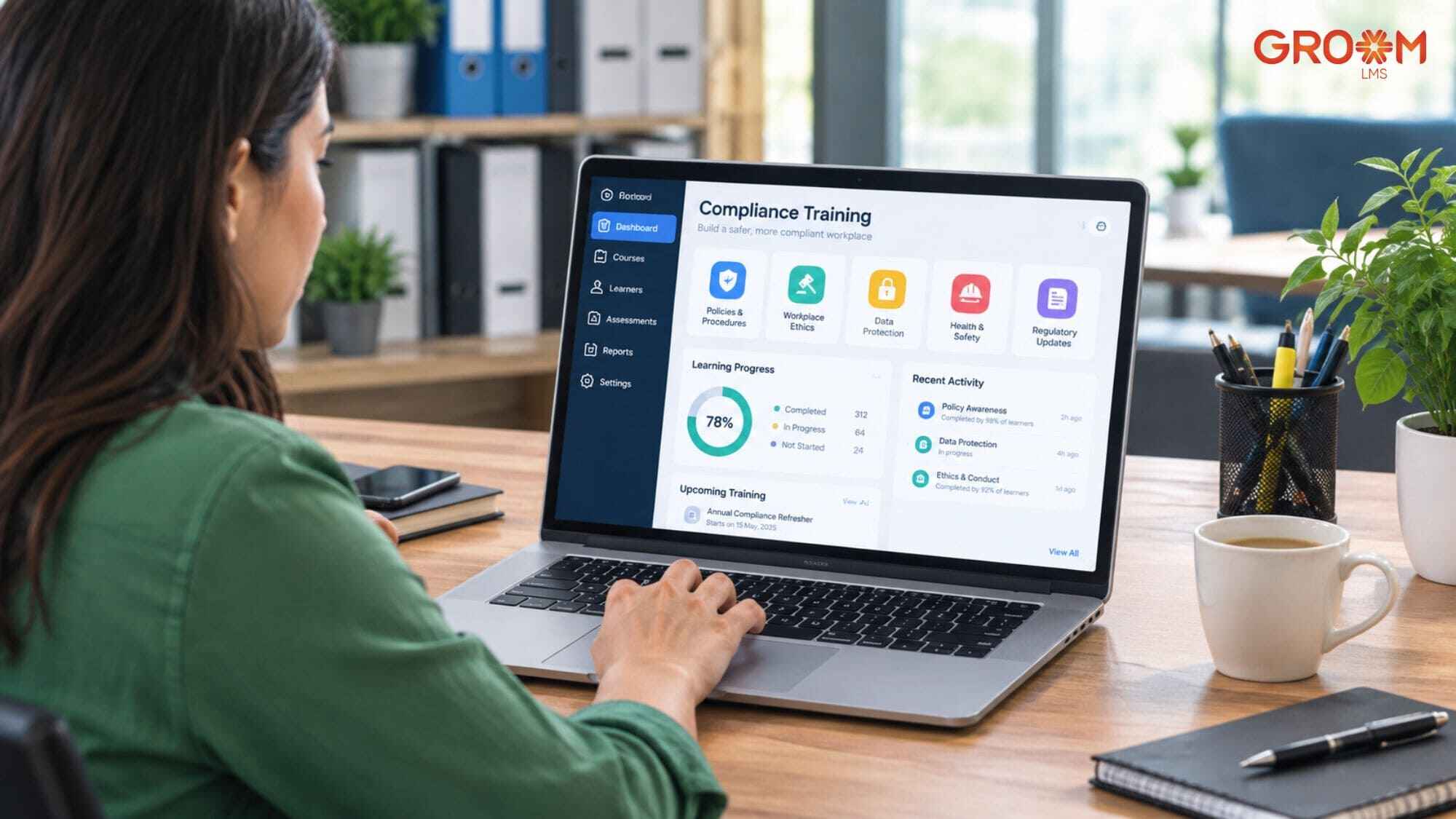
- Review reports and identify learning gaps.
This reduces dependence on spreadsheets and manual follow-ups.
GroomLMS supports course management, assessments, certifications, analytics, dashboards, multimedia learning, and virtual training. It can therefore provide the infrastructure needed to manage structured compliance learning alongside other employee development programmes.
Using SCORM and Other E-Learning Standards
Content compatibility also matters when organisations use existing e-learning materials.
SCORM, for example, provides a technical framework that allows e-learning content to communicate with an LMS and share information such as completion status, scores, and learner progress.
When selecting an LMS, check whether it supports the content standards used by your organisation.
This becomes particularly important when training teams already have a library of digital courses. Compatibility can reduce unnecessary redevelopment and make it easier to manage existing learning assets.
GroomLMS supports SCORM and xAPI as part of its digital learning capabilities.
Measuring the Effectiveness of Compliance E-Learning
Completion is useful, but it should not be the only measure.
A learner completing a course does not necessarily mean they understood the content or can apply it correctly.
Instead, consider several indicators, such as:
- Course completion
- Assessment performance
- Certification generation and status
- Learner feedback
- Participation patterns
- Knowledge retention
- Repeat training requirements
You can also use scenario-based assessments to test whether employees can make appropriate decisions.
For example, instead of asking employees to define a reporting procedure, present a workplace situation and ask them to select the correct response.
This provides more meaningful information about practical understanding.
How GroomLMS Can Support Regulatory Compliance E-Learning
Regulatory compliance e-learning content works best when content development and learning management work together.
GroomLMS provides a central environment for organisations to create, manage, deliver, assess, and monitor digital learning programmes. Its capabilities include courses, assessments, certifications, analytics, dashboards, multimedia learning, and virtual training.
This can help L&D and compliance teams organise regulatory training without relying on disconnected tools for every activity.
Organisations can also manage their learning environment independently, which can reduce the need for continuous technical support.
As compliance requirements and workforce needs grow, the same learning environment can support additional employee training programmes.
The result is a more structured approach where regulatory learning becomes part of an ongoing employee development strategy rather than an isolated annual activity.
Best Practices for Better Regulatory Compliance E-Learning
Before launching a compliance course, review the content from both a regulatory and learning perspective.
Keep these practices in mind:
- Use accurate and approved source information.
- Define specific learning objectives.
- Keep explanations concise.
- Use examples relevant to employee roles.
- Include realistic scenarios.
- Add meaningful assessments.
- Make courses accessible across relevant devices.
- Review content regularly.
- Track learning activity and assessment results.
- Use an LMS to centralise training management.
Most importantly, ask one practical question throughout development:
“What should the employee do differently after completing this training?”
That question helps keep the course focused on behaviour instead of information overload.
Conclusion
Regulatory compliance e-learning content can make employee training more practical, consistent, and manageable. However, effective compliance learning requires more than converting a policy document into an online course.
The strongest programmes combine accurate regulatory information with clear learning objectives, simple explanations, realistic scenarios, interactive activities, assessments, and regular content reviews.
An LMS then provides the operational foundation for delivering and managing that learning. It can help teams assign training, monitor progress, manage assessments, maintain certifications, and review learning data from a central environment.
For L&D, HR, and compliance teams, this approach can reduce repetitive administrative work while creating a clearer learning experience for employees.
GroomLMS supports regulatory compliance e-learning through capabilities for digital courses, assessments, certifications, analytics, dashboards, multimedia learning, and scalable training management.
Ultimately, the purpose of compliance training is not simply to mark a course as complete. It is to help employees understand their responsibilities and apply them correctly when real workplace situations arise.
Simplify Regulatory Compliance Training with GroomLMS
Deliver engaging compliance learning, track employee progress, and manage regulatory training more efficiently with GroomLMS.
Contact Us | Join GroomLMS | Chat on WhatsApp
Frequently Asked Questions (FAQs)
What is regulatory compliance e-learning content?
Regulatory compliance e-learning content is digital training that teaches employees about applicable regulations, organizational policies, industry standards, and workplace compliance requirements.
How does an LMS help with compliance training?
An LMS centralizes compliance courses, learner assignments, assessments, completion tracking, certifications, and reports. Therefore, organizations can manage training more efficiently.
Can compliance training be automated?
Yes. An LMS can automate tasks such as course assignments, notifications, reminders, progress tracking, and completion reporting. This reduces repetitive administrative work.
Why is online compliance training useful for employees?
Online compliance training gives employees flexible access to learning. Additionally, organizations can provide consistent training across different departments, offices, and locations.
How can GroomLMS support compliance training?
GroomLMS supports digital courses, assessments, certifications, virtual training, dashboards, and scalable learning management. It can also support e-learning content development and instructional design.