Imagine a public health worker practicing an emergency response before facing the same situation in the real world.
Instead of only reading instructions or watching a video, the learner enters a simulated environment. They can observe symptoms, make decisions, communicate with patients, and respond to changing situations.
That is where VR for public health worker training can create an exciting opportunity in India.
Public health programs often involve workers spread across cities, villages, districts, and remote communities. Therefore, delivering consistent practical training can become difficult. Travel, trainer availability, infrastructure, and scheduling can slow down traditional programs.
Virtual reality can help address some of these challenges. However, VR works best when it becomes part of a broader digital learning strategy.
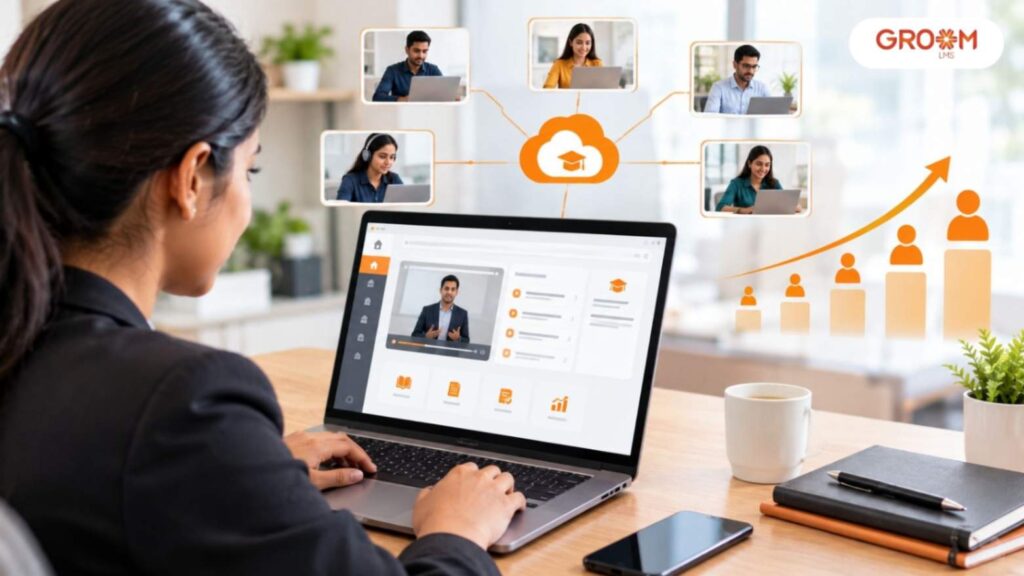
This is where an LMS can play an important role. With a platform such as GroomLMS, organizations can combine digital courses, assessments, certifications, learner tracking, and training workflows in one environment.
So, how can India use VR to strengthen public health worker training?
Why Public Health Worker Training Needs New Approaches
Public health workers deal with real-world situations that require knowledge, communication, judgment, and practical skills.
Traditional training methods still have value. However, they may not always provide enough opportunities for hands-on practice.
For example, a training program may teach workers how to:
- Respond to health emergencies
- Communicate with patients
- Follow safety procedures
- Identify potential health risks
- Educate communities
- Handle basic medical equipment
- Follow public health protocols
A classroom session can explain these processes.
However, immersive learning can allow workers to practice decision-making in simulated situations.
As a result, training can become more engaging and experience-focused.
What Is VR for Public Health Worker Training?
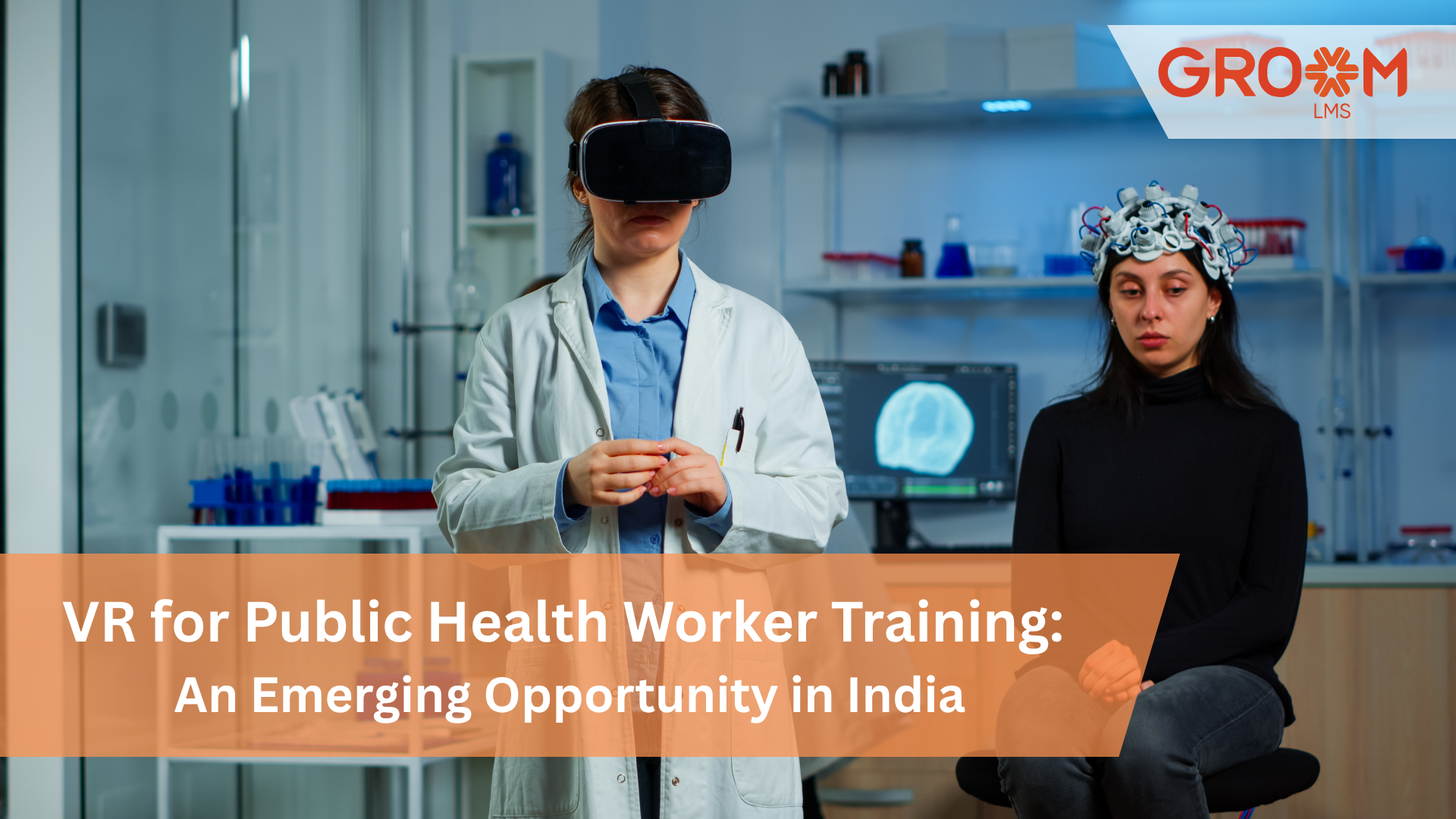
VR for public health worker training uses virtual reality technology to create simulated learning environments.
Learners can use VR devices to interact with virtual scenarios. These scenarios can replicate situations that may be difficult, expensive, or risky to reproduce physically.
For example, a training module could simulate:
- A community health visit.
- An emergency response situation.
- A disease outbreak scenario.
- A patient communication exercise.
- A healthcare facility environment.
- A vaccination or safety procedure.
The learner then performs tasks within the simulation.
More importantly, organizations can design scenarios around specific learning objectives.
Why VR Could Be Valuable in India
India has a large and diverse healthcare ecosystem.
Public health workers may operate in urban centers, rural communities, remote regions, and areas with limited training infrastructure.
Therefore, scalable digital training can offer several advantages.
1. Consistent Training Experiences
Different trainers may explain the same topic differently.
VR can provide standardized scenarios. Consequently, learners can receive a consistent practical experience.
This becomes particularly useful for large training programs.
2. Practical Learning Without Real-World Risk
Some situations are difficult to recreate safely during conventional training.
VR allows learners to practice without putting patients or communities at risk.
For example, an emergency response simulation can let learners make decisions repeatedly.
3. Better Learner Engagement
Long presentations can become difficult to follow.
Immersive learning encourages learners to interact with their environment.
Therefore, VR can make certain training experiences more memorable and engaging.
4. Repeatable Practice
Learners do not always understand a practical process on their first attempt.
With simulation-based learning, they can repeat scenarios.
This creates opportunities to learn from mistakes and improve performance.
5. Training Across Locations
Organizations can combine VR experiences with online learning.
For example:
Online course → VR simulation → Assessment → Certification
This model can create a more structured learning journey.
Where Can VR Be Used in Public Health Training?
VR does not need to replace every training method.
Instead, organizations can use it where immersive practice provides clear value.
Emergency Response Training
Learners can practice responding to simulated emergencies.
The scenario can change based on their decisions. Thus, they learn how different actions can affect outcomes.
Patient Communication
Communication is an important part of public health work.
VR can simulate conversations with different patient profiles.
For instance, learners could practice explaining preventive healthcare measures to a concerned community member.
Infection Prevention
Training programs can use simulations to demonstrate correct safety procedures.
Learners can identify mistakes and practice the correct workflow.
Community Health Scenarios
A virtual community environment can simulate household visits, awareness campaigns, or health assessments.
This can help learners prepare before entering the field.
Equipment and Procedure Training
VR can also support training around equipment handling and procedural workflows.
The exact use case depends on the learning objective and available technology.
VR Alone Is Not Enough
VR can create an immersive experience.
However, organizations still need a system to manage the complete training program.
This is where an LMS becomes valuable.
A learning management system can connect the different stages of training.
For example:
- Course Assignment
- Online Learning
- VR Practice
- Assessment
- Certification
- Performance Tracking
Instead of managing these activities separately, organizations can create a structured learning ecosystem.
How an LMS Can Support VR-Based Training
An LMS can become the central management layer around immersive learning.
Course Management
Training teams can organize learning content into structured programs.
For example:
- Introduction to public health
- Safety procedures
- VR emergency simulation
- Assessment
- Certification
Learner Tracking
Training managers can monitor participation and completion.
This becomes especially important when hundreds or thousands of workers participate in a program.
Assessments
After completing a VR activity, learners can take an online assessment.
Organizations can use the results to identify knowledge gaps.
Certifications
Once learners complete required modules and assessments, organizations can issue digital certifications.
This creates a clear record of training completion.
Analytics and Reporting
Training teams can analyze learner progress and identify areas requiring additional support.
Consequently, decisions can become more data-driven.
A Practical VR Training Workflow for India
Consider a public health organization training 500 workers across multiple districts.
Instead of conducting repeated classroom sessions, it could create a blended program.
Step 1: Assign the Program
Workers receive the training through an LMS.
Step 2: Complete Foundation Content
Learners study short videos, reading materials, and interactive modules.
Step 3: Complete VR Scenarios
Selected learners participate in relevant VR simulations.
Step 4: Take Assessments
Learners complete quizzes or scenario-based assessments.
Step 5: Review Performance
Training managers analyze completion and assessment data.
Step 6: Provide Certification
Successful learners receive certification.
Step 7: Continue Learning
Organizations can assign refresher courses and follow-up training.
This approach makes training more structured and easier to scale.
How GroomLMS Can Support the Learning Ecosystem
VR technology handles the immersive experience.
However, organizations need a reliable platform to manage the surrounding learning journey.
GroomLMS provides a scalable LMS environment where organizations can manage digital learning programs, assessments, certifications, and learner activities.
Organizations can create a GroomLMS instance online within seconds. They can also manage subscriptions independently without continuous technical dependency.
For public health training programs, this can help teams organize:
- Digital courses
- Assessments
- Certifications
- Learning workflows
- Training content
- Learner progress
- Reporting and analytics
- Mobile learning
- Gamified learning experiences
The goal is not simply to add technology.
Instead, the goal is to create a simpler and more scalable training system.
Challenges Organizations Should Consider
Although VR has potential, organizations should plan carefully.
Cost and Infrastructure
VR devices and supporting infrastructure require investment.
Therefore, organizations should first identify high-value training scenarios.
Digital Accessibility
Not every learner may have equal access to VR equipment.
A blended approach can help.
Organizations can combine VR with:
- Mobile learning
- Online courses
- Videos
- Assessments
- Instructor-led sessions
Content Development
High-quality VR scenarios require thoughtful instructional design.
The technology should support the learning objective rather than become the objective itself.
Trainer Preparation
Trainers may need guidance on integrating VR into existing programs.
Therefore, implementation should include appropriate onboarding and support.
Best Practices for Implementing VR Training
Organizations exploring VR for public health worker training can start with a focused strategy.
Start With One High-Value Scenario
Do not attempt to convert the entire curriculum into VR immediately.
Select one scenario where simulation can provide meaningful benefits.
Combine VR With an LMS
Use VR for immersive practice and an LMS for course management, assessments, reporting, and certification.
Keep Scenarios Realistic
Training scenarios should reflect situations learners may actually encounter.
Measure Learning Outcomes
Track more than participation.
Consider measuring:
- Assessment scores
- Completion rates
- Scenario performance
- Certification rates
- Knowledge improvement
- Learner feedback
Scale After Testing
Start with a pilot group.
Then use the results to improve the program before expanding it.
The Future of Immersive Healthcare Training in India
India’s growing digital ecosystem creates opportunities for new approaches to workforce development.
VR can make training more experiential.
LMS platforms can make training more organized and scalable.
Together, these technologies can create a powerful learning ecosystem.
For example, future programs could combine VR with artificial intelligence, analytics, mobile learning, gamification, and personalized learning pathways.
However, successful implementation will depend on one key principle:
Technology should solve a training problem, not simply add another tool.
Organizations that focus on learner needs and measurable outcomes will be better positioned to benefit from immersive learning.
Conclusion
VR for public health worker training represents an emerging opportunity to make practical learning more immersive, repeatable, and engaging in India.
However, VR should not operate as a standalone solution. Organizations also need a structured system for managing courses, assessments, certifications, learner progress, and ongoing development.
An LMS can provide that foundation.
With GroomLMS, organizations can independently create and manage scalable digital learning programs while reducing unnecessary technical complexity. Teams can combine online learning, assessments, certifications, analytics, and other learning experiences within a centralized platform.
The future of public health training may not be about choosing between traditional learning and technology.
Instead, it may be about combining the right technologies to create more accessible, practical, and scalable learning experiences.
Transform Your Corporate Learning with GroomLMS
Discover how GroomLMS empowers your organization to streamline training, enhance learner engagement, and deliver impactful learning experiences with an AI-powered LMS built for growth.
Request a Personalized Demo | Schedule a Consultation | Chat with Our Team
Frequently Asked Question(FAQs)
What is VR for public health worker training?
VR for public health worker training uses virtual reality simulations to help healthcare and public health workers practice realistic situations in a controlled environment.
How can VR improve healthcare worker training?
VR can provide immersive practice, repeatable scenarios, and realistic simulations. It can also help learners develop decision-making and practical skills.
Can an LMS support VR-based healthcare training?
Yes. An LMS can manage the learning activities surrounding VR, including courses, assessments, learner tracking, certifications, and reporting.
Is VR suitable for large public health training programs?
VR can support large programs when organizations use a scalable implementation strategy. A blended approach can combine VR with online courses and mobile learning.
How can GroomLMS support healthcare training?
GroomLMS can help organizations manage digital courses, assessments, certifications, learning workflows, analytics, and scalable training programs from a centralized platform.