Employee onboarding is more than introducing a new hire to the organization. It is the process of helping employees understand their role, workplace culture, policies, tools, responsibilities, and expectations. A well-structured onboarding experience can help employees become familiar with their organization faster while creating a consistent foundation for future learning and development.
Traditional onboarding often involves presentations, documents, emails, classroom sessions, and manual follow-ups. As organizations hire employees across different departments and locations, managing these activities consistently can become increasingly difficult. HR and L&D teams need a way to organize onboarding content, assign role-specific training, monitor progress, and ensure that new employees complete important learning activities.
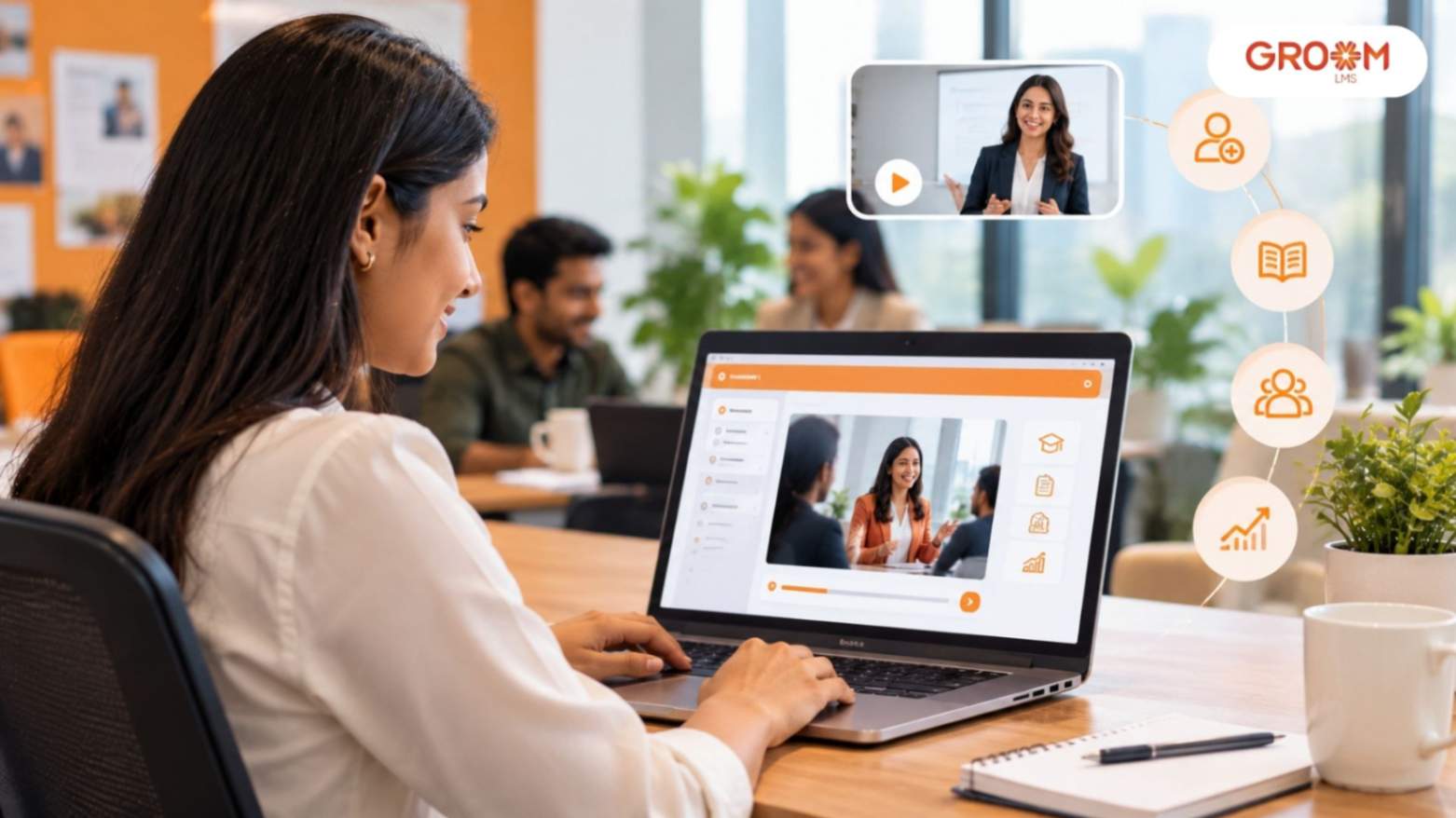
Choosing the best LMS for onboarding new employees can help organizations bring these activities into one centralized learning environment. GroomLMS supports onboarding through role-based learning paths, onboarding programs, self-paced learning, assessments, progress tracking, analytics, and customizable training paths. Its Learning Journeys can also help organizations create structured learning experiences based on roles, departments, and skill requirements.
What Is an LMS for Employee Onboarding?
A Learning Management System for employee onboarding is a digital platform that helps organizations deliver, organize, assign, and track training for new employees.
Instead of providing new hires with a collection of disconnected documents and training links, an LMS can bring onboarding content into a structured learning journey.
A typical onboarding program may include:
- Company introduction
- Organizational policies
- Code of conduct
- Workplace compliance
- Role-specific training
- Product or service knowledge
- Technology and system training
- Cybersecurity awareness
- Department procedures
- Assessments and knowledge checks
- Certification programs
The exact structure depends on the employee’s role and the organization’s requirements.
Why Is a Structured Onboarding Process Important?
The first few weeks of employment can influence how quickly new employees understand their responsibilities and become comfortable with the organization.
Without a structured process, important information may be delivered inconsistently. One employee may receive extensive guidance, while another may miss important training because of scheduling limitations or administrative delays.
A digital onboarding program creates greater consistency.
Employees can receive a defined learning path that explains what they need to learn and when they need to complete it. Meanwhile, HR and L&D teams can monitor progress and identify employees who may require additional support.
“Effective onboarding is not simply about welcoming new employees; it is about giving them the knowledge, confidence, and direction needed to contribute effectively.”
Challenges of Traditional Employee Onboarding
Organizations often face several challenges when onboarding employees manually.
Too Much Administrative Work
HR teams may need to send training materials, create accounts, schedule sessions, maintain attendance records, and follow up with employees individually.
Inconsistent Training
Different managers or trainers may deliver the same information differently, resulting in inconsistent onboarding experiences.
Difficult Progress Tracking
Spreadsheets and manual records can make it difficult to determine which employees have completed mandatory training.
Delayed Learning
New employees may have to wait for scheduled sessions before they can access important training.
Limited Personalization
Different roles require different knowledge. Providing every employee with exactly the same onboarding content may not be the most effective approach.
Multiple Locations
Organizations with distributed teams need a way to provide consistent onboarding regardless of where employees work.
What Should the Best LMS for Onboarding New Employees Offer?
Not every LMS is equally suited to employee onboarding. Organizations should evaluate platforms based on the features that directly support the employee lifecycle.
Role-Based Learning Paths
New employees should receive training relevant to their responsibilities.
For example, a sales employee may need product knowledge, CRM training, sales processes, and customer communication. An HR employee may require HR policies, employee systems, compliance, and organizational procedures.
Role-based learning paths can make onboarding more relevant and reduce unnecessary content.
Self-Paced Learning
New hires do not always learn at the same speed. Self-paced learning allows employees to access training within defined timelines while giving them greater flexibility.
Assessments and Quizzes
Knowledge checks can help organizations determine whether employees understand important onboarding content.
Assessments can cover company policies, product knowledge, workplace procedures, cybersecurity, compliance, and role-specific topics.
Progress Tracking
Managers and L&D teams need visibility into onboarding progress.
An LMS can help track course completion, learning activity, assessment performance, and certification status.
Certifications
Some onboarding programs require employees to complete mandatory training before they begin specific responsibilities. Digital certificates can provide a record of successful completion where appropriate.
Analytics and Reporting
Reports can help HR and L&D teams identify completed, pending, or overdue training and understand how employees are progressing through onboarding.
How an LMS Can Improve the Employee Onboarding Journey
A digital onboarding process can be organized into several stages.
Before the First Day
Employees can receive introductory information, welcome content, basic policies, and initial learning resources.
First Week
The organization can introduce company culture, workplace expectations, systems, compliance requirements, and role responsibilities.
First Month
New employees can move into deeper role-specific training, product knowledge, process learning, and assessments.
Ongoing Development
Once initial onboarding is complete, employees can transition into upskilling, compliance refreshers, leadership development, and other learning programs.
This creates a connection between onboarding and continuous employee development instead of treating onboarding as a one-time activity.
Key Benefits of Using an LMS for New Employee Onboarding
1. Faster Training Deployment
An LMS allows organizations to organize onboarding courses in advance and make them available to new employees when required.
2. Consistent Employee Experience
Every new employee can receive the core onboarding information required for their role and department.
3. Reduced Administrative Work
Automated assignments, learning paths, progress tracking, and reporting can reduce repetitive administrative tasks.
4. Better Learning Visibility
HR and L&D teams can see how employees are progressing instead of relying entirely on manual follow-ups.
5. Scalable Onboarding
Whether an organization hires a few employees or expands rapidly, a digital learning platform can provide a more repeatable onboarding process.
6. Improved Learner Engagement
Interactive content, assessments, multimedia, and structured learning journeys can make onboarding more engaging than a collection of documents.
7. Easier Compliance Tracking
Mandatory policies and compliance courses can be included within employee onboarding programs and monitored through the LMS.
How GroomLMS Supports Employee Onboarding
GroomLMS provides features specifically relevant to structured employee learning, including onboarding programs, role-based learning paths, skill development courses, self-paced learning, blended learning, feedback mechanisms, and customizable training paths.
Its Learning Journeys feature allows organizations to create guided learning experiences based on specific roles, departments, or skill requirements. These journeys can also provide progress tracking and help organizations maintain consistency across learners.
This can make GroomLMS useful for organizations that want to move beyond basic course delivery and create a more organized onboarding experience.
GroomLMS Features That Make Onboarding Easier
Learning Journeys
Organizations can structure onboarding into guided learning experiences rather than assigning individual courses manually.
Course Management
HR and L&D teams can organize onboarding content and create structured course libraries.
Assessments
Knowledge checks and assessments can help verify whether new employees understand important training material.
Analytics and Reporting
Administrators can monitor course completion, learner progress, assessment performance, and other training indicators.
Automated Certifications
Where certification is required, GroomLMS supports automated certificate functionality for completed learning.
HRMS Integration
GroomLMS can integrate with HRMS platforms to synchronize employee information and support role-based course assignment. This can help connect employee data with onboarding and learning processes while reducing manual data entry.
Example of a GroomLMS Onboarding Learning Path
Consider a company onboarding a new sales executive.
Instead of giving the employee a large collection of documents, the organization could create a structured learning journey:
Module 1: Welcome to the Organization
Module 2: Company Culture and Values
Module 3: Workplace Policies
Module 4: Compliance and Code of Conduct
Module 5: Product Knowledge
Module 6: CRM Training
Module 7: Sales Process
Module 8: Customer Communication
Module 9: Assessment
Module 10: Onboarding Certification
This approach gives the employee a clear learning sequence while giving managers visibility into progress.
LMS Onboarding vs Traditional Onboarding
| Factor | Traditional Onboarding | LMS-Based Onboarding |
|---|---|---|
| Training delivery | Often classroom or manual | Digital and structured |
| Progress tracking | Spreadsheets/manual follow-up | Centralized tracking |
| Content access | Documents and sessions | Central learning environment |
| Personalization | Often limited | Role-based learning paths |
| Assessments | Separate or manual | Built into learning process |
| Certifications | Manual records | Digital certification |
| Reporting | Time-consuming | Automated reports and dashboards |
| Scalability | Can become difficult | Easier to scale |
| Learning continuity | Often ends after orientation | Can continue into employee development |
How to Choose the Best LMS for Onboarding New Employees
Organizations should evaluate an LMS according to their onboarding objectives rather than choosing a platform based only on the number of features.
Define Your Onboarding Requirements
Identify the information and skills employees need during their first days, weeks, and months.
Consider Different Employee Roles
Determine whether different departments require different onboarding paths.
Evaluate Content Options
Check whether the LMS supports videos, documents, interactive content, assessments, SCORM, and other formats required by your organization.
Review Reporting Capabilities
Make sure administrators can monitor completion, assessment performance, certifications, and overdue learning.
Test the Learner Experience
New employees should be able to navigate the platform easily without extensive technical assistance.
Consider Integration
If employee information is already maintained in an HRMS, check whether the LMS can integrate with existing systems.
Think About Long-Term Learning
The best onboarding platform should ideally support more than the first few weeks. It should be capable of supporting compliance, upskilling, professional development, and continuous learning.
Best Practices for Digital Employee Onboarding
Keep Onboarding Structured
Give employees a clear learning sequence rather than presenting everything at once.
Keep Content Relevant
Focus on information that employees actually need to perform their roles effectively.
Combine Different Learning Formats
Use videos, presentations, scenarios, quizzes, assessments, and other formats where they improve understanding.
Include Practical Training
New employees should learn how policies and procedures apply to real workplace situations.
Set Completion Expectations
Clearly communicate deadlines for mandatory onboarding courses.
Monitor Progress
Use analytics to identify employees who may need additional guidance.
Continue Learning Beyond Orientation
Onboarding should be the beginning of employee development rather than the end of training.
Measuring Onboarding Success
An LMS can provide useful data for evaluating the effectiveness of an onboarding program.
Organizations can monitor:
- Onboarding completion rates
- Time taken to complete training
- Assessment performance
- Certification completion
- Course engagement
- Role-specific learning progress
- Compliance training completion
- Employee feedback
These metrics can help HR and L&D teams identify where onboarding content or processes need improvement.
The Future of Employee Onboarding
Employee onboarding is increasingly becoming a digital and continuous process. Organizations are moving toward personalized learning paths, automated workflows, skills-based development, analytics, and integrated HR and learning systems.
Artificial intelligence may also support onboarding through content recommendations, learning assistance, personalization, and administrative automation. However, organizations should maintain appropriate human oversight and ensure that onboarding information remains accurate and relevant.
The future of onboarding is therefore not simply about replacing orientation sessions with online courses. It is about creating a connected learning experience that supports employees throughout their transition into the organization.
Why GroomLMS Stands Out
The best LMS for onboarding new employees should make the process easier for both administrators and learners.
GroomLMS combines onboarding programs, role-based learning paths, assessments, certifications, progress tracking, analytics, and integrations within a centralized learning environment. Its platform is designed to support organizations from initial employee onboarding through continuous learning and development.
For HR and L&D teams, this means onboarding can become more structured and measurable. For employees, it creates a clearer path through the information, skills, and training they need to begin their journey within the organization.
Conclusion
Choosing the best LMS for onboarding new employees can help organizations create a more consistent, measurable, and scalable approach to new-hire training.
An effective LMS can bring onboarding content, learning paths, assessments, certifications, progress tracking, and reporting into one centralized environment. This can reduce administrative effort while giving new employees a clearer learning experience.
GroomLMS stands out by combining employee onboarding capabilities with broader learning management features. From role-based Learning Journeys and self-paced courses to assessments, analytics, certifications, and HRMS integration, the platform can support organizations as they build structured onboarding programs and continue employee development beyond the initial orientation period.
Make Employee Onboarding More Structured
Give new employees a clear path from their first day to confident participation in their roles.
Explore GroomLMS to build structured onboarding journeys, assign role-based training, track progress, and connect onboarding with continuous employee development.
Contact Us | Join GroomLMS | Chat on WhatsApp
Frequently Asked Questions (FAQs)
What is the best LMS for onboarding new employees?
The best LMS depends on an organization’s workforce size, onboarding requirements, content, integrations, reporting needs, and budget. A suitable platform should support structured learning paths, assessments, tracking, reporting, and role-based training.
How does an LMS improve employee onboarding?
An LMS centralizes onboarding content, automates course assignments, provides structured learning paths, tracks progress, supports assessments, and gives HR and L&D teams visibility into employee learning.
Can GroomLMS create role-based onboarding programs?
Yes. GroomLMS supports role-based learning paths and onboarding programs, allowing organizations to create learning experiences aligned with specific roles, departments, and skill requirements.
Can an LMS track new employee onboarding progress?
Yes. LMS platforms can track course completion, learner progress, assessments, certifications, and other training activities. GroomLMS provides progress tracking and analytics for employee learning programs.
Can onboarding include compliance training?
Yes. Organizations can include mandatory compliance courses, workplace policies, cybersecurity awareness, code of conduct, and other required learning within an employee onboarding path.