
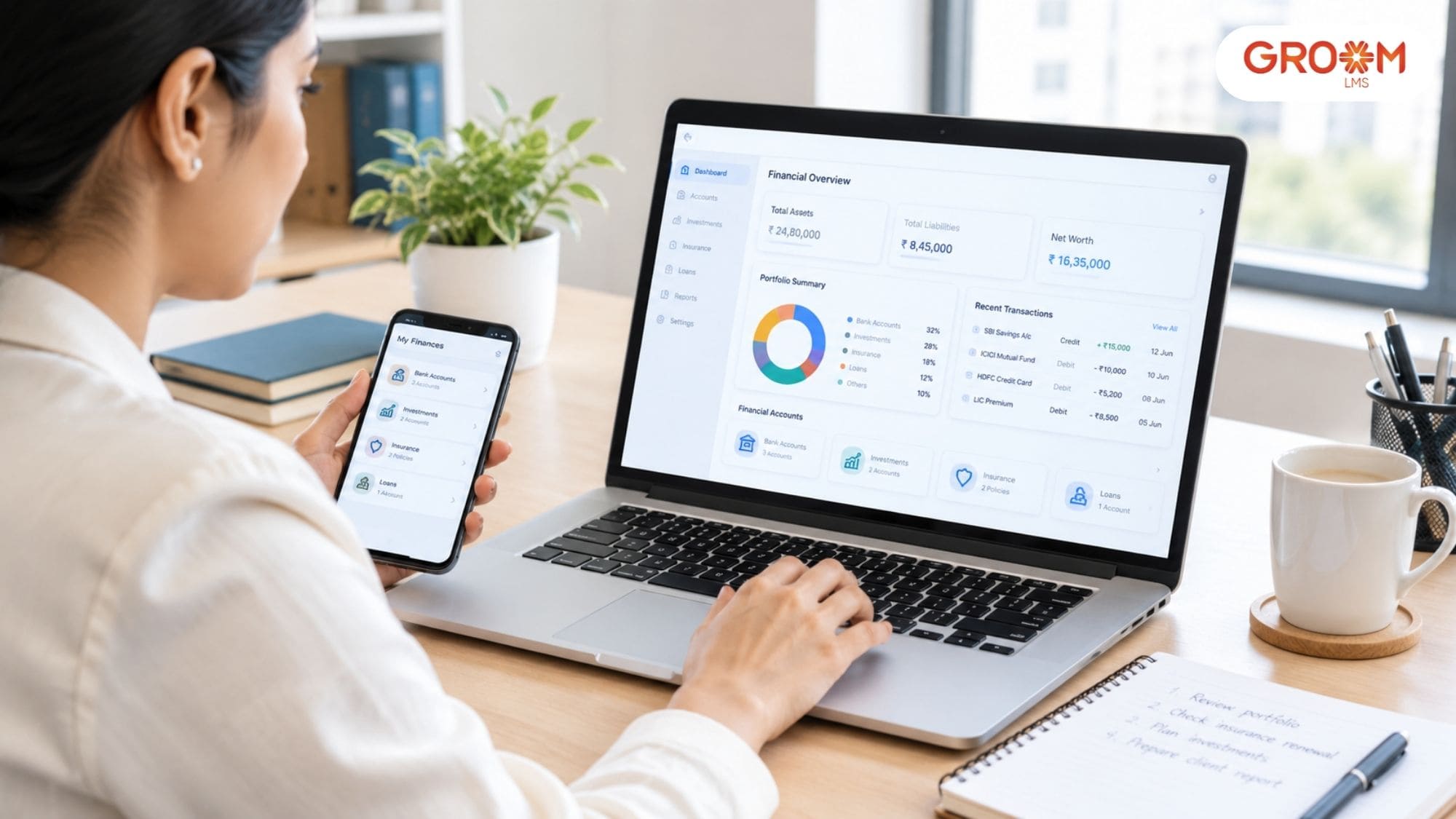
Imagine trying to understand a company’s entire financial position, but the information is scattered across five different dashboards.
One system holds bank data. Another contains investments. Insurance records sit somewhere else, while loans and transaction details live in yet another platform. The information is available, yet the complete picture remains frustratingly out of reach.
That is the problem financial aggregation software is designed to address.
By bringing relevant financial information from multiple sources into a more structured and accessible view, aggregation technology can reduce manual data collection and make financial analysis easier. For finance teams, this can mean less time switching between systems. For wealth managers and financial service providers, it can make it easier to understand a customer’s broader financial position.
India’s financial data ecosystem is also evolving through the Account Aggregator framework, which enables customers to share financial information with authorised institutions based on their consent.
But choosing the best financial aggregation software in India is not about finding the platform with the most features. The real question is whether it can fit your data sources, integrations, security requirements, reporting workflows, and business goals.
As organisations increasingly adopt digital platforms across functions, including learning and business operations, solutions such as GroomLMS also highlight the importance of choosing technology that is scalable, manageable, and aligned with real business needs.
So, what should you actually look for before investing in financial aggregation software? Let’s break it down.
What Is Financial Aggregation Software?
Financial aggregation software collects financial information from multiple sources and presents it through a centralised interface.
Depending on the use case, it can help organisations bring together information such as:
- Bank account data
- Investment information
- Insurance-related information
- Loan and credit information
- Transaction records
- Portfolio data
- Financial reports
The objective is simple: reduce fragmented information and create a more useful financial view.
For example, a wealth management team may need to understand a client’s assets across several financial institutions. Instead of reviewing separate records manually, an aggregation platform can help organise relevant information into one system.
However, financial aggregation is not the same as simply storing financial records.
A strong platform should also help users access, organise, analyse, and use information responsibly.
Why Businesses Struggle Without Financial Aggregation
Imagine a financial services team preparing a client review.
The client’s information is spread across several accounts. One employee downloads statements, another checks investment records, and someone else verifies insurance information. The team then combines everything into a report.
The process works, but it takes time and creates opportunities for errors.
This becomes more difficult as the number of customers and financial relationships increases.
Common challenges include:
- Data scattered across multiple institutions
- Repetitive manual data collection
- Inconsistent formats
- Difficult reconciliation
- Delayed reporting
- Limited visibility across financial products
- Greater dependence on spreadsheets
- Complex integration requirements
Financial aggregation software addresses this problem by creating a more structured way to access and work with financial information.
The value is not simply “having everything in one place.” The real value comes from making the information easier to access, understand, and use.
How Account Aggregators Fit Into Financial Data Aggregation in India
When researching financial aggregation software in India, it is important to understand the Account Aggregator framework.
An Account Aggregator acts as a consent manager between a Financial Information Provider and a Financial Information User. It enables financial information to move between participating institutions when the customer provides consent.
This distinction matters because organisations should not treat financial data aggregation as unrestricted data collection.
The Account Aggregator ecosystem is built around consent and user control. Customers can approve, decline, and, where applicable, revoke data-sharing requests.
The ecosystem has also expanded significantly. Sahamati reported in September 2026 that the Account Aggregator network had crossed 500 million fulfilled consents, with more than 1,100 regulated entities live on the ecosystem.
For businesses evaluating aggregation technology, this makes consent management, security, interoperability, and regulatory alignment important evaluation criteria.
Key Features to Look for in the Best Financial Aggregation Software in India
Not every financial aggregation platform will suit every organisation. Before choosing one, evaluate the features against your actual workflow.
Secure Data Integration
The platform should support secure connections with relevant financial data sources.
Look at how it handles authentication, encryption, data transmission, access permissions, and system security.
Security should not be treated as an optional add-on when financial information is involved.
Consent Management
Consent is particularly important when the solution interacts with India’s Account Aggregator ecosystem.
Users should understand what information is being requested, why it is required, and how it will be used.
A strong consent workflow should also make permissions easy to track and manage.
Multiple Financial Data Sources
Your platform should support the financial sources relevant to your business.
Depending on the use case, this may include banks, investments, insurance, lending, or other regulated financial institutions.
Before purchasing, identify the sources your organisation actually needs rather than choosing based on a generic integration count.
Centralised Dashboard
A dashboard should turn fragmented information into something people can understand quickly.
Useful dashboards may provide:
- Consolidated financial views
- Account-level information
- Portfolio summaries
- Transaction information
- Reports and analytics
- Data-status indicators
The goal is to reduce the amount of manual searching required to understand financial information.
Reporting and Analytics
Aggregation becomes more useful when collected data can support decision-making.
Look for reporting capabilities that help users identify patterns, compare information, monitor portfolios, and prepare client or internal reports.
The right analytics will depend on whether the platform is used for wealth management, lending, insurance, accounting, or personal finance.
API and Integration Support
Financial organisations rarely operate with one software system.
Your aggregation platform may need to communicate with CRM systems, financial applications, customer portals, reporting tools, or internal databases.
API support therefore deserves careful attention during evaluation.
Benefits of Using Financial Aggregation Software
The strongest reason to adopt financial aggregation software is not technology for its own sake. It is the reduction of unnecessary friction around financial information.
A well-designed platform can help organisations:
Reduce manual work: Automated data flows can reduce repetitive collection and reconciliation tasks.
Improve visibility: Decision-makers can work with a broader financial picture rather than isolated records.
Speed up processes: Faster access to relevant information can support quicker analysis and service delivery.
Reduce data-entry errors: Direct digital data flows can reduce dependence on manually entered information.
Improve customer experiences: Financial institutions can potentially reduce the amount of documentation customers need to repeatedly provide.
Support better decisions: Consolidated information can provide stronger context for financial analysis and recommendations.
Sahamati highlights similar advantages of the Account Aggregator framework, including faster access to information, reduced manual data entry, and real-time, verified financial information.
How to Choose the Right Financial Aggregation Software
Choosing the best financial aggregation software in India should start with your business requirements.
Use this process before signing a contract.
1. Define Your Primary Use Case
Start by asking what problem you are trying to solve.
Is the platform for wealth management, lending, insurance, personal finance, reporting, or another financial workflow?
A clear use case makes platform comparison much easier.
2. Map Your Data Sources
List every financial source you need to connect.
Then check whether the software supports those sources directly or through appropriate integrations.
3. Evaluate Security and Consent
Ask how the platform handles authentication, encryption, consent, access control, storage, and data deletion.
For Account Aggregator-related use cases, also understand whether the solution supports the required ecosystem processes.
Sahamati notes that regulated entities entering the AA ecosystem need appropriate API-driven technology and must follow the relevant specifications and onboarding requirements.
4. Check Integration Capabilities
Your aggregation platform should fit into your existing technology environment.
Review APIs, documentation, supported systems, implementation requirements, and integration timelines.
5. Test the User Experience
A technically powerful platform can still become a burden if employees cannot use it easily.
Ask for a demonstration or trial where possible.
Check how quickly users can find information, generate reports, manage permissions, and complete everyday tasks.
6. Consider Scalability
Your requirements today may not be the same two years from now.
Consider whether the platform can handle increasing customers, additional data sources, more users, higher reporting requirements, and new integrations.
Common Mistakes to Avoid When Buying Aggregation Software
Buying based only on the number of features can create problems later.
Avoid choosing a platform without checking:
- Actual integration requirements
- Data security practices
- Consent workflows
- Regulatory responsibilities
- API capabilities
- Reporting needs
- Implementation effort
- Customer support
- Scalability
- Total cost of ownership
Also, avoid assuming that every aggregation platform performs the same function.
Some solutions may focus on data connectivity, while others may add analytics, dashboards, portfolio management, reporting, or broader financial workflows.
The best option is therefore the one that solves your specific problem without adding unnecessary complexity.
Where GroomLMS Fits Into the Broader Digital Business Ecosystem
Financial organisations often need more than financial technology. Their employees also need structured training around financial products, compliance, processes, and internal workflows.
This is where GroomLMS can support the learning side of the operation.
GroomLMS provides a digital environment for organisations to create and manage courses, assessments, certifications, virtual training, analytics, and dashboards. Organisations can also create an LMS instance online and manage their learning environment without continuous technical dependency.
For a financial services organisation, this can provide a central place for employee onboarding, product training, compliance learning, and professional development.
The financial aggregation platform manages financial information. An LMS can manage the knowledge and training required to help teams work with that environment effectively.
What Makes Financial Aggregation Software “Best”?
There is no single platform that is automatically the best for every business.
The best financial aggregation software in India is the one that provides the right combination of:
- Relevant financial data connections
- Secure data handling
- Strong consent management
- Reliable integrations
- Useful dashboards
- Actionable reporting
- Practical analytics
- Scalability
- Usability
- Appropriate support
For a small organisation, simplicity may matter most. A larger financial institution may prioritise integrations, compliance processes, scalability, and advanced analytics.
Therefore, evaluate the software against your actual workflow rather than choosing based on marketing claims alone.
Conclusion
Financial information becomes difficult to manage when it is scattered across institutions, applications, spreadsheets, and disconnected workflows.
The right financial aggregation software can bring greater structure to this environment by helping organisations access relevant information, reduce manual work, improve visibility, and support faster financial processes.
However, choosing the best financial aggregation software in India requires more than comparing feature lists. Businesses should examine their use case, data sources, security requirements, consent workflows, integrations, reporting needs, user experience, and scalability before making a decision.
India’s Account Aggregator ecosystem also makes consent-based financial data sharing an important part of the conversation. As adoption grows, organisations need technology that can work responsibly within an increasingly connected financial environment.
For financial organisations, technology is only one part of the transformation. Employees also need the right knowledge to use new systems, follow processes, and maintain compliance. GroomLMS can support this learning layer through structured digital training, assessments, certifications, and analytics.
The strongest technology strategy connects better data with better processes and better-trained people.
Train Your Financial Teams with GroomLMS
Equip your financial teams with structured digital training, compliance learning, assessments, and certifications through GroomLMS. Help employees build the knowledge they need to work confidently with evolving financial systems and processes.
Contact Us | Join GroomLMS | Chat on WhatsApp
Frequently Asked Questions (FAQs)
What is financial aggregation software?
Financial aggregation software collects financial data from multiple systems, such as banks, accounting platforms, ERPs, and CRMs, into one centralized dashboard for easier reporting and analysis.
Why is financial aggregation important for broker operations?
It reduces manual work, improves reporting accuracy, provides real-time financial visibility, supports regulatory compliance, and helps brokers make faster decisions.
What features should I look for in the best financial aggregation software in India?
Look for secure integrations, automated data synchronization, customizable dashboards, real-time reporting, advanced analytics, compliance support, and scalability.
How does GroomLMS support financial automation?
GroomLMS enables organizations to create, manage, automate, and track training programs for financial software, compliance, onboarding, and operational workflows, helping employees adopt new systems more efficiently.
How does employee training improve the success of financial automation?
Well-trained employees use financial tools more effectively, reduce reporting errors, follow standardized processes, adapt to system updates quickly, and maximize the return on technology investments.